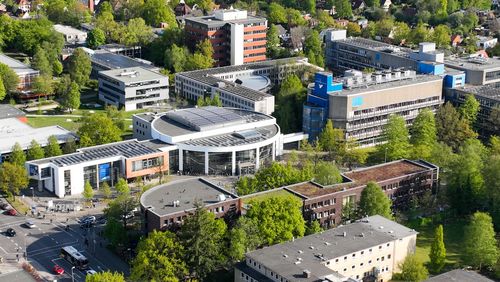


On Tuesday evening, the University and the University Society (UGO) celebrated the 50th anniversary of the University of Oldenburg and the start of the anniversary year with numerous guests from the worlds of science, politics, business and culture. The evening centred on the importance of the university - for research, the training of qualified specialists and knowledge transfer in the city and region. It also offered a look back at the early days of university teaching and the development of the university over the past decades.
"Congratulations on the 50th anniversary of the University of Oldenburg, which is also my alma mater. Its influence on education, research and social engagement has sustainably enriched our city and made it a centre of innovation, cultural diversity and economic success in north-west Lower Saxony. It was the best thing that could have happened to Oldenburg, and as President of the State Parliament, I am particularly proud that it has been committed to a strong, democratic and enlightened society from the very beginning," said State Parliament President Hanna Naber, paying tribute to the University of Oldenburg.
Lower Saxony's Science Minister Falko Mohrs was also among the guests. "For 50 years to the day, the University of Oldenburg has been a driving force in the north-west region of Lower Saxony. It assumes social responsibility and develops responsible solutions for the major issues of our time through national and international high-level research, teaching and transfer. I am confident and hope that the university will continue on this path with courage for the next 50 years," he said.
Lord Mayor Jürgen Krogmann emphasised the importance of the university for the city's society. "Its foundation was a milestone for our city. Without it, Oldenburg would not have become the modern, dynamic and liveable city that we value so highly today," he said. The development of the city is closely linked to the growth of the university. Both sides had benefited from each other - creating a stable basis for a good and successful future. "I look forward to everything that is yet to come and to the path we will continue to take together."
Guests who were unable to attend in person sent their greetings via video message, including Lower Saxony's Minister President Stephan Weil. Prof Dr Jouke de Vries, President of the Rijksuniversiteit Groningen (Netherlands) and Prof Sibongile Muthwa, Vice-Chancellor of Nelson Mandela University (South Africa), sent their congratulations on behalf of the partner universities. Nobel laureate in physics and honorary doctor Prof. Dr Dr h. c. mult. Klaus von Klitzing, Prof Dr Walter Rosenthal, Chair of the German Rectors' Conference, and Dr Heide Ahrens, former Vice President of the University of Oldenburg and current Secretary General of the German Research Foundation, also sent their congratulations.
Lecture on research ethics
The centrepiece of the evening was the lecture by Prof. Dr Alena Buyx, Chair of the German Ethics Council. Entitled "Between the end of the world and the promise of salvation", she spoke about current challenges in research ethics. "Science can ruin us, science will save us: the ethical and social consequences of scientific work have rarely been as obvious as they are today, from vaccinations to renewable energies, embryo structures to artificial intelligence," she said, outlining the variety of topics in which ethical issues are currently arising. She addressed how research can succeed in an ethically responsible manner and contribute to solving the major transformative issues of our time.
Buyx has been Chair of the German Ethics Council since 2020 and is Professor of Ethics in Medicine and Health Technologies and Director of the Institute of History and Ethics of Medicine at the Technical University of Munich. She works on the entire breadth of biomedical ethics and theory, from "classic" medical ethical issues from clinical practice to challenges posed by biotechnological innovation and medical research to ethical and justice issues in modern healthcare systems. She is a member of various committees - including being admitted to the German Academy of Sciences (Leopoldina) in 2020 - and regularly advises international research consortia.
Speech by the President
In his speech, University President Prof. Dr Ralph Bruder emphasised the University's research strength, which is visible both nationally and internationally thanks to its many top-class successes. The high level of professionalism in teacher training and transfer were further important criteria for the success of the University of Oldenburg. "But today we are also celebrating the many partnerships and friendships that began over these 50 years and have played their part in making the university what it is today: always open to new paths, networked in many parts of the world and particularly closely interwoven with the city and the region," said Bruder.
Prizes for outstanding academics
The University's research strength was also reflected in the presentation of this year's UGO awards, which were presented by UGO Chair Wiebke Schneidewind. Music teacher Prof Dr Mario Dunkel, children's and young adult literature expert Prof Dr Thomas Boyken and Prof Dr Antje Wulff, Junior Professor of Big Data in Medicine, were honoured for their excellent research. Chemist Dr Lars Mohrhusen and biologist Dr Jingjing Xu received the prize for outstanding doctorates. Health services researcher Prof. Dr Falk Hoffmann and ornithologist Prof. Dr Miriam Liedvogel were honoured for outstanding doctoral supervisors. The UGO Open Science Award went to the "Open Science Interest Group" of the Department of Psychology, for which psychologist Dr Cassie Short accepted the award.
The ceremony was accompanied by high-calibre music from several ensembles from the University's Institute of Music under the direction of Christian Kappe, Volker Schindel, Gereon Voß, Ursula Berger-Nashir and Nangialai Nashir. Members of "Schlagwerk Ossietzky" led the guests from the foyer into the Audimax with lively rhythms. There, the big band presented an excerpt from the musical theatre piece "Jazz Stories" together with soloist Tabea Hensel. A student quintet with accordion, violins, guitar and double bass interpreted "Oblivion", a piece by Argentinian composer Astor Piazzolla. After the official part, the student band "Sway" played in the foyer of the lecture hall centre for dancing and a convivial end to the evening.