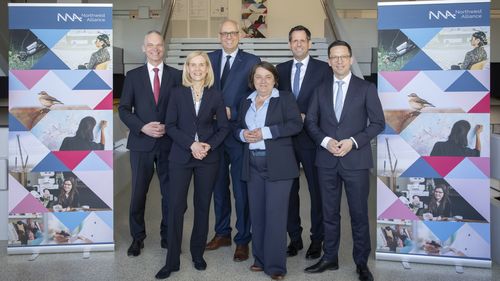



Continuing to be successful in the Excellence Strategy - possibly with three clusters of excellence funded by the federal and state governments in the future: that is the goal of the University of Oldenburg. Today, teams from animal navigation research, marine sciences and hearing research cleared another hurdle on the way to achieving this goal.
The researchers submitted three full proposals for clusters of excellence to the German Research Foundation (DFG) - detailed research concepts totalling more than 750 pages. They describe in detail the research teams' concerns, framework conditions and planned innovations for the seven-year funding phase starting in 2026, from when the Excellence Strategy will provide 539 million euros annually for up to 70 clusters of excellence nationwide. The federal government will contribute 75 per cent of this, with the respective Federal State contributing 25 per cent. The decision on who will receive funding will be made in May 2025.
"Another important step has been taken to further expand the special research strength of the University of Oldenburg," says President Prof Dr Ralph Bruder. "We have not yet reached our goal, but the commitment shown by all those involved in research and university administration up to this point is already excellent. This applies to all three teams, and it also applies to the extremely constructive and very good coordination with our closest partners in the follow-up applications - with the University of Bremen in terms of marine research and with the University and Hannover Medical School in terms of hearing research."
The researchers in the three planned clusters are focussing on very different topics: The NaviSense team wants to find out how animals navigate over long distances. The knowledge gained will also be channelled into new technical developments. The researchers are investigating the physical, biochemical and physiological processes on which animal navigation is based, as well as the senses that underlie these abilities. As the magnetic sense of birds is presumably based on a quantum effect, the focus is also on quantum mechanical phenomena. The team hopes to draw conclusions for animal ecology and nature conservation from the findings. The aim is also to develop models and algorithms for technical systems inspired by animal navigation - for example sensors or autonomous devices.
Oldenburg researchers have been involved as partners in the Ocean Floor cluster of excellence ("The ocean floor - unexplored interface of the earth") at the University of Bremen since 2019. The universities of Oldenburg and Bremen are jointly applying for the continuation of the project. The project focuses on the seabed - the largest habitat on Earth, but also one of the least researched. The aim of the researchers is to understand the role of the seabed for material cycles and biodiversity under changing climatic conditions. They are using the unique infrastructure and experience of both universities and their partners as well as new modelling and data science approaches. These should make it possible to estimate future environmental changes based on the geological past and the biogeochemistry and ecology of the present. This should provide the scientific basis for the protection and sustainable use of the oceans.
The cluster of excellence Hearing4all ("Hearing for All: Medicine, Basic Research and Technical Solutions for Personalised Hearing Support") is applying for a further funding period after two successful proposals. The University of Oldenburg, Hanover Medical School and the University of Hanover are involved. The partners aim to develop innovative solutions for the care of people with hearing impairments and thus sustainably improve the quality of life of those affected. The research team has made considerable progress over the past ten years. For example, it has been able to optimise the sound quality and speech intelligibility of hearing aids, integrate artificial intelligence (AI) into hearing aids and further develop cochlear implants. In the next funding phase, the researchers want to develop data-driven solutions for hearing aids, investigate the genetic causes of hearing loss with a view to new treatment options and shed light on social-communicative factors in hearing comprehension, among other things.
As a permanent federal and state funding programme, the Excellence Strategy consists of a further funding line: the Universities of Excellence. To be eligible to apply as a University of Excellence, a university must have at least two clusters of excellence of its own or be involved in at least three clusters as an applicant in university alliances. This funding line is intended to strengthen universities or university alliances and help expand their leading international position in research on the basis of several successful clusters of excellence. If the University of Oldenburg is successful with the clusters of excellence, it would also have the opportunity to apply for funding as a University of Excellence.