
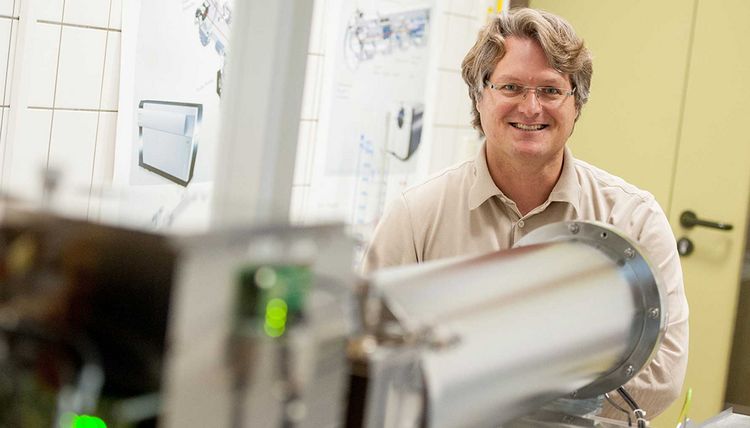

"Genomes are something like a blueprint for life," explains microbiologist Prof Dr Ralf Rabus.
But it is the proteomes, the totality of all proteins in a cell, that breathe life into them.
They are the focus of the new discipline of proteomics, which Rabus presents in the journal PROTEOMICS.
Proteomics is a rapidly developing field of research in the life sciences. It is now the subject of a special issue of the internationally renowned journal PROTEOMICS. "Environmental Microbial Proteomics" is the title of the issue, edited by Prof Dr Ralf Rabus, head of the General and Molecular Microbiology working group at the Institute of Chemistry and Biology of the Marine Environment (ICBM) at the University of Oldenburg.
In the journal, Rabus provides an overview of the diversity of proteomics technologies, bioinformatic approaches and possible applications in modern environmental microbiology. "Proteomics reveals the processes that are currently taking place in a cell, in an organism - it allows a completely new view of the active building blocks of life and can open up completely new perspectives, especially for the functional understanding of biodiversity and environmental processes," says the microbiologist.
Rabus collaborated with more than 70 scientists from eight countries for the special edition. The result is 16 peer-reviewed publications that shed light on the field of research at the intersection of microbiology, ecology and biogeochemistry.
Over the last two decades, microbiologists and (bio)-geochemists have worked out the central role of microorganisms in global material cycles. For example, they have investigated the contribution of marine bacteria to the degradation of algal blooms and crude oil.
Rabu's special focus is on the corresponding enzymes that drive and influence the process as so-called biocatalysts. And this is where proteomics comes in: While genomes form something like a blueprint for life, it is the proteomes - i.e. the totality of all proteins in a cell - that bring the organism to life in the first place. "In contrast to the genome, the associated proteome is highly dynamic, as many proteins are only formed directly in response to specific environmental conditions," explains Rabus.
The microbiologist investigates the metabolic performance of bacteria, which are important for the material cycles in the world's oceans. In the laboratory, he and his team simulate environmentally relevant processes with the help of complex laboratory set-ups (fermenters) and analyse them using modern measuring instruments such as mass spectrometers. The scientists examine how the protein components of metabolic networks react to the addition of certain nutrients or oxygen. Rabus is thus gaining an insight into the global adaptation strategies of bacteria to changing environmental conditions.
More on the topic
General and molecular microbiology
Contact
Prof Dr Ralf Rabus
Institute of Chemistry and Biology of the Marine Environment
Tel: 0441-798/3884