


Why do some organic substances survive for many thousands of years in the sea? Geochemist Thorsten Dittmar and his team have been investigating this mysterious mixture for almost exactly ten years - and have now found an explanation for its longevity.
Whether wood, bone or asphalt: microbes are able to decompose even the toughest remnants of life sooner or later. In the long term, only inorganic forms of carbon such as graphite and diamond resist the appetite of unicellular organisms. Another exception is invisible and can be found in all seas and oceans worldwide: dissolved in the water is a mix of different organic substances with an average age of 5,000 years. Some substances are even 20,000 years old.
Although the concentration of these substances in seawater is tiny, when added up across all the oceans, the quantities are enormous: "The dissolved organic material forms one of the largest carbon reservoirs on Earth," explains Prof Dr Thorsten Dittmar. "There is more carbon dissolved in seawater than in all the world's forests combined." The geochemist has been on the trail of this mysterious mixture for a long time. Dittmar, who is one of the world's most cited interdisciplinary scientists according to the current "Highly Cited Researchers" ranking by Clarivate Analytics, heads the Marine Geochemistry research group at the Institute of Chemistry and Biology of the Marine Environment (ICBM). The working group has been based at the University of Oldenburg in co-operation with the Max Planck Institute for Marine Microbiology for ten years now. He and his team have made a significant contribution to clearing up some of the uncertainties surrounding the mysterious substances. Two questions in particular have been puzzling until now: What is the dissolved material made of? And why does it exist at all - and is it not quickly utilised by microbes like other organic substances?
Diverse mixture
According to the latest findings of the Oldenburg researchers, the answers to these questions appear to be connected. Dittmar and his colleagues cannot identify the individual substances down to the last detail. However, they have good reason to believe that the dissolved mixture is enormously diverse - and that this diversity is also responsible for its longevity.
Marine researchers have known for some time that the main source of the long-lasting mixture is bacteria and other unicellular organisms. When the unicellular organisms decompose biomass, they release metabolic products into the water. After their death, they also release organic residues. Experiments by the Oldenburg researchers have now shown that even a single species of bacteria can secrete an astonishing number of different substances. In one experiment, the team fed the species Dinoroseobacter shibae only with glucose. However, the microbes' excretions contained more than 3000 different substances, reported Dittmar together with Dr Jutta Niggemann and other colleagues from the "Roseobacter" Collaborative Research Centre at the ICBM in the journal Frontiers in Microbiology. The team showed that only a small fraction of this mixture consisted of substances that the bacteria can produce with their enzymes. The rest, the team surmises, is produced by errors in metabolism. "We were very surprised that bacteria have extremely diverse excretory products and thus contribute to the complexity of the organic mixture in the sea," says Dittmar.
Structural fingerprint
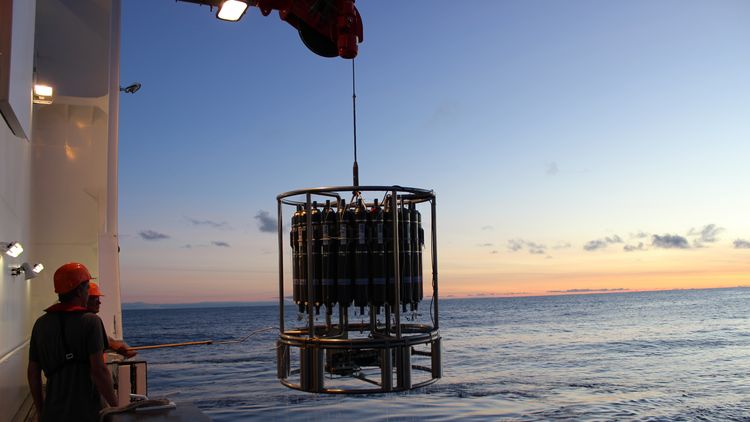
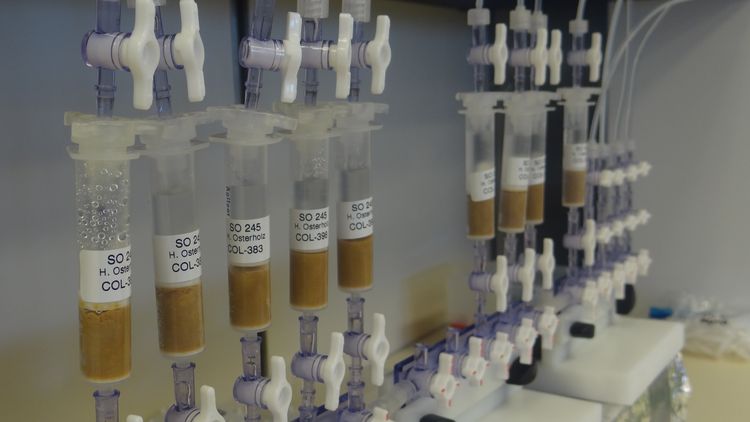
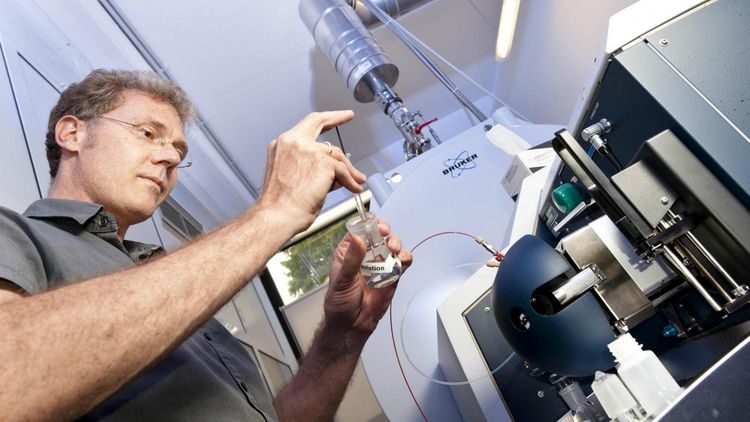
The geochemist and his colleagues analyse their samples with an extremely powerful measuring device, an ultra-high-resolution mass spectrometer. With this sensitive machine - the only one of its kind in the world used in marine research - the Oldenburg researchers can determine the sum formulae, i.e. the respective number of carbon, hydrogen, oxygen, nitrogen and other atoms that make up a molecule. In their water samples from all over the world, they have now identified organic substances with several tens of thousands of different molecular formulae. However, the total number of dissolved substances could be many times higher.
This is because each molecular formula can conceal hundreds or even thousands of substances with the same composition but a different structure. The properties of these so-called isomers often differ greatly from one another, as a look at well-known examples shows. For example, the molecular formula C₆H₁₂O₆ stands for around 45 different substances, including glucose and fructose, but also a messenger substance called inositol.
It is almost impossible to elucidate the different structures of the mixture in the sea in detail, but Dittmar's colleague Dr Maren Zark developed a method in her doctoral thesis that can be used to distinguish between different isomers. With the help of this "structural fingerprint", she has gained two interesting insights: Firstly, she showed that the dissolved organic material actually consists of countless substances with a wide variety of structures: there could be millions or even billions. And secondly, she discovered that this mixture consists of exactly half of the same substances in different places around the world - from the Atlantic Ocean to the North Sea and the Zwischenahner Meer. Apparently, identical degradation processes are at work in all waters, Zark and Dittmar reported in July 2018 in the journal Nature Communications.
Indigestible residues
This fact now makes it easier for Dittmar and his colleagues to answer the second question - that of the unusually long lifespan of the dissolved material. Many geochemists assume that it contains substances with a particularly stable structure that simply cannot be broken down by microbes. Dittmar, on the other hand, assumes that it is simply too difficult for the unicellular organisms to utilise the extremely diverse mixture. "The high number of different molecules in the sea slows down the degradation process so much that it takes several thousand years for the material to be converted," explains the Oldenburg researcher.
Strong evidence for this assumption does not come from microbiology - but from mathematics. In her doctorate, Oldenburg mathematician Dr Andrea Mentges developed a model to calculate the concentration and age of the dissolved organic material using well-known textbook knowledge from microbiology. For her simulation calculations, she needs the number of bacterial species present, the number of dissolved molecules and some formulae for the growth of microbes. The result was similar to measured values. "This means that microbes can indeed break down the dissolved material, but extremely slowly," says Dittmar.
Based on these results, his team, together with modellers from the group of Prof. Dr Bernd Blasius from the ICBM, will soon be tackling the question of how the dissolved organic material in the sea reacts to climate change. So far, nobody knows how the huge carbon reservoir will change with warmer temperatures. Even small fluctuations could have a huge impact on the global climate, Dittmar calculates: "If just one per cent of carbon were released into the atmosphere as CO₂ each year, this would roughly double human emissions." Conversely, global warming could - in theory - be mitigated if the amount of dissolved organic material in the sea increased.
However, there is currently no evidence of this.