

Five short paragraphs, three signatures, a model for success: this is how the first cooperation agreement between a university and the German Trade Union Confederation (DGB) in Germany, concluded in 1974, can be summarised, and the university celebrated its 50th anniversary with a ceremony.
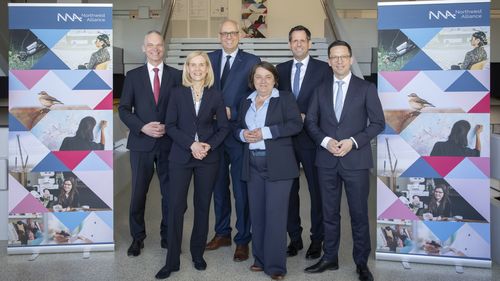
Around 150 guests from education, trade unions, business, politics and society accepted the invitation from the Office for University and Trade Union Co-operation. With this centre, a central interface between academia and the world of work has now been firmly anchored at the University of Oldenburg for almost four decades.
It is no coincidence that in its own anniversary year, the university can already look back on a cooperation agreement with the trade unions that has lasted almost as long, said University President Prof. Dr Ralph Bruder in his welcoming address. "From the outset, the founding idea of the University of Oldenburg was to address socially relevant issues and use the solutions to contribute to changing social realities - including the world of work." Universities should be related to the world of work, says Bruder, himself a labour scientist by training. There are two directions: How do current issues from the world of work find their way into research, and conversely, how can new findings be successfully transferred into working practice? Bruder: "You need translation assistance at both points, you need moderation - and that was precisely the idea behind this cooperation agreement."
Just one month after the university was founded, in January 1974, the university's founding committee unanimously approved co-operation with the trade unions. In October, the University Senate and the DGB adopted the resulting draft contract, which was finally signed on 17 December 1974 by the then Rector of the University, Prof. Dr Rainer Krüger, DGB regional head Georg Drescher and Wolfgang Schulze for the educational association Arbeit und Leben. The second of the five paragraphs sets out the goal of incorporating "employee problems" into research, teaching and studies at the University of Oldenburg, "especially in social, economic, social and cultural terms".
"A science with social responsibility - the founding ideals of the University of Oldenburg coincided to a large extent with the ideas of the DGB and its member unions and still do today," said Elke Hannack, deputy chairwoman of the DGB. Despite strong headwinds at the time, "the breakthrough was achieved" in Oldenburg, said Hannack in her speech: "The activities of the cooperation centre are of immense importance for trade union work, as it links science and practice and offers a forum for discussion on current challenges - such as the transition to a sustainable society or dealing with right-wing extremism."
"The cooperation work provides extremely valuable impetus for research from the world of work and vice versa," said the second keynote speaker, university lecturer Prof Dr Thomas Breisig. For him as a business economist, who deals with topics such as personnel planning and co-determination in companies in his research and teaching, the cooperation is of course particularly obvious. "However, the cooperation centre works on a wide range of other topics - from good work, educational equality, anti-discrimination and strengthening our democracy to socio-ecological transformation and sustainability." Breisig is currently Chair of the Cooperation Committee, whose members from the university and trade unions support the cooperation work and decide on projects and priorities together with the Cooperation Centre team led by Dr Uwe Kröcher and Dr Claudia Czycholl.
Numerous other personalities from the university and trade union environment, business and politics congratulated the cooperation centre on its formal birth around 50 years ago, including - via video message - Lower Saxony's Science Minister Falko Mohrs.
There had already been an exchange between academic teaching and professional practice at the university's predecessor institution, the University College of Teacher Education. Nevertheless, deepening and even formalising the cooperation in 1974 was by no means uncontroversial - the media and politics were sometimes very critical of it and questioned the cooperation agreement. However, it withstood all legal scrutiny and proved to be a successful model that was transferred to other regions and firmly established at the University of Oldenburg in the course of the 1980s. Since 1997, the Office for University and Trade Union Co-operation has operated as a staff unit of the Presidential Board.
An early Oldenburg example of the dovetailing of research and the world of work, which attracted nationwide attention, was the co-operation between biochemistry and trade unions between 1977 and 1982: the starting point was health complaints from employees at a factory, which led the works council and the then chemical industry trade union to approach the university. Laboratory tests revealed that The so-called water vapour volatility of the toxic chemical PCP used to disinfect machine pipes had not been determined beforehand, meaning that employees had inhaled the pentachlorophenol. The research results not only led to the use of a harmless substitute substance, as the current team of the cooperation centre led by Dr Uwe Kröcher and Dr Claudia Czycholl together with the former head Manfred Klöpper writes in a review. The project also drew the attention of biochemistry researchers to the ecological consequences of PCP discharge into the Wadden Sea - and thus provided an important impetus for extensive marine ecosystem research, which is now one of the university's recognised research focuses.
The Office for University and Trade Union Co-operation continues to see its task as moderating and organising the dialogue between the university and trade unions, creating space for exchange, networking and knowledge transfer - also in many events aimed at the general public. In addition, the team itself is involved in several projects, such as the so-called future discourse "Rethinking Working Time" or the "Working World Monitor", which examines the long-term consequences of the coronavirus pandemic in the labour context. The Oldenburg cooperation centre is one of five in Lower Saxony and 14 nationwide.