

Dr Marc Alexander Bausch has supervised more than 140 ‘Jugend forscht’ projects over the past twenty years. This remarkable commitment has now earned the mathematics and computer science teacher the Klaus von Klitzing Prize.
When Marc Alexander Bausch first took part in ‘Jugend forscht’ as a pupil in 1986, an idea took root in his mind: he wanted to make this extraordinary experience possible for others too. Thirty years on, the 45-year-old can look back on over 140 pupil projects which, with his support, have made it to Europe’s largest youth competition in the fields of science and technology. At Hermeskeil Grammar School in Rhineland-Palatinate, he has created the framework for this through the “Jugend forscht” working group – and, at the same time, established a successful STEM education hub in a predominantly rural region.
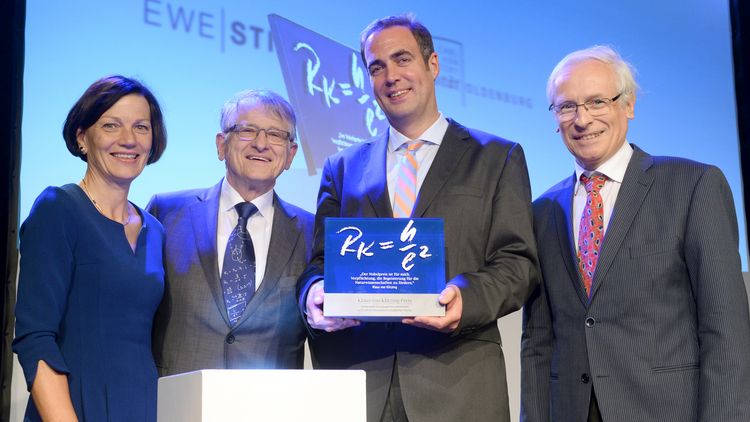
He has now been honoured with the Klaus von Klitzing Prize for this commitment: on Tuesday, Bauch received the award, worth 15,000 euros, during a ceremony at the Graf-Anton-Günther-Schule in Oldenburg. The prize’s namesake and Nobel Laureate in Physics, Prof. Dr Klaus von Klitzing, once again presented the award in person: “Senior Teacher Dr Marc Alexander Bauch impressed the jury both with his outstanding professional qualifications and with his team spirit and above-average commitment, even outside regular lessons,” he said, explaining the decision. In addition to von Klitzing, the jury comprises representatives from the University of Oldenburg, the EWE Foundation and the headteacher of the Graf-Anton-Günther School, Wolfgang Schoedel. For the second time, the jury was particularly enriched by the inclusion of a pupil juror – this year, Johanna Holberg.
Prevailed against 28 applicants
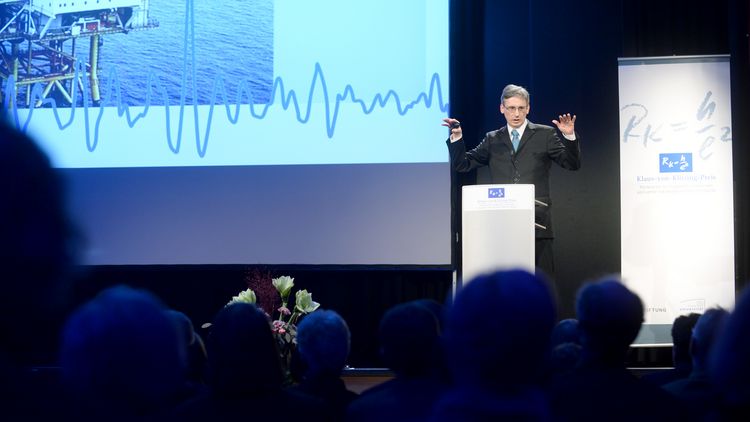
For him, the prize was “like an Oscar for a lifetime’s work”, explained Bauch, visibly delighted, in his acceptance speech. “The commitment to fostering enthusiasm for the natural sciences – that could also be my motto in life,” he continued, echoing a quote from von Klitzing. He expressed his gratitude above all to his pupils.
The prize, which the University of Oldenburg and the EWE Foundation have been awarding in co-operation for fourteen years, recognises outstanding commitment to the STEM subjects – that is, science, technology, engineering and Computing Science. Bauch had prevailed against 28 candidates from across Germany.
The 45-year-old has repeatedly taken time out from his teaching career, sometimes to pursue a PhD, sometimes for further education in the USA. He has successfully channelled the experience he has gained into his professional and voluntary work, has enjoyed frequent success with his pupils in competitions and has already been honoured with numerous national and international awards.
Bringing science and research into the everyday lives of children and young people
Bauch has succeeded in an impressive way in inspiring pupils of all ages – namely those in Years 5 to 13 – to take an interest in Computing Science and mathematics, explained Prof. Dr Dr Hans Michael Piper, President of the University of Oldenburg. “His dedication is just as remarkable as his widely acclaimed teaching skills. He works across school boundaries and is extremely well connected within his region. This enables him to bring science and research into the everyday lives of children and young people. As a university committed to research-oriented teaching and learning, this gives us particular cause for delight.” Prof. Dr Meinhard Simon, Vice-President for Research and Transfer, emphasised at the award ceremony that introducing pupils to science at an early age is the key to a region’s future.
Marion Rövekamp, Chair of the Board of the EWE Foundation, added: “The Klitzing Prize has succeeded in emphatically highlighting the importance of inspiring teachers for our children’s educational and career paths. At the same time, the award highlights the importance of STEM subjects for our educational, economic and scientific systems.”
Klaus von Klitzing spent the early years of his school life in Oldenburg. Today, he is, amongst other things, Director of the Max Planck Institute for Solid State Research in Stuttgart and an honorary member of the International Solvay Institutes. In 1980, he discovered a new quantum effect, for which he was awarded the Nobel Prize in Physics in 1985. The Von Klitzing constant, named after him, is now used to define the unit of measurement ‘ohm’ for electrical resistance. His discovery had a significant influence on modern semiconductor development and precision measurement technology. In 2006, he was awarded an honorary doctorate by the University of Oldenburg.