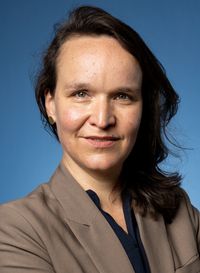
Dr Beatrix van Dam
Dr Beatrix van Dam
Research Fellow
Dutch Literature
Departmental Gender Equality Officer at the Institute of Dutch Studies
Main areas of work
- Contemporary Dutch literature
- Dutch literature of the long 19th century
- Travelogues
- historical fiction
- Fictionality and factuality
- Literature and (non-)knowledge
- Ecocriticism
- Experience-based literature teaching: aesthetics in Dutch as a foreign language
Publications and lectures
Monographs
Telling history:Representing the past in German and Dutch contemporary texts. Diss. Studies in German Literature 211. ed. Wilfried Barner, Georg Braungart, Martina Wagner-Egelhaaf. Berlin: De Gruyter, 2016.
Editorships
Lead Editor for the class of 40 (2025) of the neighbouring language Dutch
Fundamental Topics in Literary Studies: Fictionality. Berlin: De Gruyter, 2020. (with Lut Missinne and Ralf Schneider)
Travel Writing in Dutch and German, 1790–1930: Modernity, Regionality, Mobility. Routledge Research in Travel Writing 14. London: Routledge, 2017. (with Alison E. Martin and Lut Missinne)
Refereed journal articles
"Multilingual nature experience: Intertextuality in E.M. Post’s *Het land, in brieven* (1788) from an international perspective," International Dutch Studies (accepted for review).
“‘Delighted by this beautiful prospect?’ Genre experiments between visions of the future and doubts about the future in early nineteenth-century Dutch literature.” De Moderne Tijd [accepted].
“Staging Conscience: Johannes Nomsz’s Morality Play Iemant en Niemant (1768) and the Enlightened Zinnespel in the eighteenth century.“ Early Modern Low Countries 8/1 (2024): 87–107.
‘Ignorant Dutch Boys Reading German Philosophy? The Concept of Ignorance in Rhijnvis Feith’s Brieven aan Sophie (1806) and Johannes Kinker’s Brieven van Sophie aan Mr Rhynvis Feith (1807).“ Journal of Dutch Literature 9/2 (2018): 22–35.
‘Telling History: The Representation of Historical Knowledge in Fictional and Non-Fictional Texts.’ International Dutch Studies 55/2 (2017): 171–187.
‘The past here and now? The double illusion of reality in the historical novel.’ Dutch Literature 21/2 (2016): 131–158.
Articles in specialist journals, anthologies and encyclopaedias
(with Feike Dietz) “Knowing Through Not-Knowing in Dutch Travel Writing: Narrating the Nova Zembla Expedition Between Ignorance and Knowledge Formation.” Knowledge-Making and Ignorance in Early Modern Travel and its Translations (1550–1820). Early Modern Translation Cultures. Edited by Alison Martin et al. Berlin/New York: Metzler. (forthcoming)
(with Veronika Wenzel) “Mijn potlood zweeg in alle talen: Experiencing postcolonial perspectives on literary multilingualism in German Dutch language teaching.” Polyphonic Circularity: A dialogue between specialised scholarship and pedagogy on literary multilingualism in French and Dutch as foreign languages. Edited by Corinna Koch and Sabine Schmitz. (forthcoming)
“Language learning in adult education: The role of Dutch at German adult education centres in the 21st century.” nachbarsprache niederländisch 40 (2025): 83–100. (with Marthe Wieringa)
“LYRICAL-CARIBBEAN: Learning Dutch through literature in a postcolonial context: Poems and ideas for experience-based teaching.” Dutch as a Neighbouring Language 38 (2023): 41–51.
“A crash course in experience-based teaching using the example of Giselle Ecury’s poem ‘Dividivi’.” Neighbouring Language: Dutch 38 (2023): 51–58.
Miek Zwamborn.” The Critical Literature Lexicon of the 21st Century. Edited by Sander Bax, Bram Lambrecht, Christina Lammer and Lieselot De Taeye. Tilburg: Open Press Tilburg University, 2022. 366–387.
“Lyrical! (Reading) experience as a gateway to literature in Dutch lessons.” Neighbouring Language Dutch 37 (2022): 73–92. (with Jeroen Dera)
“Literary Texts in Dutch Lessons: A Survey of Teachers and Pupils in Lower and Upper Secondary Education in Lower Saxony and North Rhine-Westphalia.” Nachbarsprache Niederländisch 27 (2022): 93–108. (with Alina Viermann)
“Introduction.” Fundamental Topics in Literary Studies: Fictionality. Edited by Lut Missinne, Ralf Schneider and Beatrix van Dam. Berlin: De Gruyter, 2020. 3–49. (with Lut Missinne and Ralf Schneider)
“Documenting or Revitalising? Historical Experience and Metahistoriography in Contemporary Popular Historical Narratives.” Pasts Brought to Life: Novelistic Historical Narratives in the Early 21st Century. Edited by Daniel Fulda, Stephan Jaeger and Elena Agazzi. Berlin: De Gruyter, 2019. 57–80.
‘Non-fiction, but literary? On fiction in popular history books: Geert Maks In *Europa* (2004) and David van Reybrouck’s Congo (2010).” Neighbouring language: Dutch 32/2 (2018): 57–69.
‘Introduction.’ Travel Writing in Dutch and German, 1790–1930: Modernity, Regionality, Mobility. Edited by Alison E. Martin, Lut Missinne and Beatrix van Dam. London: Routledge, 2017. 1–15. (with Alison E. Martin and Lut Missinne)
‘“A novel into which you just throw everything in a haphazard jumble:” Louis Paul Boon’s *De Kapellekensbaan*.’ Introductory Course on Literature from Flanders and the Netherlands. Edited by Johanna Bundschuh-Van Duikeren, Lut Missinne and Jan Konst. Volume 1. Berlin: LIT-Verlag, 2014. 252–280. (with Lut Missinne)
“‘Teken de wisseling der dingen:’ Textual processing of the past in Geert Mak’s *Het Stadspaleis*.” On the Threshold: ‘Own’ and ‘Other’ in Dutch Literature. Ed. Herbert van Uffelen. Vienna: praesens, 2010. 163–180.
Reviews / Conference reports
"Schakeringen van de koloniale blik in negentiende-eeuwse reisverhalen over de Indische archipel." Mirror of letters 66/2-3 (2024). [via: Rick Honings, De ontdekking van Insulinde: Op reis in Nederlands-Indië in de negentiende eeuw, 2024]
"Peter Buijs: De geboorte van het moderne ik." Nederlandse Letterkunde 28/1 (2023): 97-99 [about: Peter Buijs, De geboorte van het moderne ik: Geluk en identiteit in Nederlandse ego-documenten 1500-1850, 2021]
"'Dagboekschrijfgebeuren:' Matthieu Sergier verkent dagboekexperimenten uit de (lange) jaren zestig." Internationale Neerlandistiek 57/2 (2019): 190-194 [about: Matthieu Sergier, Het 'nouveau journal': dagboekexperimenten voor een nieuwe tijd, 2017]
"Johanna Bundschuh-van Duikeren: Gender and Postmodernism." Journal of Dutch Literature 5/2 (2014). Web. [about: Johanna Bundschuh-van Duikeren, Gender and Postmodernism: Exploring a Complex Relationship in the Dutch-Language Novel, 2014]
"'Lezen wat er niet staat': Een nieuw perspectief op de teksten van Geertruida Toussaint." Internationale Neerlandistiek 52/1 (2014): 84-88 [via: Annemarie Doornbos, Tegendraadse elementen in het werk van Geertruida Toussaint, 2013]
"Marco de Waard: Imagining Global Amsterdam." Francia-Recensio 4 (2013). Web. [about: Marco de Waard (ed.), Imagining Global Amsterdam: History, Culture and Geography in a World City, 2012]
[Conference report] "Through Words and Places: Travel and Writing in Dutch- and German-speaking Regions of Europe between 1800 and 1950." H-Germanistik (17 April 2013); Hsozkult (7 May 2013). Web. [about: "Through (W)Places", University of Münster. Münster, 1.3.-2.3. 2013]
"Judith Gera and Agnes Sneller: Inleiding literatuurgeschiedenis." Nederlandse Letterkunde 15/3 (2010). Web. [about: Judith Gera and Agnes Sneller, Inleiding literatuurgeschiedenis voor de internationale neerlandistiek, 2010]
For a wider audience
“Snapshots: Dutch Studies in the German-speaking world around 1986.” Introduction and editing of the dossier. Dutch as a Neighbouring Language: Festschrift marking the 40th anniversary of the Fachvereinigung Niederländisch e.V. 41 (2026): 35–37 (introduction), 33–94 (dossier with contributions from various authors in the field of Dutch Studies in the German-speaking world).
Chief editor of the website“Lyrisch! Learning Dutch through Literature.” More than 80 literary texts adapted for teaching Dutch. University of Münster 2021–. Web.
‘A Hundred Hands Waving in the Waves.’ Anything but Flat: Essays on Contemporary Literature from the Netherlands and Flanders. Edited by Hans Beelen, Johanna Bundschuh-van Duikeren and Jan Konst. Aachen: amikejo, 2024. 25–31. [on: Miek Zwamborn, Algen: a portrait, translated from Dutch by Bettina Bach, 2019]
“An explosion of literature from and about the Caribbean: The Album of Caribbean Poetry (2022).” Neighbouring Language : Dutch 38 (2023): 96–97. [on: Michiel van Kempen, Bert Paasman, Noraly Beyer (eds.): Album of Caribbean Poetry, 2022 ]
“Farewell to the Father’s Garden: Protestantism in Dutch Literature since the 18th Century.” epd-Dokumentation 13 (2017): 17–21.
‘Sebald in the Swiss Alps: Hiking on the edge of the abyss with Miek Zwamborn.’ literaturkritik.de 2016/10. Web. [on: Miek Zwamborn, We’ll Meet at the End of the World, translated from the Dutch by Bettina Bach, 2015]
“Ciska in Wonderland.” Ons Erfdeel 2 (2009): 163–165. [on: Monika van Paemel, *De koningin van Sheba*, 2008]
“ABelgian magic lamp: On the German translation of Hubert Lampo’s *Die Ankunft des Joachim Stiller* (2009).” Neighbouring Language: Dutch 1–2 (2009): 117–120. [on: Hubert Lampo, *Die Ankunft des Joachim Stiller*, translated from the Dutch by Herbert Genzmer, 2009]
“With Faust on the motorway.” Neighbouring Language: Dutch 1–2 (2008): 110–113. [on: Geert van Istendael, *My Germany*, 2007 ]
Readings
(with Feike Dietz) “Breaking the ice? Affective dimensions of climate history in Gerrit de Veer’s travelogue about the Dutch shipwreck on Nova Zembla (1598).” Research Seminar in Environmental Studies. Amsterdam Institute for Humanities Research: Environment and Society, University of Amsterdam. Amsterdam, 2 October 2026.
“‘Wat eeuwig was is niet meer eeuwig:’ (‘What was eternal is no longer eternal.’) Narratives of deep time in contemporary Dutch culture and literature.” Critique and Culture. 11th Annual Conference of the Society for Cultural Studies. Humboldt University of Berlin. Berlin, 19 September 2026.
(with Feike Dietz) “‘vandeonuytsprekelijcke ondraechelijcke coude: ’weather experiences in Gerrit de Veer’s logbook *Waerachtighe beschryvinghe van drie seylagien*.” Early Modern Ecologies. Annual Conference of the Seventeenth-Century Working Group, the Eighteenth-Century Working Group and the Flemish-Dutch Association for New History, Antwerp, 4 September 2026.
(with Veronika Wenzel) “‘Mijnpotlood zweeg in alle talen:’ Postcolonial perspectives on literary multilingualism in German Dutch language teaching.” Polyphonic Circularity: A dialogue between specialised scholarship and pedagogy on literary multilingualism in French and Dutch as foreign languages. University of Paderborn, Paderborn, 6–7 May 2026.
“Between (reading) experience-oriented and analytical? Literature teaching and reading strategies in Dutch lessons in Germany.” Panel: “Literary reading? Didactic perspectives on reading strategies in a multilingual context.” Behind the Stories 10 “Forms of reading”, Ghent University, Ghent, 15 April 2026.
(with Feike Dietz) “Knowing Through Not-Knowing in Dutch Travel Writing: Narrating the Nova Zembla Expedition between Ignorance and Knowledge Formation.” Keynote address at the SPP2130 conference Travel Writing, Knowledge-Making and Ignorance in the Early Modern Period (1600–1820). Johannes Gutenberg University Mainz (Germersheim campus), Germersheim, 24–26 March 2026.
“'Stuitende ontkenning' ('Outrageous Denial'): Ecocritical Perspectives on the Past in Contemporary Dutch Literature.” University of Duisburg–Essen, 22 January 2026.
“Literature and Emotion: A Historical Perspective on Feeling and Knowing as Conflict.” Dutch in multilingual contexts. 22nd Colloquium Neerlandicum: World Congress of Dutch Studies. Vrije Universiteit Brussel. 25–29 August 2025.
“Know your feelings? Feeling between knowledge and ignorance in Elisabeth Maria Post’s *Het land*, in letters (1788)". Symposium The Art of Not Knowing: Ignorance in the Early Modern Low Countries. Amsterdam Centre for the Study of Early Modernity. University of Amsterdam. 16 June 2025.
“‘Delighted by this beautiful prospect?’ Genre experiments between visions of the future and doubts about the future in early nineteenth-century Dutch literature.” Annual Conference of *De Moderne Tijd* 2025: “The Future in the Low Countries, 1780–1940.” University of Amsterdam. 21 March 2025.
“Talking to the dead? On dealing with fictionality in non-fictional (con)texts.” Practices of Fictionality: series of lectures at School III, University of Oldenburg. Oldenburg, 3 December 2024.
‘Deep Drilling 1: Ignorance in historical perspective – the knowledge of not knowing around 1800.” Panel ‘The power of not knowing: Ignorance Studies as an opportunity for Dutch literature’ (organised and moderated by Feike Dietz and Beatrix van Dam), Achter de verhalen 9 “Fields and Paths”, Radboud University Nijmegen. Nijmegen, 30 October–1 November 2024.
‘The Purity of Ignorance? (Pseudo-)Naivety in Jacob van Lennep’s Dagboek van mijne reis (1823).” 15th ALCS (Association for Low Countries Studies) Conference “Questioning the UN/KNOWN”, University of Sheffield. Sheffield, 7–9 July 2024.
“Poetics of Ignorance in Dutch literature around 1800.” Amsterdam School of Historical Studies: “Historical literatures and textual cultures”– Research Group Session, University of Amsterdam. Amsterdam , 6 June 2024.
“‘Uwe onkunde leren zien’: The function of ignorance in J.F. Martinet’s *Katechismus der natuur* (1777–1779).”Plenary lecture at the lecturers’ meeting of the Association of Dutch Studies Scholars, Freie Universität Berlin. Berlin and Leipzig, 21–23 March 2024.
“Lyrical! Project presentation and workshop on experience-based literature teaching.” 11th Colloquium of the Dutch Studies Association, University of Oldenburg. Oldenburg, 6–7 March 2023. (with Alina Viermann)
“What is experience-based literature teaching?” Digital colloquium “Lyrisch! Experience-based literature teaching”, University of Münster. 28 September 2022.
“Ethical decision-making as conflict: Johannes Nomsz’s ‘enlightened allusion’ Iemant and Niemant (1768) and the early modern history of the figure ‘Nobody’.” Annual Conference of the Working Groups ‘The Seventeenth Century’ & ‘The Eighteenth Century’: “EMOTIONS IN CONFLICT”, Leiden University. Leiden, 26 August 2022.
‘Not knowing as a matter of conscience: Johannes Nomsz’s play Iemant en Niemant (1768).” 21st IVN (International Association for Dutch Studies) Colloquium Neerlandicum, Radboud University Nijmegen. Nijmegen, 22–26 August 2022.
“Lyrical! Literature in NVT education.” 21st IVN (International Association for Dutch Studies) Colloquium Neerlandicum, Radboud University Nijmegen. Nijmegen, 22–26 August 2022. (with Alina Viermann)
“Not knowing as a matter of conscience: Johannes Nomsz’s drama *Iemant en Niemant* (1768) and the early modern history of ‘Nobody’ as an allegorical figure across the English, German and Dutch-speaking worlds.” Rhine-Meuse Colloquium, University of Duisburg-Essen, Essen , 21 June 2022.
“Experience-based literature teaching.” Dutch Studies Day, Lower Saxony State Institute for School Quality Development. Nordhorn, 9 June 2022.
“Lyrisch! Learning Dutch through literature.” Digital conference “Lyrisch! Learning Dutch through literature”, University of Münster. 7 October 2021.
[accepted] ‘How knowledge became a choice: Rhijnvis Feith’s and Johannes Kinker’s Letters from/to Sophie (1806/07) as the beginning of a ‘post-factual’ era.” Behind the Stories 8 “Fluid stories: Dutch Studies under late-modern conditions”, Leiden University. Leiden, June 2020/June 2021. [Conference cancelled twice due to the coronavirus pandemic]
“Can you feel facts? On literary narrative strategies in Dutch and Flemish popular histories at the beginning of the 21st century.” 12th ALCS (Association for Low Countries Studies) Conference “Picturing Reality”, University of Sheffield. Sheffield, 28–30 June 2018.
“Nature versus culture: loss in the work of Miek Zwamborn.” Behind the Stories 7 “The Return of History”, University of Antwerp. Antwerp , 18–20 April 2018.
“Feeling facts? Fictionalising narrative techniques in contemporary historical narratives.” Post-factual storytelling? International conference marking the 10th anniversary of the Centre for Narrative Research, University of Wuppertal. Wuppertal, 6–8 February 2018.
“The Representation of Ignorance in Literary Texts around 1800.” NLV (Association of Dutch Studies Academics) lecturers’ meeting and colloquium for PhD students and postdoctoral researchers in German-language Dutch Studies, Goethe University Frankfurt. Frankfurt am Main and Darmstadt, 21–23 October 2016.
“Enlightenment light? On the interaction between German philosophical discourses and Dutch literary texts in the (late) eighteenth century.” Section on Dutch–German cultural interactions, GSA (German Studies Association) Fortieth Annual Conference, University of San Diego. San Diego, 29 September–2 October 2016.
“Farewell to My Father’s Garden: Protestantism in Dutch Literature.” Cycling with God: A Tour through the Religious Literary Landscape of the Netherlands, Evangelical Academy Frankfurt. Frankfurt am Main, 25 June 2016.
“Snapshots of the Past: Reading the Present through the Past in Contemporary Factual Narratives.” Reading the Present through the Past: Forms and Trajectories of Neo-Historical Fiction, University of Amsterdam. Amsterdam, 4 March 2016.
“Literature and History: On the Incorporation of Historical Knowledge into Fictional Narratives.” Panel ‘Literature and Knowledge’, 19th IVN (International Association for Dutch Studies)Colloquium Neerlandicum, Leiden University. Leiden, 17–21 August 2015.
‘Speaking with the (nearly) dead: Fictionalising narrative strategies in contemporary historiography.’ Behind the Stories 5 “Back to the text?”, Vrije Universiteit Brussel. Brussels, 26–28 March 2014.
“Through Time and Space: The Concept of Time Travel.” Writing in Motion: Travel – Tourism – Transculturalism, Ghent University. Ghent , 27–29 March 2013.
Presentations on my doctoral thesis at the doctoral candidate and post-doctoral colloquium on Dutch Studies in Germany and Austria (Universities of Duisburg-Essen, Berlin (FU), Oldenburg, Vienna, Münster, 2008–2013)
“Multatuli’s *Max Havelaar* (1860) and Louis Couperus’s *De stille kracht* (1900) as (post-?)colonial literature.” Dutch Reading Course, Franz Hitze Haus Catholic Social Academy. Münster, 23 August 2011.

Projects
"Poetics of the denial of knowledge in Dutch literature around 1800"
Habilitation project (University of Oldenburg)
"Lyrical! Learning Dutch with literature"
Project to promote the use of literature in Dutch lessons