
A "school for mentally abnormal children"

A "school for mentally abnormal children"
by Ulrich Schröder
Drawing on source material that has been preserved with a rare degree of completeness, this article examines the background and establishment of the Cologne ‘special school’. The analysis focuses in particular on attempts to determine the pupil body and on socio-economic aspects such as parents’ occupations, residential areas and so on.
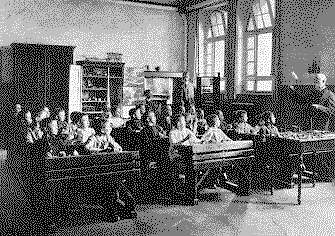
Cologne Special School of 1886
“It is therefore a cause for joy that a school has been established in which these poor children are treated and taught on their own terms, with due regard for their limited abilities.”
Today, 15 November 1886, the anniversary of the death of Johann Amos Comenius, lessons began at the school for children with intellectual disabilities in this city, located at Burgmauer No. 31 in Cologne. These are children who, because they are slow in thought and judgement, sluggish in comprehension and retention, and clumsy in application and understanding, are unable to keep up with the ordinary curriculum of the elementary school; they are a hindrance to it; when the teacher devotes considerable attention to them, they hinder the progress of children of normal ability; yet, upon leaving school, they take with them nothing but the memory of years spent in torment and (much to their parents’ distress) the inability to make a useful living. It is therefore a cause for great joy that a school has been established in which these poor children are treated and taught on their own terms, with due regard for their limited abilities. Following extensive preparatory work on the part of the school inspector, Dr Brandenberg, two classes were initially established with the approval of the Royal Government; the boys’ class, comprising 28 pupils, was entrusted to the teacher Michael Holl, and the girls’ class, comprising 20 pupils, to the teacher Anna Altengarten. These 48 children were selected from among the pupils nominated by the headteachers of the municipal primary schools by the school inspector, Dr Brandenberg, and the Medical Councillor, Dr Laudahn, Director of the municipal mental asylum at Lindenburg, with the assistance of the two lecturers mentioned, and were then deemed suitable for our institution . . .”
These lines open the school chronicle of Cologne’s first educational institution for children who are today described as ‘having learning difficulties’. In his writing, the first teacher strives for a refined tone and even refers to one of the most significant historical educators, Comenius. This is likely in keeping with his sense of pride at being part of a worthy new endeavour.
In fact, this type of special school for children with extreme learning difficulties was still in its infancy: although its establishment had been called for as early as 1864 in a short treatise, the first actual school was not founded until 1879 in Elberfeld (now Wuppertal). Braunschweig and Leipzig followed two years later. Incidentally, the first special school in Oldenburg was not established until 1908. Whilst the terms used initially varied from place to place (remedial school, school for the mentally disabled, etc.), the name ‘Hilfsschule’ (special school), chosen in Braunschweig, later became the standard term. Braunschweig, and in particular the teacher Kielhorn based there, were also the source of significant publishing and even propaganda activities, which led in 1898 to the founding of the ‘Association of Special Schools in Germany’ and to the further dissemination of the ‘special school concept’. Since the early 1960s, the name ‘(special) school for pupils with learning difficulties’ has been in use in the Federal Republic of Germany; this is currently being replaced in various Federal States by ‘special needs school’, ‘school for learning support’ or similar terms.
Cologne was by no means the first such school to be established, and it was able to build on the experience gained in the nearby Rhineland towns of Elberfeld and Krefeld. Nor did the people working there have any significant public impact. What makes the unspectacular example of Cologne so special is that sources have been preserved at all levels: the records of the city council and the school committee, the files of the school administration, the minutes of headteachers’ conferences and, finally, the school chronicles. These sources reflect different perspectives on the historical events, which can be weighed up against one another.
Background and Founding Phase
As early as the end of 1881 – just two years after the founding of the ‘School for the Mentally Disabled’ in Elberfeld – the first reference appears to the activities of the Cologne school inspector Brandenberg towards establishing such an educational institution: He reported to the School Board on his visit to the ‘Institute for the Mentally Disabled’ Hephata in Mönchengladbach. A year and a half later, this body discussed for the first time a ‘school for children with intellectual disabilities’, as well as a ‘school for neglected children’. In 1883, the school inspector had the headteachers draw up an initial list of ‘children with developmental delays’, which contained 91 names but was entirely unsatisfactory because the criteria for inclusion were apparently unclear. The school was never established; no ‘suitable premises for such a school’ could be found. It is difficult to judge whether this argument was put forward to conceal a lack of interest. Nevertheless, the issue of premises still played a certain role even when the school’s establishment was finally given serious consideration in 1886 and realised in November. And although the building that was subsequently made available did have the desired courtyard for ‘gymnastics exercises’, it was otherwise in a state of disrepair and first had to be cleared out and repaired.
Despite this setback, Brandenberg tirelessly pursued his goal, once again calling for lists to be drawn up and raising the issue of the planned school with the school board. And from early 1886, the preparations entered a decisive phase: A procurement plan and budget are requested, and the procurement of teaching materials is set in motion. The school inspector again plans an informative visit to an institution that can serve as a model; but this time it is no longer an asylum, but the school in Elberfeld, which has now been in existence for over six years. The director of the municipal mental asylum is asked to provide an opinion from a medical perspective. The two lecturers are selected and sent to Elberfeld to observe lessons.
Once again, a list is requested from the headteachers of the primary schools (district and independent schools). It again comprises over 90 names, from which a boys’ class and a girls’ class, each comprising 25 children, are to be formed. In fact, considerably more boys than girls are admitted (28:20). However, this does not prompt any further reflection – nor does the fact that even the figures for children reported by the schools already showed a ratio of approximately 3:2 to the disadvantage of the boys. This ratio still applies today in schools for children with learning difficulties. To interpret this phenomenon, sociological approaches such as gender-specific roles and the corresponding behavioural norms are usually invoked. However, these alone cannot suffice, as no form of disability – not even, for example, blindness – exhibits a balanced gender distribution.
In order to assess the class size – both the planned size of 25 children and the actual size of the boys’ class of 28 – one must bear in mind that primary school classes at that time were generally more than twice as large. In preliminary discussions, whether in Cologne, Leipzig or elsewhere, however, the maximum number mentioned was between 15 and 20 children. In his correspondence with the school authorities, the Cologne teacher Holl repeatedly urged, almost desperately, that class sizes be reduced. As early as May 1887, his school had three classes: one with 28 boys, a girls’ class with 17 and a mixed class with 27 children. In a petition, he notes, on the one hand, that the girls’ class was “entirely adequately filled”, whilst regarding the other two classes, he states that “with this number of pupils”, “nothing can be achieved”; 15 to 20 children were “the absolute maximum”. He lost the battle. In 1893, the maximum number of 25 – which had long since been a dead letter anyway – was raised to 30.

Practical lessons with
Career guidance in the
new special schools:
Carpentry workshop,
School garden,
Teaching kitchen
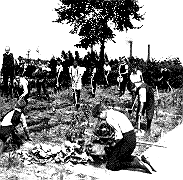
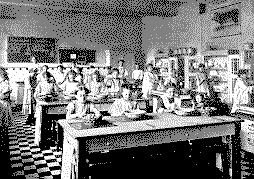
A similar pattern can be observed almost everywhere: Kielhorn in Braunschweig speaks of 20 as the ‘normal number’, but his first class in 1881 already had 29 children, and even he did not succeed in significantly reducing the average number in the long term. Overall, one must conclude that, from the very beginning, the special school was unable to operate under the conditions that all educational and medical experts and advocates had declared to be indispensable – and one might add: this remained the case later on, right up to the present day.
The ‘suitable’ pupils
One of the main problems facing the fledgling special school was determining the right pupil intake. It was certainly recognised that these had to be children who were nowhere near achieving academic success in mainstream schools, even though they did not primarily suffer from organic impairments or were merely neglected by parents or lecturers. They were thought to fall somewhere between the reasonably ‘normal’ learners and those with intellectual disabilities (‘the feeble-minded’). They were described as ‘the lowest in the class’, the ‘mentally weak’, ‘half-idiots’, as ‘low-ability’, ‘low-gifted’ or ‘(school-educable) feeble-minded’. This terminological confusion reflects the fact that there was a complete lack of a theoretical basis. This is also reflected in the most common phrase found in the sources, used by the Cologne teacher Holl and his school inspector, namely a vague ‘suitable for our institution’.
An exception to this is Cologne’s preference for the expression “not normally developed mentally”, which certainly can be traced back to the school inspector. It has not yet been possible to determine where he drew his inspiration from. There is only one parallel, though Brandenberg is unlikely to have been aware of it: in Braunschweig, prior to the founding of the special school, the term ‘school section for children with underdeveloped mental faculties’ was once considered. What both formulations have in common is that they do not express a static lack of ability or a defect, but rather the aspect of development. This strikes one as downright modern; in any case, it cannot simply be dismissed as a meaningless variant within the colourful spectrum of terms. Furthermore, the way in which the term is used demonstrates that, from the very beginning, great importance was attached to characterising the pupil body as accurately as possible. The fact that this search was bound to be unsuccessful due to a lack of scientific foundations must not lead us to question the seriousness with which it was pursued.
Social aspects
The situation was similar with regard to socio-economic aspects. It was recognised early on that special schools would mainly be attended by children from the poorer classes. However, any systematic examination of the phenomenon failed, again because theoretical approaches – in this case sociological ones – were not available, and certainly also due to the political climate of the Wilhelmine era. Nevertheless, the sources contain a wealth of material offering insight into family and social circumstances. For instance, in his report on the mother of a child suspected of prostitution, a police commissioner openly calls for socio-political measures to alleviate the social misery of those ‘lower-class’ families. Home visits gave lecturers an insight into the reality of their pupils’ lives, which is reflected in the sources. The same applies to the ‘follow-up care’ provided by lecturers for pupils who have left school, which makes it possible to track individual life trajectories in terms of their vocational and social integration over the course of several years. There is not enough space here to go into detail on this. Instead, we shall present an analysis of pupils’ educational background, their parents’ occupations and their addresses. These data provide insights into both economic and socio-cultural aspects.
At the time of the first two surviving enrolment lists, from 1883 and 1886, Cologne still distinguished between ‘district schools’ (for which school fees were payable) and so-called ‘free schools for the poor’. The latter suffered from generally appalling conditions. It is hardly surprising that, of the 91 children listed in the 1883 register, 67 were in free schools and only 24 in district schools. In 1886, the ratio was less skewed at 58:34, but it is important to note that, in the intervening period, children had on several occasions been transferred from overcrowded free school classes to district schools.
The lists also requested details of the ‘parents’ occupation’. ‘Day labourers’ predominate – that is, workers in a very precarious position without long-term contractual ties – though they need not always be unskilled. There is evidence of frequent shifts between craft trades and day labour – in both directions. These day labourers, who must in any case be counted amongst the poor or at least amongst those constantly at risk of poverty, account for 46 per cent of the occupational entries in the 1883 register (and, with the exception of three cases, these are exclusively parents of children attending free schools), 40 per cent in 1886 and around 40 per cent in the registrations for the following years as well. This proportion is extremely high; it far exceeds the figures recorded, for example, in Aachen (20 per cent) and Düsseldorf (26 per cent). This reflects the long-standing – and still ongoing – problematic social and economic structure of Cologne’s population.
If one were to mark on a city map the homes of all the children listed in the 1886 registration records, a strong concentration would be evident in a section of the southern Old Town. This includes several streets that have been known for centuries as working-class neighbourhoods. Indeed, there appears to be a very enduring socio-economic topography in large historic cities. So whilst the groups of ‘children with intellectual developmental disabilities’ were drawn from very specific, identifiable residential areas of Cologne’s Old Town, the school building – the location of which was expressly approved – was situated almost at the other end of the city. This demonstrates once again how ‘blind’ the decision-makers were to the unequal distribution of social classes, despite their intimate knowledge of the city.
It would, however, be wrong to assume that the socio-economic aspects were completely ignored. Nevertheless, it took a few years before a second special school was established in the southern part of the old town, which soon surpassed the first in terms of pupil numbers. The main response of the school inspector, the lecturers and private, mostly church-affiliated associations to the social issues was to make intensive efforts towards vocational integration, which culminated in the long-term aftercare mentioned earlier. It is in this area that early special school pedagogy achieved its most significant educational successes (even if these were all too often not followed by lasting success).
Preliminary conclusion
The historical origins of schools for pupils with learning difficulties lay, in many respects, the foundations for their problematic situation today: the relationship with mainstream schools was ambivalent. On the one hand, special schools promoted themselves using the dubious argument of relieving the burden on mainstream schools; on the other hand, there appeared to be no particular enthusiasm for this within mainstream schools. Quite apart from the fact that special education may come across as an unspoken reproach to ‘normal’ education, other means of ridding oneself of the ‘burden’ had long been available: Children were made to sit at the back of the class, or they were expelled from school as ‘unable to learn’.
On the one hand, the municipal authorities welcomed the new school; on the other, the required class sizes – which were minuscule by the standards of the time – were nevertheless deemed too costly. Thus, although high expectations were raised – even by the advocates of the special school concept – the special school was denied the conditions necessary to fulfil them from the very outset. At best, it was able to excel in the areas of vocational preparation and subsequent welfare support.
The definition of the pupil body was also characterised by several ‘on the one hand, on the other hand’ considerations: Although the children were regarded as not having developed normally and as having limited abilities – and in any case as incapable of benefiting from primary school education – they were not to be placed on a par with the ‘fools’ who were deemed completely unfit for schooling. A priori, the children’s underdeveloped mental (today we would say: intellectual) abilities were identified as the decisive factors behind their educational difficulties, and ample evidence was found to support this; on the other hand, experiences in day-to-day educational work repeatedly called this theoretical premise into question. In particular, lecturers were confronted almost daily with the poverty and marginalised social position of the children and their families.
The special school carried all these contradictions and ambiguities with it for decades, carried them over into the phase of the ‘school for pupils with learning difficulties’, and has, in essence, been unable to resolve them to this day. The fact that a confusion of terminology has recently resurfaced, with the coexistence of terms such as ‘school for pupils with learning difficulties’, ‘special school’ and ‘school for learning support’, is merely one indication of this. However, today I often cannot even discern any serious effort to bring about a clarification, as was attempted at the end of the 19th century. And whether the abolition of this problematic form of special school represented a solution remains an open question....
The author
Prof. Dr Ulrich Schröder, a special needs educator at the Institute of Educational Sciences 2 within Department 1 of Pedagogy, was appointed to Oldenburg in 1978. After working as a teacher for several years, he studied psychology, pedagogy and art history in Cologne. After completing his doctorate, he worked as an academic counsellor in Cologne. His research focuses are the history of special education for pupils with learning difficulties, metacognition and comparative special education.