
Liberal drug policy between prohibition and legalisation

Liberal drug policy between prohibition and legalisation
by Rüdiger Meyenberg
Where is drug policy heading in the Federal Republic of Germany? The positions taken by various social groups vary widely: from the legalisation of hard drugs to more drastic measures to restrict their use. The author of the article himself argues in favour of taking a pragmatic approach that is not paved with ideological positions, because the aim of all drug work and policy is prevention, especially among young people.
We all know that the key to reducing the spread of drugs lies in demand; that is why all policies that focus on supply reduction (supply-reduction) are doomed to failure. However, we know very little about demand, its causes, manifestations, consequences and interaction with the drug market and drug policy. There are considerable research deficits in the area of drug use in the Federal Republic of Germany. However, simply believing that more research in itself or in certain areas will improve the situation is not enough. One of the most important reasons for the possible failure of research to date lies in the wrong perception of the drug problem. Up to now, the dominant approach has focussed on the drugs on the one hand and the person on the other, but has seen the person as an isolated individual and not as a socially integrated individual. Accordingly, drug use was perceived almost exclusively as a problem of somatic and mental health. The social factors influencing the initiation and continuation of drug use were ignored.
Previous drug policy concepts have not reduced the number of addicts.
The social, informal regulatory mechanisms that determine the behaviour of the subculture, for example, have also been ignored (see Reuband: Forschungsdefizite im Bereich des Drogengebrauchs, in: Sucht, No. 93 (1993) pp. 48-57). If we want to understand the drug problem better and put drug policy on a more national basis than it has been up to now, we need a special financial effort for basic research, which must primarily be social science research.
The epidemiological spread of drug addiction continues to increase; the number of new drug users in particular is rising. The number of drug-related deaths is at a high level (approx. 1,438 in 1995). Although the term "drugs" initially refers to illicit drugs (hashish, marijuana, heroin, ecstasy, cocaine), legal drugs such as alcohol, tobacco products, medicines, as well as non-substance-related addictions such as gambling and eating disorders, are increasingly becoming the focus of public awareness. Strong increases are also being recorded here. Despite these high figures, there are too few treatment centres in Germany, especially detoxification centres; but the success rates in treatment are also no higher than between 10 and 30 %.
Accepting drug work
When it comes to dealing with illegal drugs and drug addicts, politicians and the general public in Germany are divided.
One group (prohibitionists) demands the retention of the current very harsh drug laws, which prohibit the purchase, possession and trade of drugs and punish them severely (as is well known, consumption is not punishable). Only those who undergo therapy as addicts, i.e. who want to live abstinently from drugs, can be spared punishment (Section 35 (1) of the Narcotics Act (BtMG)). Under certain circumstances, the acquisition or possession of small quantities of drugs for personal use can also remain exempt from punishment (Section 31a BtMG) in light of the judgement of the Federal Constitutional Court. In addition, the state is initiating "pilot projects", the main aim of which is to prevent the spread of AIDS by substituting drugs with another addictive substance, e.g. methadone, paid for by the state/health insurance fund. Other drugs are also frequently used for this purpose (codeine, Remadacen).
Against the background of the low success rate of treatment, but also because drug addicts are unable to overcome their addiction on their own, a second group wants to abandon the requirement of abstinence and help addicts with their drug use; the term "accepting drug work" has become established here. In particular, social institutions such as churches, drug help centres and self-help groups provide places for addicts to stay where they can eat, shower and take care of themselves, i.e. where the social effects of their situation are alleviated (harm-reduction). However, such drop-in centres are also places for simple communication, problem-solving and possibly also counselling for "quitting". Their aim is to provide psychosocial support for drug addicts. Where possible, they also provide housing and paid work.
Such a drug help concept is also increasingly based on the realisation that drug addiction marks a certain phase in an individual's life from which the person concerned must slowly grow out of. The phase of drug addiction should therefore be kept as health-friendly and low-risk as possible.
Drug policy: decriminalisation
This group also wants change in drug policy; for them, an "accepting drug policy" means the decriminalisation of "soft" illegal drugs, but this does not mean that consumption is generally legalised; possession or purchase should only remain a misdemeanour. Soft and hard drugs should be separated!
Although there are approximately one million hashish smokers in Germany today, the purchase/possession or trade of cannabis products is still illegal, as it is in the Netherlands. Today, hashish is easy for anyone to obtain. Only against the background of the judgement of the Federal Constitutional Court and the corresponding implementation by the Lower Saxony Ministry of Justice has the acquisition/possession of small quantities become de facto exempt from punishment, but remains illegal from a legal point of view; this must be changed.
| In drug policy there is no one-size-fits-all solution worldwide, and therefore also in Germany, as to how to deal with the acquisition or possession and consumption of narcotics. Some European countries (the Netherlands, Switzerland, Great Britain) have started to carry out open-ended model trials which could provide information about a change in consumption behaviour, i.e. one that is more health-conscious. This is the only way to understand the proposal from Schleswig Holstein to dispense cannabis products (i.e. soft drugs) via pharmacies. On the one hand, this concept aims to prevent children and young people from being put at risk, but on the other hand to put a stop to the illegal activities of dealers. This is also the decisive advantage of this attempted solution, namely to dry up the swamp of illegality. In addition, this pilot scheme would have to show whether the number of consumers increases as a result of such a regulation. However, pharmacies should not be forced to dispense cannabis products; the principle of voluntariness applies here. The dispensing of soft drugs via pharmacies should find its equivalent in hard drugs (opiates) by registered doctors. The dispensing of original substances (i.e. heroin, cocaine) for severely addicted people should also be tested in pilot projects in Germany. A more liberal drug policy, which cautiously breaks new ground, sets up the state as a monopolist for drugs, which then decides on the conditions for the distribution of drugs to whichever group. |  The number of users of hard drugs continues to rise. Even the most rigid concepts have so far been unable to halt the trend. |
However, the long-term goal of all measures must always be a life free of drugs (addiction), or at least a controlled approach to addictive substances, if this is possible at all for addicts. For the sake of completeness, it should be mentioned at this point that a final group is calling for a complete reversal in drug policy; their aim is the abolition of the Drug Act (BtMG), i.e. the total legalisation of all narcotics; they consider this law to be unconstitutional anyway because it violates human dignity and impairs people's opportunities for development. The state/the economy must keep all drugs available for sale. Those who want to accompany their lives with drugs should not be prevented from doing so.
The Dutch drug policy
The Netherlands has long been a role model for a liberal drug policy, also for groups in Germany. These days, the government in The Hague has presented a report in which it sets out the guidelines for drug policy for the coming years. Although the policy will not be fundamentally changed, some regulations have proved to be inadequate and are now being adapted. Pressure from the other countries of the European Union also seems to have prompted the Dutch to take this step.
Even if the results of Dutch drug policy in the health sector are comparatively favourable, drug use and the drug scene are a major social problem. Therefore, according to the report, the policy will also focus more on preventing nuisance to the population caused by the drug scene. For example, the amendment to the municipal law should make it possible to prevent access to flats where drugs are traded.
Reducing the volume of sales in coffee shops. In order to make it more difficult for foreign visitors in particular to trade larger quantities for their own country, the quantity of soft drugs whose sale in coffee shops is not subject to criminal prosecution will be reduced from 30 grams to 5 grams.
Combating the cultivation of "Nederwiet". More cannabis products, so-called Nederwiet, are being cultivated in the Netherlands than ever before, making it a country of production and export. Here, the government wants to prioritise investigation and prosecution on a large scale.
Expulsion of foreign drug addicts and "drug tourists". Some of the problems associated with drug trafficking are caused by foreign addicts who are staying in the Netherlands illegally.
 Drug deaths in the old Federal States 1983 - 1995. | 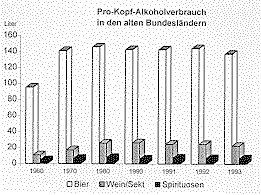 Per capita alcohol consumption in the old Federal States 1960 - 1993. |
Drug addicts residing illegally in the Netherlands who commit criminal offences are to be subject to stricter deportation measures. More targeted investigation and prosecution measures and more consistent penalties are also envisaged. Foreign drug addicts must be helped in their own country, according to the report.
Trial supply of heroin on the basis of a medical indication. Initially, limited trials are planned to administer heroin to severely addicted people who are in a hopeless physical and social situation. Here, Swiss projects invite imitation.
No legalisation of drugs. In conclusion, the report states that the legalisation of hard or soft drugs is not being sought. The most important argument against such legalisation is the major health risks. As far as soft drugs are concerned, the Dutch government assumes that the criminal trade would not decrease if the Netherlands were the only country to decide on legalisation. There are also fears that drug tourism could be boosted.
Prevention: acquiring life skills
In addition to the humane treatment of addicts and the corresponding legal foundation, preventative efforts in families, schools, leisure facilities and the media must be strengthened and improved. The aim of addiction and drug prevention work is to create life skills. Young people should be equipped with behaviour, skills and knowledge so that they can resist internal and external pressure to use psychoactive substances. For children/young people, this means that they learn to deal with life-stressing situations "naturally". The result of drug prevention work is the ability to deal with all addictive substances responsibly, i.e. in a health-conscious manner. However, this also includes developing an awareness of abuse that makes it clear to them when they are entering risky situations with addictive substances.
For children and young people who are already using drugs, the aim of prevention is to develop a willingness to refrain from using addictive substances in a way that endangers their health, while addicts/drug addicts should realise that they can get help. They should also develop a willingness to switch to more health-friendly addictive substances or even to live abstinently. The goals of addiction and drug prevention today must be formulated more precisely than in the past, i.e. in a consumer-dependent and development-specific manner.
The important socialisation instances of children and adolescents would also have to take on more educational, i.e. orientating tasks again. It would therefore make sense for families to take on a stronger orientation function for children and young people by teaching them sensible norms and values of solidarity. And schools should be given a stronger socio-educational orientation and become more of a space for pupils to live and shape their lives; instead of being "overhead", sensory, holistic learning methods must be at the centre of teaching.
New approaches to educational work in the leisure sector must be given greater consideration; the active involvement of children and young people, serious challenges and self-awareness that involve testing their own physical strength and mental and social competence, activities and actions in which their own possibilities and limits of behaviour can be tested, must once again take centre stage. And the consumption of electronic media must also simply be reduced!
The use of drugs can always be an expression of a profound mental disorder; understood in this way, it is a cry for help from children and young people: "Look after me!", "Help me!" - combined with the unspoken question: "What else do I have to do so that you finally understand me and my grade?"
Perhaps we adults have talked too much about ourselves in recent years and forgotten the problems of children and young people. Perhaps we should listen more to them again when they hold up a mirror to us through their behaviour, when they call for help quietly or loudly and when they need someone.
The author
 Prof Dr Rüdiger Meyenberg (52), member of the Institute of Social Sciences II - Politics and Society, has been teaching and researching the didactics of social sciences in Oldenburg since 1974 - after studying to become a teacher and working as a school teacher. His research focuses on addiction and drug prevention as well as violence among young people. Among other things, he is Chair of the Drug Education Section of the WHO organisation "International Council on Alcohol and Addictions" (ICAA).