
What the bedroom is a sign of

What the bedroom is a sign of
by Thomas Jung and Stefan Müller-Doohm
In the 'experience society', the way we live is an important field of everyday aesthetic self-presentation. The design of the bedroom has long since been drawn into this process of 'impression management'. This is why the phrase "Tell me how your bedroom is designed and I'll tell you who you are" applies even to this intimate area. However, the design of one's own lifestyle in the area of bedroom culture is also controlled by the supply side and its mediators: home magazines, furniture stores, advertising, etc. The way in which this mediation of lifestyles takes place has been investigated as part of a cultural sociological study funded by the German Research Foundation. The results reveal what the bedroom is a sign of.
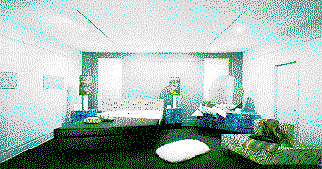
Claes Oldenburg's
"Bedroom Ensemble - Replica I",
1969, Frankfurt Museum of Modern Art
As children of modernity, we have long since become accustomed to the fact that the enlightenment sciences, spearheaded by sociology, break taboos, not only fight against prejudices, but also question established habits and overturn the tried and tested self-evident aspects of our everyday lives. But what is to be made of the fact that the science of society, having become completely unstable, invades the bedrooms of our private homes and voyeuristically makes its way between the bed, bedside table and wardrobe? Despite all sympathy for the vehemence of scientific curiosity, this overstepping of the boundaries of the sociological gaze is too much of a good thing.
Because of this understandable reaction, restraint and extreme caution are required under all circumstances in the case of bedroom sociology. For the bedroom, as its cultural history teaches us, is traditionally a place of utmost intimacy, a domestic area that has been protected from the prying eyes of the outside world, at least since the establishment of bourgeois privacy.
Since when has the bedroom existed as a separate room that differs in importance from the living room, study, children's room, kitchen and bathroom, for example? In the Middle Ages and until late modern times, the common people slept relatively unregulated, at night in colourful diversity, communally in places to which no special attention was paid and which were therefore accessible to everyone. In the courtly society of absolutism, on the other hand, the process of dressing and undressing, going to bed and having a morning toilette was considered a highly prestigious process, which Louis XIV, for example, staged or had staged at great expense.
| Bedrooms of the present and at the turn of the century | 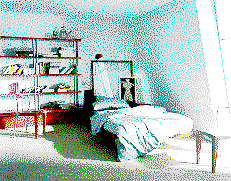 | 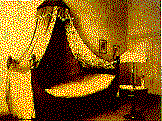 |
There is a consensus among cultural historians that the customary ideal of a home with its standard functional division into living room, bedroom, kitchen and bathroom is barely more than a century old. For a long time, regulated living in a private home was the privilege of the wealthy classes who could afford a family (such as the aristocracy and the business and educated middle classes). When social reformers developed ideas about family-friendly living towards the end of the last century and defined minimum sizes for interior spaces, the spatial separation of the sleeping area from the living area slowly became the norm. The upper middle-class solution of providing separate sleeping areas for the master, mistress and children was considered a luxury. Home décor is not least dependent on economic leeway, which differs according to class and milieu. In this respect, the bedchamber or bedroom also owes its existence to a process of industrialisation and urbanisation that began with modernity. At the end of this process, the affluent society saw individualisation, which is a decisive condition for the privatisation of sleep in a living space culture shaped by bourgeois mission statements. From a psycho-historical point of view, having your own bed in your own four walls is the long-term result of the civilisation process described by Norbert Elias. This not only goes hand in hand with the separation between the public and private spheres as well as with a rational lifestyle and emotional control of each individual, but also leads to a general sensitisation of the individual towards his or her peers and thus to increasingly narrow boundaries with regard to personal feelings of shame. From this point onwards, whoever says bedroom also says intimacy. Strangers have no business in the bedroom. Private individuals only spend time there themselves, and only at set times when they go to bed in their nightwear, in their own room of course, in order to find undisturbed sleep, which may be accompanied by "sweet dreams" at best. More precisely: the inner world of private domesticity stands out from the public outside world, in which the intimate places protected from the eyes of others are differentiated internally, in clear distinction to the rooms for representational purposes and for the life of the family as a whole.
The bourgeois bedroom
The fact that the bedroom is ascribed the meaning of a space of maximum intimacy within the domestic interior world can by no means be attributed exclusively to the fact that bodies and minds exhausted by their everyday activities find their well-earned night's rest in this place and do what the room prescribes in its name: sleep. Although people go to bed at set times in the bedroom, an activity to which the human species sacrifices a good third of its lifetime, this time-consuming going to bed is in not so rare cases a means to quite different ends: coitus. An insight that hardly requires sociological acumen. Because, preferably in the bourgeois marriage community, sleep and coitus - in terms of location - represent a unity, not only do the doors of this special room remain closed, but its interior must take account of two apparently contradictory forms of behaviour: the undisturbed passivity of sleep and the activity of the sexual act. Consequently, it can be expected that the symbolism of bedroom culture reflects the complicated polarity of this dual purpose. Despite this passive-active opposition of sleep and coitus, these protected behaviours in the bedroom have something in common: the ultimately regenerative function, in the one case the preservation of individual labour, in the other the preservation of the succession of generations, and thus of the species as a whole.
The locally organised and socially structured unity of sleep and coitus makes the sociology of the bedroom an exciting field of research. On the one hand, the sociology of the bedroom is an exciting field of research because it is important to find out the relationship between the social behaviours of individual regeneration and sexuality and, above all, what symbolic forms of expression these two central ways of life take in the cultural design of the bedroom interior. On the other hand, there are enormous methodological problems in data collection. Because of the dual functional use of the bedroom as well as its attribution of meaning as a place of intimacy, the tried and tested method of participant observation in empirical social research is out of the question. Even the tried and tested questioning techniques only provide very superficial insights, because the interviewed subjects only reveal what they consider to be normatively desirable and/or (just barely) worth sharing about their bedroom activities. Both are probably far removed from social reality. How can this shortcoming be countered?
In their study on "Lifestyles and Bedroom Culture", the Oldenburg working group "Cultural and Communication Research" took a path that was pointed out to them by the American environment artist Claes Oldenburg. The Museum of Modern Art in Frankfurt am Main houses a work by this artist entitled "Bedroom Ensemble".
Although this environment consists of classic objects such as a bed, bedside table and dressing table, the objects appear to be functionless, dead objects. The artist, who himself associates the deliberate sterility of his model with the coldness of a tomb, was inspired by advertising brochures for this aesthetic condensation of American bedroom culture. This source of inspiration for the artist opens up a fascinating perspective for the sociologist. Is it possible to analyse the pictorial and textual staging of bedroom advertising in prestigious home magazines, supplements and furniture store catalogues as a reflection of the everyday aesthetic desires of those who buy bedroom furniture, design bedrooms and spend time in them during their daily routine? The answer to this question can be in the affirmative if two assumptions are made. Firstly, such an analysis of bedroom advertising is limited to pure message analysis. It explores the nature of society's codified knowledge about bedroom culture, which culture of taste and which lifestyles are regarded as socially exemplary and, in this sense, binding. Secondly, it is assumed that the presentation in the highest-circulation magazines for home decor in their target group-specific orientation corresponds to the needs of those who consult such lifestyle magazines as guides for their own life practice: What they see and read is itself borrowed from their own everyday lives and at the same time steers them in a direction in which furniture manufacturers would like to go with furniture consumers.
How to make a bed ...
The various advertising media for bedroom culture by no means convey a uniform image of generally binding furnishing practice. Instead, images are presented in the plural. After analysing the content of over 200 text-image templates, mainly from widely distributed home decor magazines (e.g. 'Schöner Wohnen', 'Zu Hause', 'Architektur und Wohnen') using a sophisticated interpretation method as part of the study on bedroom culture, a total of ten different main types of bedroom culture emerged as an initial result of the analysis: 1: ecologically oriented naturalness type. 2: experience-orientated tension type. 3: creative-avant-garde type. 4: multifunctional-space-economical type. 5: classic-stylish type. 6: modernist-anticonventional type. 7: conventional-pneumodic type. 8: bieder-rustic type. 9: neo-romantic type. 10: exotic-transcultural type.
Despite all their heterogeneity, these advertising presentations of bedroom culture have something in common: a contradictory tendency or a tension that is pronounced to varying degrees. On the one hand, the productions stick to the conventional ensemble of bed, wardrobe and bedside table throughout, even if they are combined and varied in imaginative new ways. On the other hand, the bedroom presentations are dominated by the attempt to liquefy this purpose as a closed area of regeneration and sexuality through new design elements or, if possible, to do away with it altogether. To exaggerate, one could say that contemporary bedroom culture serves the 'basic needs' of sleep less and less. This could be a sign that the significance of regenerative moments of time is diminishing in contemporary modernity. Mere sleep, always suspected of being lost time, is being marginalised. This de-functionalisation of the bedroom as a place of rest goes hand in hand with another striking characteristic: the bedroom culture contains virtually no reference to the fact that this place, especially the bed, is a site of erotic rapprochement and sexual encounters. In its advertising messages, the sign language of bedroom culture seems to respect the taboo that has always weighed on sexuality in bourgeois society.
A meticulous text and image analysis of the ten main types listed has led to the finding that the empirically established trends of a progressive alienation of the bedroom as a refuge and a kind of chastity in the symbolism of the interior are expressed in an astonishing range of variations. Of course, the respective distinctiveness of this trend also varies. It was most clearly demonstrated by analysing individual cases of the second prototype, the "experience-oriented tension type".
The experience-orientated tension type
What is striking about this advertising example from the catalogue of the Hülsta furnishing company is that it is not the design of the bedroom that is at the forefront of the advertisement, but the person or what they represent. The wide double bed does not serve as a private retreat, but becomes a stage for the person who is busy reading the newspaper, drinking and talking on the phone at the same time. The person actively organises the scarce resource of time. In line with the leitmotifs of the advert text, he is the master of his time as a "modern-progressive successful person", who steps out of the classic separation of productive daytime and reproductive nighttime. The interior depicted does not adhere to the classic separation of sleeping, working and living space. Rather, daytime and nighttime merge into one another. This is reflected in the fact that the gaze of the man in the blue bathrobe on the black bed goes beyond the given space, thus transcending the present situation and focussing on the future. The half-sitting, half-lying posture of the figure is entirely in keeping with this. It is the traveller in the night, for whom brightness and darkness are suspended, a person who is not located anywhere. For them, the bedroom is not an intimate retreat, but a temporary place in the airy heights of their penthouse flat.
Characteristic of this and many other ways of presenting bedroom culture is the complete rejection of the separation of living space and bedroom that characterises the bourgeois lifestyle. Another advert for contemporary sleeping style, distributed nationwide by Bettenhaus Rid under the heading "Everything is allowed in bed", depicts a young successful man in a plumb bed with his laptop, which is the object of all his sensual passion for play.
Everything is allowed in bed
Here, the bed is not a sign of intimacy, but of a contemporary lifestyle as practised by progressive single households. Privacy and the public sphere are one and the same. Outward orientation takes precedence over inward orientation. Self-realisation is at the service of self-stylisation. This goes hand in hand with the fact that the integrated living/sleeping space no longer primarily represents a status, but rather symbolises the way in which a mobile and fashionably compatible lifestyle is practised. For the experience-orientated tension type, the bedroom culture serves multifunctional purposes, and at the same time and above all, it demonstrates a lifestyle. Permanent mobility is decisive for this type. It is fitting that all the room elements shown in the picture can be easily rearranged and put together to form an arrangement. It is an almost improvised living ambience in which the bed blends in unobtrusively. All the interior design elements converge in such a way that the living room/bedroom design aestheticises the new cultural value of openness and indiscretion. The same can be said for the modernist-anti-conventional type.
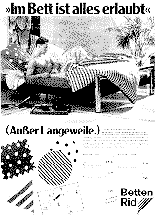 |  | Newspaper advert for bedrooms: "Everything is allowed in bed" |
The "Magazine" advertisement selected as a prototype depicts, without reference to a bedroom and under the heading "Relax tonight", individual objects in a collage-like photomontage, such as coloured file folders, alarm clock, halogen table lamp, stainless steel box bed, desk chair, sliding-door wardrobe. In view of the de-spatialisation of the furniture presented, these objects serve as room furnishing elements that can be arranged at will and used in a variety of ways and do not follow any specific spatial grammar, such as that of a living room or a bedroom. The style suggested by the concise text and image messages is that of postmodern stillness, which in turn sees itself as a new style of anti-conventional furnishing. This style of living consciously keeps its distance from all patterns of domesticity and is not primarily related to living and sleeping. Rather, it is limited to 'relaxing', as it is called in the idiom of youth culture. In view of the semantic sparseness with regard to intimacy, this advertising example can hardly be identified as a bedroom presentation. Everything that could be reflected within one's own four walls as a subjectively designed inscription is excluded in favour of the minimal functions of sleeping.
Bedroom culture as an expression of lifestyle demands
If one attempts to distil the central characteristics from the overall material of all ten prototypes analysed from a comparative perspective, it becomes clear that the design of the bedroom as a parental taboo zone has clearly lost significance with regard to the symbolisation of intimacy. Instead, the bedroom culture functions as a medium for the offensive demonstration of a lifestyle pattern. The cultural language of the bedroom presents itself in such a way that minimal demands for intimacy flow indistinguishably together with lifestyle-orientated demands for milieu-specific living, working and presenting oneself along the lines of a life practice in which a remnant of privacy is mixed with the desire for presentation. It's no wonder that one advertisement advertises with the slogan: "According to a survey, 85% of the population want more variety in the bedroom". And another advert from the company "Team sieben. Natürlich wohnen" states: "Our society has learnt to document itself with status symbols. Appearances are becoming disproportionately important and are part of the modern lifestyle." The variety in the bedroom is reflected not least in the fact that the telephone, television, fax machine and computer system are often grouped around the bed, which disappears into the background. What was previously clearly the preserve of the living room, namely documenting status symbols through the interior, is increasingly being incorporated into the forms of presentation in the bedroom. As a result, the everyday use of the bedroom has expanded significantly, at least at the level of consumer images conveyed by the media: Work and leisure activities are being shifted into the bedroom and it is significantly becoming an additional living area. Parallel to this homelisation of the bedroom, the bedroom culture is an expression of the specific way in which individuals want to lead their lives. The symbolism of the bedroom ensemble serves to manifest the affiliation to certain milieu- and group-specific value contexts by means of stylisation forms. "Tell me how you live, I'll tell you who you are", this claim to distinction is also emphasised for the first time in bedroom furnishings. The styling of bedroom culture is a sign of the increasing aestheticisation of everyday life. As a result, this room loses its original regenerative function and cultural attribution of meaning as a refuge behind the backdrop of social life in favour of self-staging desires that express culturally influenced lifestyles and taste preferences.
Dhe authors

Prof Dr Müller-Doohm (right), a sociologist specialising in interaction and communication theory at the Institute of Sociology, was appointed to the University of Oldenburg in 1974. His current research focus is on social theory, cultural and media research. Dr Thomas Jung is also a sociologist at the university and a lecturer and member of the cultural and communication research group.