On contemporary Russian philosophy

On contemporary Russian philosophy
On contemporary Russian cultural philosophy
by Rainer Grübel
The twentieth century has put an end to inner-worldly eschatologies. Only hard-boiled progressive thinkers still expect the self-enlightenment of philosophical discourse. In the West, fear of catastrophe is spreading in the form of secular apocalypticism, which, as a negative imprint of the progress-believing Adventism of the 1960s and 1970s, relies on the ominous forces of the times.
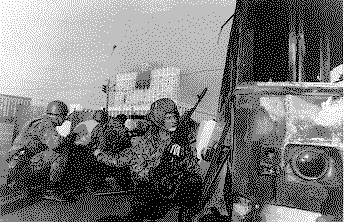
Russia in upheaval: the battle for the "White House" during the attempted coup by the old guard in 1993
The collapse of the Soviet Union unleashed much stronger centrifugal forces in the intellectual life of Russia, which, after decades of pressure on the centre, allowed the peripheral to become recognisable. The pressure unleashed has torn the Soviet Union, which only a decade ago seemed to be an erratic bloc, into an indeterminate number of parts, without the Commonwealth of Independent States or Russia in the narrower sense being regarded as equivalent successors. As after a moulting that has unexpectedly turned into a division, the end of the body can no longer be felt from within. Suddenly there are several bodies with different circumferences, as in the matryoshka dolls, one inside the other. The east-west extension from Vladivostok in Siberia to the Polish or Belarusian border seems firmer and more tangible than the north-west and south borders. It is no wonder that, following the abandonment of Marxism (1992), Russian books with titles such as Russian Idea or On Russia and Russian Philosophical Culture are booming.
The advocacy of Russia's kinship with Asia, which is currently particularly effective in less educated Russian circles, goes back to the philosopher and linguist Trubeckoj and the geographer, economist and philosopher Savickij and was continued by the historian and geographer Lev Gumilev. Gumilev countered the 'Eurocentric legend' of the Tatar-Mongolian yoke (1240-1480) with the view of a culturally fruitful symbiosis between the Mongolian nomads and the East Slavic forest dwellers. By basing ethnogenesis on climate and landscape, his thesis of the "passionarity" of the steppe dwellers is all too reminiscent of the foundation of Hippolyte Taine's positivist model of culture in climate, landscape and race. ("Passionarity" is what Gumilev calls the biochemical energy that a person has absorbed from their natural environment. It varies from individual to individual and in its sum determines the passionarity of an ethnic group).
The Eastern Slavs certainly learnt a lot from the Turkic peoples and Mongols about administration and warfare, and some things about building cities, but not about philosophising. Like the Orthodox religion, their written language, their literature and their forms of thought also originated in Byzantium. As a result of this Byzantine heritage, the Eastern Slavic Middle Ages knew no philosophy independent of religion until well into the 16th century: Aristotle was hardly known, and the Arab influences that were transmitted via Spain and challenged Western European thought were absent here.
The Russian Orthodox Church opposed any philosophical teaching at the universities with varying degrees of success until well into the 19th century, and Marxism-Leninism hindered academic philosophical education from the 1920s onwards. Less than five years after the October Revolution, Lenin had philosophers and independent thinkers who had not yet emigrated put on two ships and shipped off to Western Europe. Russia, which had enriched Western European intellectual life with such important minds as Berdyaev and Frank, Lossky and Shestov, became a philosophical desert. The remaining philosophers were killed by the Bolševiki, such as Pavel Florenskij (1937) and Gustav Špet (1940).
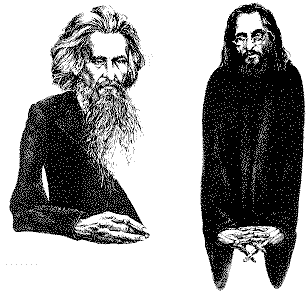 | Pavel Florensky and Vladimir Solovyov |
Skovoroda, the earliest East Slavic thinker, promoted the secularisation of thought from a religious point of view with his gnoseological dualism of the visible (creaturely) and invisible (divine) world and his pragmatic ontology. The flip side of this is the immanence of the religious, which still characterises philosophising in Russia to this day. Outside of religion, but always in dialogue with it, Russian literature of the 18th and 19th centuries, from Lomonosov to Puškin to Cechov, continued the secularisation of thought in the direction of a literary philosophy. We encounter it in the religious writings of Gogol as well as in the profane speeches and treatises of Turgenev.
At the turn of the century, Russian symbolism brought together the two traditions that, according to Western ideas, are peripheral, the religious and the literary philosophical. And it was precisely at this time that Russian philosophy first flourished. It was equally characterised by the lively influence of Hegel and the lack of reception of Descartes and Leibniz. Russian philosophers read Spinoza more than the Enlightenment philosophers until very recently. Kant only found his way to Russia in the 20th century via the Marburg School.
Until a few years ago, the role of literature as a guide to the world of thought was significantly promoted by the particularly strict Russian and Soviet marks on philosophical issues. Even today in Russia, anyone seeking instruction in questions of thought still reads the works of Puškin and Gogol', Dostoevskij and Tolstoj, Bulgakov and Platonov. What bothers many in German about Benjamin's style of writing, despite or because of Nietzsche, applies to the tone of Russian thought from the very beginning: He has kept a 'literary philosophy' in motion since Solov'ev and Rozanov.
This standpoint provides a revealing view of the cultural present: postmodernism and deconstructivism take pre-existing processes of consciousness for events of being. Conversely, from a point of view extraterritorial to postmodernism, postmodern being is exposed here as pure (linguistic) thinking. Mamardašvili and Pjatigorskij herald the end of the linguistic age by rejecting not only the postmodern critique of logocentrism but also the premises of Derrida's grammatology. Their metatheory of consciousness can trigger an avalanche-like slide in the humanities; those who follow it will shift the emphasis from textual studies to research on concrete processes of consciousness.
We also observe the shift from an attitude towards norms and rules to a pragmatic consideration of concrete individual cases in Russian logic. Truth in discourse is the title of Yuri Levin's propositional investigation of the question of truth, which, in view of the singularity or plurality of truth in everyday sentences, grants only limited validity to the proposition of the excluded third.
By looking at statements with dubious and unclear or relative, with conditional or subjective as well as irrelevant truth value, against the custom of truth-logical treatises, Levin is able to identify the unambiguity of the truth value in statements of real discourse as an exception. For the predominant cases of ambivalence, undecidability and irrelevance, he succeeds in gaining remarkable insights. The totalitarian discourse uses ritual language to replace the open-ended opposition of truth or falsehood, which can only be determined in each case, with the normative, predetermined alternatives of right or wrong, admissible or inadmissible. Incidentally, this is no less true of speech characterised by 'political correctness': without the risk of error, which ideologists and science managers shun, truth cannot bear fruit. Levin therefore calls for philosophy to abandon the claim to truth.
In Podoroga's metaphysics of landscape, a new kind of philosophy of space elevates the location of the philosopher to the object of philosophising. It individualises the ecological passion of Lev Gumilev's landscape-determined ethnogenesis. For Podoroga, landscape is first and foremost cultural landscape. This difference to Gumilev follows from the fact that, unlike the steppe of the nomadic Mongols, the land of Modia, the Engadine and the Black Forest are not fated birthplaces, but spiritual spaces that Podoroga's 'heroes' Kierkegaard, Nietzsche and Heidegger first sought out and then visited. The Russian philosopher is concerned with the congruence between basic principles in the strategies of philosophising and experiences of a physical landscape, which penetrate into figures of thought and styles of representation. He succumbs to the pull of the mythical communion of earthly body and (folk) body, of landscape and mentality postulated by Gumilev. The unpleasant memory of Josef Nadler's literary history of German tribes and landscapes comes to mind. Mikhail Ryklin's philosophising, on the other hand, exposes the tradition of Russian culturology to the thought-provoking impulses of early French postmodernism. His 'logics of terror' confront the terrorist practices that took their most terrible form in this century in Soviet Stalinism and German National Socialism. He sees the practice of state terror as always directed at a collective body in which the body of the individual, rendered faceless, is dissolved, whereas the logics of terror are directed at the individual body as a reflexive cultural experience of terror.
Ryklin contrasts the Western (terrorological-sadistic) tradition of confession with an Eastern tradition that makes gender independent, elevates it to a cosmic phenomenon and appears above all in literature. The basic premise of his cultural model is the contrast between the singularity of the human body in both reflexive and meta-reflexive culture on the one hand and the collective and non-reflexive character of the body of words in modern urban verbal communication shaped by industrialisation on the other.
The juxtaposition of historical terror with its orientation towards reasons on the one hand and the non-historical logics of terror, like the laws of nature, with their focus on effects on the other, makes it possible to leap out of the mediatedness of time, of which thanatology is an indispensable component. Thus the step from the "discourse of gender" of the October Revolution to the "natural, cosmic terror" of the 1930s can be understood as Stalinism's farewell to history, which is signalled by the Chernobyl reactor catastrophe.
By emphasising the ability of exstatically rational terror to defeat the logocentric mind and aim directly at the body, Ryklin expresses a desire for immediacy that is as alien to postmodernism as the cosmological dimension of Russian philosophising. Here, a constant motif of Russian history is given literary-philosophical honour, the motif of the crown pretender, whose role in de Sade is assigned to God and thus breaks the norms of rational atheism.
With the rallying cry "Yes, Apocalypse, yes now", Boris Groys negates Derrida's outcry "No Apocalypse, not now". From a cultural-economic perspective, which in the good Russian tradition takes a pragmatic view of the proclaimed truth with a view to the question "cui bono?", he uses Derrida's critique of logocentrism to roll up the apocalyptic mood as postmodern self-criticism. Groys identifies nuclear war as a concrete case of Derrida's meta-apocalypse, which threatens to wipe out all (literary) fictions - the 'archive'. In that post-structuralism, unlike its predecessor, does not set the redemption of meaning, not the hitting of the target by the missiles, as the norm, but rather the confusion of determination, the apocalypse of the apocalypse rises to the hope of salvation and Derrida, the guarantor of salvation, becomes its leader.
Igor' Smirnov's essay The Primordially Repressed has its place in the context of his Psychodiachronologik, which has just been published in Moscow. This volume, which unfolds Russian cultural development since Romanticism as a series of stages of psychological maturation, summarises works from the last fifteen years and, after Vygotsky's Psychology of Art and Grifcov's Psychology of the Writer from the 1920s, is the third major work of Russian cultural psychology. It offers a psycho-theory, indeed a psycho-philosophy of the development of culture in nuce.
Western philosophical readers are most challenged by those Russian works that seek to overcome the Cartesian separation of subject and object in the sense of a "non-classical philosophy". Contemporary Russian philosophers claim their place on the fringes of classical philosophy, but in the centre of life.
The author
 Prof Dr Rainer Grübel, university lecturer in Slavic Philology at the Department of Linguistics and Literature, studied Slavic Studies, German Studies and Philosophy in Göttingen, Frankfurt and Leningrad. After gaining his doctorate, he first became a full professor at the University of Utrecht and then at the University of Leiden. In 1986, he accepted an appointment at the University of Oldenburg.