Medieval Studies - Older German Literature and Language
Contributions to medieval narrative research (BmE)
A medieval studies online journal from Oldenburg and Bremen

Medieval Studies - Older German Literature and Language
The ongoing co-operation project between the Department of Medieval Studies at the University of Oldenburg and the University of Bremen:
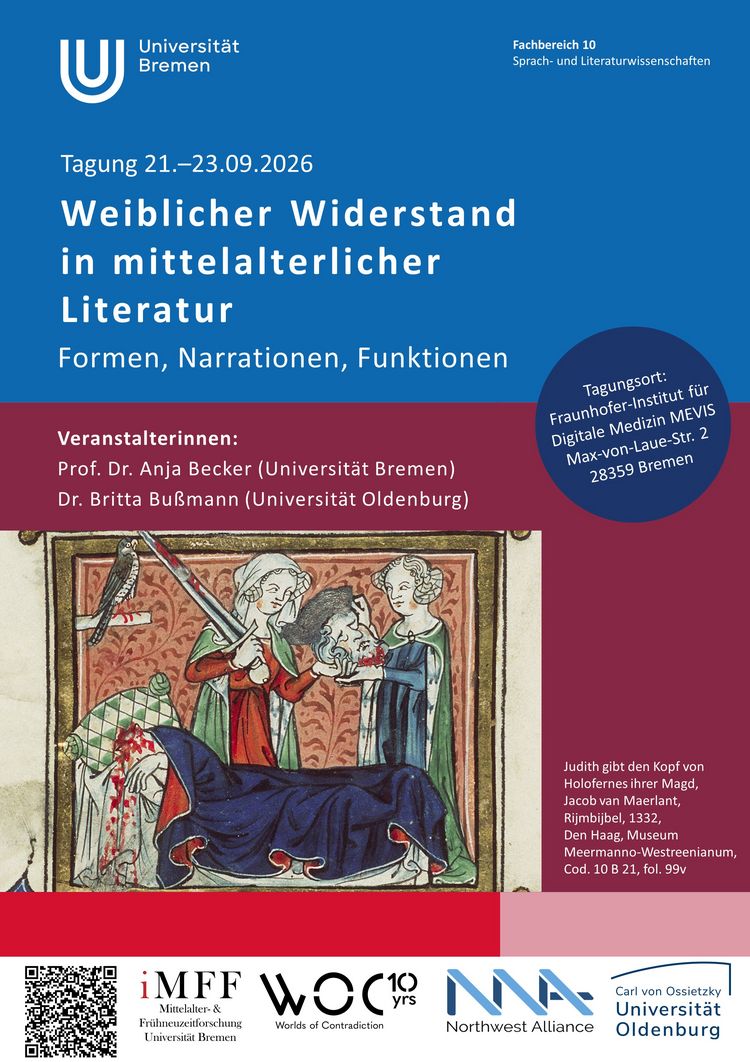
Narratives of Female Resistance in Medieval German Literature
This project examines Middle High German literary narratives of acts of female resistance, looking at their narrative content and form, their functions within the literary text, and the cultural and historical significance they convey as narratives.
(Funding period: 1 November 2025–31 October 2027, funded by the University of Bremen’s Central Research Funding Programme, Funding Line 06 A: Exploratory Projects on New Topics)
Participants: Prof. Dr Anja Becker (University of Bremen) (Principal Investigator and Lead Researcher), Dr Britta Bußmann (2nd principal investigator), Prof. Dr Albrecht Hausmann (University of Oldenburg), PD Dr Sonja Kerth-Wittrock (University of Bremen).
For students: What is medieval studies - and why study medieval literature?
The idea of a "middle age" (Latin medium aevum) between antiquity and modern times is an invention of the Italian Renaissance humanists of the 14th and 15th centuries. They dreamed of a revival of ancient culture and saw the "Middle Ages" as a phase of cultural and political decline that separated them from the heyday of Rome. This concept of the epoch still characterises the image of the Middle Ages today: we speak of the "dark" Middle Ages and often imagine medieval people as prisoners of irrational superstition.
Anyone who takes a closer look at the culture of the medieval centuries discovers a completely different, colourful world that is not easy to reduce to a common denominator. As medievalists specialising in German studies, we approach it primarily through German-language medieval literature. It is in many ways different from modern literature, but certainly no less exciting. Especially in the period around 1200, new concepts of lyric poetry (Minnesang) and narrative (Arthurian romance) were tested in the vernacular literatures - including German. In addition, there is the fascinating tradition of medieval texts: they were copied by hand and changed again and again. Medieval studies therefore also include the study of medieval manuscripts and the examination of their special mediality. Medievalists always work in an interdisciplinary way: because manuscripts often contain images, there are many links to art history; because German-language literature of the Middle Ages is often literature in translation, it is always appropriate to look at French literature in particular.
The second major pillar of medieval studies is language history: German medieval studies is also "responsible" for the older language stages of German from around 750 AD (Old High German, Old Saxon) to the emergence of Modern High German in the early modern period. Middle High German (around 1050-1350) is of particular importance here, as the works of the so-called courtly classics were also written in this language (Hartmann von Aue: 'Erec', 'Iwein'; Wolfram von Eschenbach: 'Parzival'; Gottfried von Straßburg: 'Tristan').
Important note for students in the M.Ed. programme (Gymnasium)
If you did not complete any medieval literature modules in your Bachelor's degree programme, you must do so in your Master's degree programme, even if this is not mentioned as a requirement in your letter of acceptance. The M.Ed. Gym German examination regulations require every student to provide proof of basic knowledge of medieval literature by the time they register for their Master's thesis. Please contact Prof Dr Albrecht Hausmann in good time to clarify how this proof can be provided. You can find a form for the certificate here. This note applies in particular to students who have completed their Bachelor's degree at another university where there may not have been any medieval studies programmes (e.g. Vechta, Lüneburg, Hanover, Hildesheim).