Events for the 2024/2025 winter semester
Events for the 2024/2025 winter semester
14.10.2024
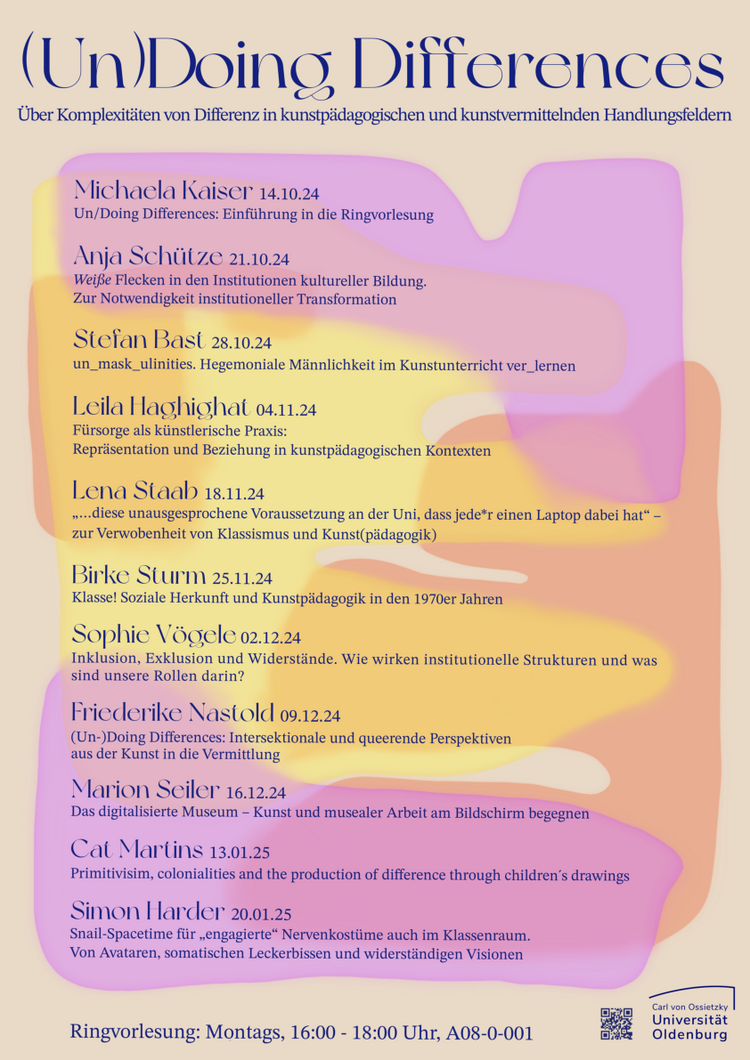
Michaela Kaiser: (Un-)Doing Difference: An Introduction
Michaela Kaiser is Professor of Art Education and Art Mediation at the University of Oldenburg. She conducts research on questions of art education and art mediation in the context of inclusion and exclusion, in particular on relations of difference in art mediating institutions. She is a co-founder of the working group "Building Access in Art Education" and a board member of the scientific association Kunst, Medien, Bildung.
21.10.2024
Anja Schütze: *White* spots in the institutions of cultural education. On the necessity of institutional transformation
white spots in the institutions of cultural education. On the necessity of institutional transformation
Abstract: The concept of cultural education is associated with multiple promises and expectations: culture should educate, be open to all, be made by all and hold society together. These promises and expectations arecontrasted by the constant criticalanalyses that institutions of cultural education - e.g. museums, theatres and concert halls - are still characterised by structural exclusions. The cultural sector in Germany is predominantly white and reproduces inequality and injustice along the lines of racism, sexism, classism and ableism. On the one hand, the lecture will critically introduce key concepts such as 'diversity' and 'discrimination' and, on the other hand, point out possibilities for action in order to disrupt the constant power relations and transform the institutions that reproduce them. In concrete terms, transformation processes will be analysed using the example of voluntary cultural and educational services.
Anja Schütze, white, cis-woman, mother, grew up in a village near Dresden. She currently works as a trainer for diversity and anti-discrimination, process facilitator and educational counsellor. She has a degree in cultural and media education (FH Merseburg), is a certified intercultural business trainer (London) and a systemic organisational developer.
She has worked as an education officer at the Bundesvereinigung Kulturelle Kinder- und Jugendbildung for 20 years. There she helped to set up the nationwide cultural youth volunteer service (FSJ Kultur) and has been focussing on the inclusive opening and diversification of volunteer services for 10 years.
She has been working as a trainer on diversity and anti-discrimination since 2007. In this context, she gives lectures, moderates and accompanies transformation processes and provides further training for managers and employees from cultural institutions.
28.10.2024
Stefan Bast: un_mask_ulinities. Un_learning hegemonic masculinity in art lessons?
Abstract: In art education research, questions of masculinity have only been addressed sporadically over the last three decades. The debates outlined for the subject of art range from rather essentialist understandings of masculinity to the deconstruction of gender stereotypes in the context of queer art education in general. However, a hegemony-critical debate explicitly on masculinity in art education has been lacking in the German-speaking research field to date, although proposals for a corresponding theorisation have been available in related disciplines such as sociology since the 1990s.
The lecture "un_mask_ulinities. Un_learning hegemonic masculinity in art classes" aims to contribute to closing this gap. It will examine the extent to which specific images of masculinity are effective in art lessons and how a critical examination of masculinities can be initiated in art lessons. In addition to a clarification of central concepts, exemplary materials such as memory protocols, images and curricula from an autoethnographic study will be presented and discussed, which provide initial impulses for un_learning hegemonic constructions of masculinity in art lessons.
Stefan Bast (no pronoun or he/him) is an art educator* and art teacher*. He works as a research assistant in art didactics at the Kunsthochschule Mainz, regularly takes on teaching assignments at various universities (UdK Berlin, Goethe University Frankfurt, Pädagogische Hochschule Karlsruhe, University of Potsdam) and trains multipliers in the field in workshops. Previously, he was an art teacher at a school in Berlin Marzahn-Hellersdorf for five years, an artistic assistant at the Kunsthochschule Kassel and worked in various extracurricular educational contexts. Bast teaches and researches discrimination-critical art education with a special focus on class issues, images of masculinity and the body, queerness and shame, which he analyses in his research using visual-autoethnographic strategies and hegemony criticism.
04.11.2024
Leila Haghighat: Care as Artistic Practice: Representation and Relationship in Art Education Contexts
Abstract: A central question in art education and art mediation contexts is how artistic practices can negotiate difference without falling into essentialising or simplistic representations. As an approach to meeting this challenge, the lecture introduces an "aesthetics of care" that illuminates the significance of representation and relationship in art education from a postcolonial and feminist perspective. Especially in times of global crises and divisions, it is crucial how we can relate to each other and fill the social "we" with meaning. Building on the theories of Gayatri Chakravorty Spivak and Édouard Glissant as well as feminist care ethics, care is presented as a necessary ethical practice and form of aesthetic reflection that emphasises relationships and interdependence. The concepts of "opacity" (Glissant) and "radical alterity" (Spivak) play a central role here: they call for the limits of understanding to be recognised and for difference not to be appropriated through representation. Instead, a responsible relationship with the "other" is sought. This is not only about recognising difference, but also about the responsibility to reflect on power relations and create the conditions under which care becomes possible in the first place.
An authentic 'we' requires attentive listening, looking, sensing and the admission of hidden narratives and emotions in order to take into account the perspectives and vulnerabilities of others. A practice that focuses on care must also critically reflect on who is entitled to care work, what resources are available for this and how their often invisible added value can be recognised. The concept of an aesthetics of care should serve to explore possible approaches and challenges of an art education practice that has the potential to create new forms of togetherness.
Leila Haghighat is doing her doctorate on the double bind in socially engaged art at the Academy of Arts in Vienna and was most recently the administrator of the professorship for art education at the Braunschweig University of Art (2023/2024) and a fellow of the Nietzsche Fellowship of the Klassikstiftung Weimar (2023). She is a member of bildungslab* and was coordinator for cultural education at the Haus der Kulturen der Welt in Berlin (2012-2017). Her current work focuses on socially engaged art, (urban) spaces, care, institutional analysis and representation.
18.11.2024
Lena Staab: "...this unspoken requirement at university that everyone has a laptop with them" - on the interweaving of classism and art (pedagogy)
Abstract: Classism - discrimination on the basis of social origin and/or economic or social position - influences both access to artistic education, whether in school art lessons or in extracurricular programmes, as well as the production and reception of art itself. Questions about the invisibility of class and classism, as well as the difficulty of visualising these differences and the associated discrimination, appear to be central to this.
Using theoretical approaches and empirical examples, the lecture will highlight the interweaving of classist structures and their re-productions within art education fields of action in order to then raise questions about art education that is critical of classism.
What questions must a classism-critical art education or art educators ask themselves in order to reflect on their own entanglement in classist structures, norms and habits and, in this sense, to be able to design art education programmes that are critical of power?
25.11.2024
Birke Sturm: Class! Social background and art education in the 1970s
Abstract: Between 1970 and 1980, the category of social background was the subject of intense debate in German-speaking art education. A discussion about improving the life opportunities of children and young people with little economic, cultural and social capital centred around the socio-theoretical and political category of class. The aim was to create lessons that would have an empowering effect and offer social participation for all - a goal that remains an educational utopia for many to this day, as is currently evident from the urgent debate on inclusion and educational justice.
In my presentation, I will introduce three art education approaches from the 1970s and work out which theories and methods these approaches used to activate the potential of school art education to reduce class-based disadvantage. Firstly, I look at visual communication, which problematised mass cultural images against the background of the Frankfurt School. Secondly, I show how, in debates about the phenomenon of kitsch and in connection with Pierre Bourdieu's theory of distinction, the sovereignty of taste of the ruling class in art education was held responsible for a false education in values at school. Finally, I look at how the examination of popular youth cultures inspired by cultural studies has called for a positive approach to lifeworld-relevant visual worlds in art lessons.
Finally, I discuss the question of which of these sometimes contradictory approaches can still be taken into account today when it comes to designing art education practice as a space for action in which as many people as possible are given opportunities for a better life and class is considered intersectionally.
Birke Sturm holds a doctorate in art education and cultural studies. She works as an assistant professor for the didactics of art and design at the Mozarteum University Salzburg. Previously, she was a lecturer and post-doctoral researcher at the Academy of Fine Arts Vienna and a teacher for the subjects of visual education and English at the Lauder Chabad Campus Vienna.
Her work is characterised by her experience in both academic and school environments. They lie in the fields of cultural studies and visual literacy, critical art and cultural education, the history of art education as well as in the development of didactic and art education theory. She is currently writing her habilitation thesis on art education, popular cultures and social justice.
02.12.2024
Sophie Vögele: Inclusion, exclusion and resistance. How do institutional structures work and what are our roles within them?
Abstract: The study "Art.School.Differences." focussed on inequalities and normativities in the field of Swiss art schools. Eight years after the study was completed, the questions and results are still relevant far beyond the field of art schools. Why?
Sophie Vögele presents the most important results of the study: How exactly do processes of inclusion and exclusion take place at art colleges? Why are these exemplary for understanding discriminatory structures in the field of higher education? And what is institutional normativity? It is interesting to see how the reactions to the study - from approval to denial - confirmed the findings even after it was completed.
Inspired by the explanations, it will be exciting to jointly question the functioning of institutions and processes and exchange experiences: What has changed; or what needs to change? What are possible fields of action - and what is our responsibility as part of the institution?
Sophie Vögele joined Zurich University of the Arts ZHdK in 2014 to work on the "Art.School.Differences" project (research and teaching Art Education and Design, Department of Cultural Analyses and Mediation) and has since worked intensively on inclusions and exclusions, diversity, representation and inequality at Swiss art schools (see: bit.ly/a_s_d). She is currently leading the interdisciplinary project "Right to We" and is exploring the question of cultural participation and its connection to sustainability efforts. She has a background in gender studies, ethnology and sociology.
09.12.2024
Friederike Nastold: (Un-)Doing Differences: Intersectional and queer perspectives from art into mediation
+++ Content to follow shortly +++
16.12.2024
Marion Seiler: The digitalised museum - encountering art and museum work on screen
Abstract: In the context of digitality, it is necessary to make museum work visible on the Internet and to develop access points there in order to remain relevant and transparent. While most institutions already advertise and provide information on social media, large parts of museum collections are still invisible to the public. Platforms and digital collections should provide a remedy. Under the heading of democratising culture, interested parties and experts can use the platforms to examine and get to know works and artefacts. The focus here is on metadata and institutionally acquired knowledge about the objects and artworks.
When analysing the platforms, hegemonic structures become particularly clear. The institutions consolidate their positions and strengthen their power of interpretation. The article is dedicated to the questions of how users can encounter art on various platforms, which concept of art is communicated by the institutions and how art is mediated in the context of post-digitality.
Marion Seiler studied European Ethnology and Museum Studies. From 2020 she worked as a curator and collection assistant. She has been working at the Institute of Art and Visual Culture since 2023 in a project position on digitally based art education in the context of schools. Her research focus is on digitality and museum collecting.
13.01.2025
Cat Martins: Primitivism, colonialities and the production of difference through children's drawings
Abstract: This talk is about the construction of the White Western creative child in the late 19th and early 20th centuries, focusing on the discourses that equated the child with the "primitive" at the intersection of art education, anthropology/ethnography, psychology, and education, rooted in the recapitulationist theories of the time. It traces how these notions were part of travelling libraries that produced corresponding visual affinities, creating a visual culture that reinforced the concept of the child as an artist. I take a poststructuralist and decolonial approach, arguing that many of these concepts, formed around the creative child, are phantasmagrams that continue to haunt art education today. To look critically at these archives is the path to understand their historical persistence, and thus, disrupting these colonialities in the present.
Cat Martins: Professor at the Faculty of Fine Arts, University of Porto, where they are the director of the PhD in Art Education and coordinator of LabEA_Laboratory of Research in Art Education, at i2ADS. Their research focus is on the history of the present of art education through a post-structuralist and decolonial approach. They are the author of the book The invention of Childhood Creativity: colonialities and the production of difference (Routledge, 2025).
20.01.2025
Simon Harder: Snail spacetime for "dedicated" nerve costumes in the classroom too. Of avatars, somatic delicacies and resistant visions
Abstract: In a participatory format, Simon Noa Harder gives an insight into the long-term research project: "Supersnail: infinitely magical". It revolves around the trans*formation of embodied forms of violence, shame and the embodiment of "pleasure". The space declared to be a game is interesting because it creates a small distance to the bitter seriousness of reality in order to examine, question and shift the narrowness of spaces. Why does this shift always involve somatic work? What does this have to do with nervous costumes? Because bodyminds are sites of struggles for hegemony - including in schools. In the process, certain bodyminds are not only altered, de-placed and literally suppressed. In the neoliberal acceleration society, for example, a set of heteronormative, ableist practices and norms makes it difficult to relate positively to certain bodyminds. Some are rejected as unworthy of "pleasure".
The project searches for trauma-sensitive spaces of possibility with critical optimism, utopian imagination - and, if necessary, magic. The point of reference for the participatory presentation is the Snail-Pace performance "Friends of the Molluscs. My body belongs to me" (2023/2024 Schwankhalle Bremen). It followed in the footsteps of the gender-variant superhero "Supersnail", who has been slithering around the world for 500 million years. Against all odds, she has managed to remain naked and soft. Between lecture performance, object theatre and participatory installation, Supersnail went on a crawling journey through time in search of the delicate hatchling of its symbiont. She talks about her survival skills, searches for treats for neuro-queer nerve costumes, meets friends - the drag persona Becky, Y. - and very special super-soft animals and contributions from young FLINTA*. They emerged from the artistic-educational workshop series of the same name with intergenerational exchange on the topic of "My body belongs to me".
Simon Noa Harder is an artist*, scientist* and mediator* researching the interfaces between cultural-political education, art education and pedagogy, art/performance, critical trans*, somatic work, embodied social justice and disability studies. In the long-term project "Super Snail: Infinitely Magical", SNH is artistically researching the self-determined appropriation of neuroqueer bodyminds. Since 2024 he* has been a visiting professor at the Institute for Art Didactics and Aesthetic Education (UdK). Since 2022 he has been teaching at the Institute for Art in Context (UdK) with a focus on artistic work with social groups. In 2020, SNH completed his doctorate at the University of Applied Arts in Vienna with the multimedia, transdisciplinary work "Trans*formations&Art Education. Negotiating un*visibilities". From 2012-2019 SNH was an artistic-research associate at the Institute for Cultural Studies and from 2013-2015 co-researcher at the Institute for Art Education at the Zurich University of the Arts in research projects of the Swiss National Science Foundation. SNH is the author* of "Reclaim your Body/Pleasure! Embodied tectonics trans*form. For trauma-sensitive approaches in the context of "engaged" educational work" and "Embodied Magic - ein*e Superheld*in. For trauma-sensitive spaces of possibility" (both in: re-visionen No. 1, Berlin, UdK 2023). Co-author* "to the Spirit of Les Complices* (Zurich, 2022); "Ansätze für trans*formative Pädagogiken" In: Bildung Macht Diversität, transcript, 2021