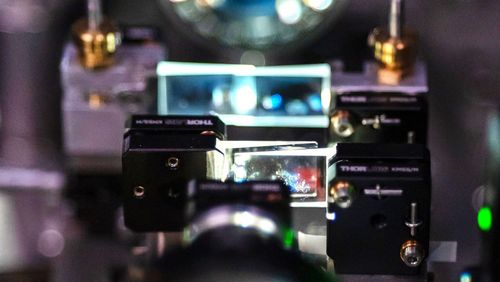


An international team of physicists led by the University of Oldenburg has demonstrated an ultra-fast switching process that could be used in optical components in the future. The light switch consists of extremely thin semiconductor layers.
A nanostructure made of silver and an extremely thin semiconductor layer can be transformed into a fast-switching mirror - in principle, an optical transistor that switches around 10,000 times faster than the corresponding electronic component. This effect is described by an international team led by physicist Prof Dr Christoph Lienau from the University of Oldenburg in the current issue of the journal Nature Nanotechnology. As the researchers report, such ultra-fast light switches are of particular interest for optical data processing.
The team's aim was to find a material whose reflective properties can be specifically changed, i.e. "switched", by a laser within a period of a few femtoseconds. A femtosecond corresponds to a millionth of a billionth of a second. For the study, the researchers used a thin silver plate, on the surface of which they milled a grid of parallel grooves around 45 nanometres (billionths of a metre) wide and deep. Team members from the University of Cambridge (UK) applied an extremely thin semiconductor layer on top of this. The film of the semiconductor material tungsten disulphide consisted of just one monolayer of the crystal, i.e. it was three atomic diameters thick.
Nanostructure with an unusual reaction to light
Due to this combination, the nanostructure showed an unusual reaction to light, as the team reports. "Neither of the two materials alone exhibits a switch effect," emphasises Lienau. However, when combined in a nanostructure, the two materials react in a completely new way, which is why researchers refer to them as an active metamaterial: Irradiated light can be stored on the surface of the nanostructure for around 70 femtoseconds in the form of a special quantum state, a so-called exciton-plasmon polariton, before it is reflected. In this state, which has the properties of both light and matter, the light propagates along the surface of the semiconductor layer in the form of so-called plasmon waves. In doing so, it interacts strongly with the electron-hole pairs of the semiconductor layer, the so-called excitons.
"During this storage time, we were able to specifically control the reflectivity of the layer," explains Dr Daniel Timmer from the Institute of Physics in Oldenburg, who was the first author of the study together with Dr Moritz Gittinger. The researchers used an external laser pulse to change the strength of the interaction between the excitons and the plasmon wave. In their first experiments, the team already succeeded in changing the brightness of the reflected light by up to 10 percent in this way - an astonishingly large value that can probably be increased by optimising the material.
Timmer and Gittinger investigated the effect using the method of two-dimensional electronic spectroscopy (2DES). This experimentally challenging method makes it possible to observe quantum physical interaction processes with a time resolution of a few femtoseconds, just like in a film. A team led by Lienau recently used a trick to significantly simplify the application of 2DES, making it usable for further studies. "In the current study, we succeeded for the first time in examining such a metamaterial with light pulses that are shorter than the observed switching process," emphasises Lienau. This made it possible to record the various stages of the phenomenon at intervals of a few femtoseconds.
Possible applications: Chip production, sensors and quantum computers
"Our results are of great interest if you want to realise ultra-fast light switches on the nanoscale," emphasises Lienau. One possible application is optical data processing, for example. "The information that can be transmitted per unit of time would increase dramatically with such switches," explains Lienau. By way of comparison, the switching time of electronic transistors, which are used millions of times in computers or LED televisions, is around a thousand times as long. From a physical point of view, optical technologies are therefore the only way to further increase the clock rate of conventional computers. Nano light switches could also offer interesting possibilities in chip production, in optical sensors or quantum computers. Lienau emphasises: "The most important task will be to design, tailor and optimise active metamaterials in such a way that corresponding applications become possible."
In addition to the Oldenburg team, researchers from the University of Cambridge (UK), the Politecnico di Milano in Milan (Italy) and the Technical University of Berlin were involved in the study.