

Low algal growth despite high iron supply: Study uncovers surprising link between West Antarctic Ice Sheet retreat and the growth of marine algae over the past 500,000 years.
A sediment core from the Pacific sector of the Southern Ocean has provided a research team led by geochemist Dr Torben Struve from the University of Oldenburg with evidence of an unexpected climate feedback in Antarctica. As the team reports in the latest issue of Nature Geoscience, there was a close correlation between changes in the West Antarctic Ice Sheet (WAIS) and marine algae growth over previous glacial cycles – but the correlation was not as expected. Based on the results, the team concludes that global warming may lead to reduced uptake of carbon dioxide than at present in the Pacific sector of the Southern Ocean if the West Antarctic Ice Sheet, which is considered unstable, continues to shrink.
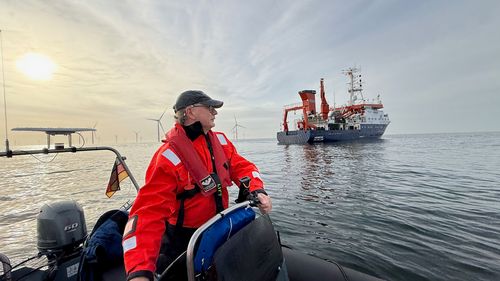
The sediment core analysed in this study contains deposits dating back to around half a million years ago, covering four glacial cycles. It was retrieved in 2001 during an expedition with the research vessel Polarstern from a depth of almost 5,000 metres at 116 degrees west and 62 degrees south. Located south of the Antarctic Polar Front between South America and New Zealand, this area is part of the Southern Ocean.
The element iron (Fe) plays an unexpected role in the climate feedback process observed by the researchers. “Normally, an increased supply of iron in the Southern Ocean acts like fertiliser: it stimulates algae growth, which increases the oceanic uptake of carbon dioxide,” explains Struve. According to earlier studies this is what occurred during previous glacial periods: strong winds blew iron-rich dust from the continents into the oceans. This promoted algae growth and the uptake of carbon dioxide in the Southern Ocean north of the Polar Front, which intensified global cooling at the beginning of glacial periods.
Ice in West Antarctica retreated on a large scale 130.000 years ago
However, the sediment core examined in the current study painted a different picture: analyses revealed that – unlike reconstructions from the ocean areas north of the Polar Front – iron input south of the Polar Front was particularly high during warm intervals. Based on their analyses and the size of the particles in question, the researchers conclude that these sediments were transported to the site by icebergs. The composition of the sediment also suggests that the material came from West Antarctica, the section of Antarctica located west of the Antarctic Peninsula. The ice sheet there is considered to be rather unstable because much of the ice is grounded below sea level.
The current study thus makes a small contribution towards clarifying the question of how sensitive the West Antarctic Ice Sheet is to climate change, Struve reports. Several recent research results indicate that the ice in this part of Antarctica retreated on a large scale during the last interglacial period around 130,000 years ago. Temperatures were at around the same level as they are today during this period. “Our results also suggest that a lot of ice was lost in West Antarctica at that time,” explains Struve, who conducts research in the Marine Isotope Geochemistry research group at the University of Oldenburg’s Institute for Chemistry and Biology of the Marine Environment. The disintegration of the ice sheet, which was several kilometres thick in places, created a large number of icebergs that had picked up sediments from the underlying bedrock and then released them as they drifted northwards and melted. According to the data from the sediment core, particularly large numbers of icebergs were present at the end of the glacial periods and during the peak of the interglacial periods.
Struve and his colleagues from the Alfred Wegener Institute Helmholtz Centre for Polar and Marine Research in Bremerhaven and the Lamont-Doherty Earth Observatory in New York State were surprised to find that the high iron supply did not result in accelerated marine algae growth. “The growth of phytoplankton – microalgae found in the light-flooded upper layers of the ocean – was either not stimulated or only weakly stimulated. This led to a sharp reduction in CO2 absorption,” explains Dr Frank Lamy, a palaeoclimatologist at the Alfred Wegener Institute, Helmholtz Centre for Polar and Marine Research (AWI), and co-author of the study. The researchers attribute this to the fact that the sediments were highly “weathered”. Their analysis showed that the iron contained in these mineral grains was in a less soluble form that cannot be easily utilised by living organisms.
In this area of the Southern Ocean, the total amount of iron input was not the controlling factor for algae growth.
Torben Struve, geochemist.
The picture that emerges from the data is as follows: “Beneath the West Antarctica Ice Sheet there is probably a layer of geologically ancient, highly weathered rock,” Struve explains. Each time the ice sheet shrank during previous interglacial periods and numerous icebergs broke off, they carried large quantities of weathered minerals into the adjacent South Pacific and algae growth remained low. “We were very surprised by this correlation,” says the scientist, “because in this area of the Southern Ocean the total amount of iron input was not the controlling factor for algae growth.” Contrary to previous assumptions, he explains that this study has shown that iron input does not necessarily increase CO2 uptake in the Southern Ocean. Rather, this depends on the bioavailability of the iron, and thus also on the chemical composition of the transported minerals.
Looking ahead and facing continued shrinking of the West Antarctic Ice Sheet as a result of global warming, the team points out that scenarios similar to those during the last interglacial period may be expected. “Based on what we know so far, the ice sheet is not likely to collapse in the near future, but we can see that the ice there is already thinning,” explains Struve. Further shrinking could accelerate the erosion of weathered rock layers by glaciers and icebergs. This, in turn, could lead to reduced carbon uptake in the Pacific sector of the Southern Ocean than at present – a feedback that would further exacerbate climate change. To determine the scope and impact of this phenomenon, Struve notes that further, more precise studies and analyses of additional sediment cores from the South Pacific are needed: “There is still plenty of material to work with in various archives,” he points out.