

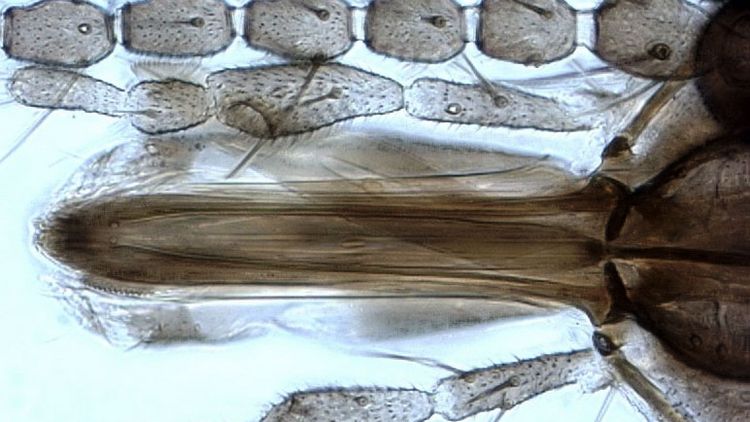

Small but treacherous: Gnats of the genus Culicoides are much smaller than the related mosquitoes, but as disease vectors they can cause epidemics in sheep or cattle with losses in the hundreds of millions. Young researchers at the university are investigating the ecology of the bloodsuckers.
By Sonja Steinke, Renke Lühken and Ellen Kiel
A specimen of the inconspicuous insect species Culicoides obsoletus, which belongs to the family of midges, is less than two millimetres in size. As is so often the case, size bears no relation to importance, as members of the Culicoides genus are vectors of various pathogens - including the bluetongue virus.
This virus infects ruminants and leads to miscarriages and reduced milk production in sheep and cattle, for example. Bluetongue is often fatal, especially in sheep. When it broke out in northern Europe in 2006, a lack of knowledge about the transmitting midges and their breeding sites prevented effective control of the epidemic. In Germany alone, the estimated damage amounted to a quarter of a billion euros.
The Aquatic Ecology working group at the University of Oldenburg had already conducted research into the breeding ecology of midges and other potential vectors among insects - and has since intensified this work in national and international projects.
Among other things, our working group is involved in the EU project VICE, in which scientists from eight countries are developing models to facilitate the monitoring and risk assessment of diseases transmitted by midges in the future. The central element of our work in this project is a nationwide study on the distribution and breeding ecology of the most important species in Germany.
Over the past two years, we have analysed the midge population and potential breeding habitats on 20 farms spread evenly across Germany. Initial results show that, for example, Culicoides obsoletus - a major vector of bluetongue disease - develops in particularly large numbers in dung heaps, while other species prefer to use cow dung, for example, as a breeding site.
Several theses and two doctoral projects are also concerned with further basic research into environmental influences on the development of the midge population: Which key stimulus is responsible for entry into the next stage of development? How well do larvae and pupae tolerate flooding or desiccation? How frost-resistant are the overwintering larvae?
These and other questions will be answered in field and laboratory experiments. To this end, breeding substrates including the larvae living in them are flooded, frozen or kept in the dark, for example. The aim is then to catch the hatching midges in order to measure their developmental success.
Although Germany has been officially free of bluetongue since 2012, a new disease, also transmitted by midges, broke out in 2011: Schmallenberg virus can cause premature births and embryonic malformations in cattle, sheep and goats, among other things. The sudden outbreak of this new disease has once again confirmed the importance of vector ecology research.
Sonja Steinke and Renke Lühken are doctoral candidates in the Aquatic Ecology and Nature Conservation working group at the Institute of Biology and Environmental Sciences (IBU). The head of the working group is Prof Dr Ellen Kiel.
More on the topic
EU project "Vector-borne infections: risk based and cost efficient surveillance systems (VICE)"
AG Gewässerökologie und Naturschutz
Contact
Sonja Steinke
Institute of Biology and Environmental Sciences
Tel: 0441/798-2057
sonja.steinke@uni-oldenburg.de