

The ocean is closely involved in the Earth's climate. It is responsible for the transport and global redistribution of heat and nutrients. How has the ocean behaved during abrupt climate changes in the past and what role has it played? The Max Planck Research Group "Marine Isotope Geochemistry", based at the Institute of Chemistry and Biology of the Marine Environment (ICBM) at the University of Oldenburg and supported by the Max Planck Institute for Marine Microbiology in Bremen, is asking itself these and other questions.
In order to find answers to their questions, the scientists are analysing the distribution of neodymium isotopes in the sea and in fossil marine sediments. The isotope ratios are characteristically distributed in the Earth's crust and thus imprint an isotopic "fingerprint" on the oceans. "By reading the neodymium isotopes, we can determine the origin of the seawater and thus the ocean currents," says Dr Katharina Pahnke, who has been setting up and leading the research group since August 2011.
Neodymium isotopy is Pahnke's speciality - the palaeoceanographer has already worked with her methodology at the Lamont-Doherty Earth Observatory at Columbia University in New York (USA). She had previously spent two years researching at the Massachusetts Institute of Technology in Cambridge (USA). Before coming to Oldenburg, Pahnke was an Associate Research Professor at the University of Hawaii.
"Neodymium isotopes offer a unique opportunity to study changes and processes in the ocean," explains Pahnke. Fossil marine sediments are also being analysed. "They provide us with information on how ocean circulation has changed in the course of climate fluctuations in the past."
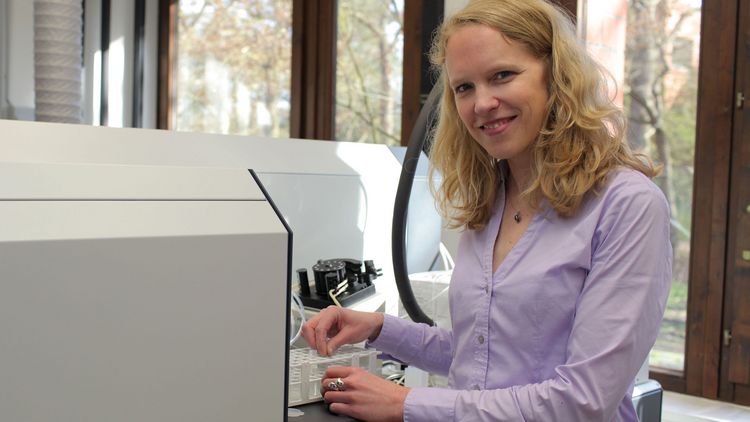
The research work is tricky: the isotopes only occur in very low concentrations in seawater. Measuring them requires patience and meticulousness - and above all very clean and dust-free conditions in the laboratory. The ICBM has purchased a highly sensitive mass spectrometer for the measurements. "The high-performance device has multiple detectors," says Pahnke. This allows it to measure up to nine isotopes simultaneously. "The mass spectrometer allows us to determine isotope ratios with high precision, which only show very slight differences in the environment."
Pahnke is confident that he will soon be able to provide initial insights into the history of the ocean and make a significant contribution to a better understanding of the world's oceans. Her research group already has water and sediment samples - obtained on ship expeditions in the Pacific sector of the Southern Ocean, the North Atlantic and the North Pacific. The next expedition is planned for the autumn: The research vessel "Sonne" will then head out to sea again - back into the ocean's past.