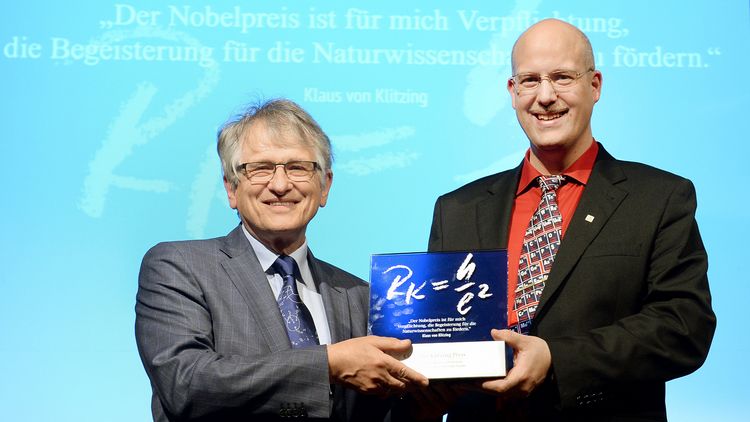

Great joy at Friedrich-Koenig-Gymnasium in Würzburg: Christian Lorey, senior teacher for Chemistry, Biology and Nature & Technology, receives the Klaus von Klitzing Prize 2015. The award, which is endowed with 15,000 euros and has been presented by the University of Oldenburg together with the EWE Foundation for eleven years, recognises outstanding commitment in the MINT subjects - i.e. Mathematics, Computing Science, Natural Sciences and Technology.
Prof Dr Klaus von Klitzing, Nobel Prize winner in Physics, presented the award on Tuesday evening during a ceremony at the Altes Gymnasium in Oldenburg. "Senior teacher Christian Lorey impressed the jury with his outstanding professional qualifications as well as his social commitment and above-average dedication," said von Klitzing, explaining the jury's decision.
Christian Lorey (41), who came out on top among 52 applicants from all over Germany, has been teaching at Friedrich-Koenig-Gymnasium (FKG) in Würzburg for 13 years. In 2006, he set up a special school laboratory, the "Natural Science Laboratory for Pupils at FKG e.V.". It includes a biology and chemistry laboratory, a laser and optics laboratory, a science library and, since 2009, the Hans Haffner Observatory in nearby Hettstadt. In the experimental and research rooms, the pupils not only carry out classic science experiments, but are also involved in current research through several co-operations with the University of Würzburg. This goes far beyond the curriculum. "To be honest, that's where the fun really begins," says Lorey.
They approach current issues in biology, chemistry, physics and astronomy through independent experimentation. For example, they investigate the special features of the Venus flytrap Dionaea muscipula, a carnivorous plant. As part of the astronomy research project "Fluctuations in the brightness of active galactic nuclei", they obtained measurement results that will soon be published in a renowned scientific journal. However, the students not only use the laboratory, they also keep it in good shape. They maintain sophisticated laboratory equipment largely independently and are supported by scientists from the University of Würzburg.
In addition, the students are involved in the organisation of the laboratory in a variety of ways - for example in the development of new experiments, the commissioning of new laboratory equipment or construction work at the observatory - and are also involved in the management of the student laboratory as board members. Every year, around 70 to 80 pupils - including pupils from neighbouring schools - conduct experiments in the laboratory in teams of 10 to 16 people.
Lorey's commitment to the school lab is voluntary; he supervises the young researchers alongside his teaching duties on free afternoons, weekends and during the holidays. He also raises funds for the lab and supports the purchase of new materials - even with his own funds. Lorey is also the initiator and coordinator of the science focus class at the FKG, a special class in which interested and talented pupils receive special support in the STEM subjects through an additional programme. Together with his pupils, he came second in the nationwide "School meets Science" competition organised by the Robert Bosch Foundation in 2009 and 2013.
"With his extraordinary school laboratory, Oberstudienrat Lorey awakens young people's curiosity for science and technology - and even paves the way for many of them to study these subjects. A great success, which we as a university with a focus on research-oriented learning are particularly pleased about," emphasises Prof. Dr Dr Hans Michael Piper, President of the University of Oldenburg.
Matthias Brückmann, who has also been Chairman of the Board of the EWE Foundation since October, adds: "The Klitzing Prize has succeeded in drawing attention to the importance of teachers for the educational and professional biographies of our children and the significance of STEM disciplines as a whole in our educational, economic and scientific system. At the same time, two thirds of the prize money totalling 15,000 euros is used to support a school project each year. In this way, the EWE Foundation is making a sustainable and targeted commitment to science and technology education."
In addition to von Klitzing, the jury includes representatives from the University of Oldenburg, the EWE Foundation and the Karl Heinz Beckurts Foundation. Klaus von Klitzing, who spent his early school years in Oldenburg, is, among other things, Director of the Max Planck Institute for Solid State Research in Stuttgart and a member of the International Solvay Institute and the decision-making board of the German Industry Innovation Award. In 1980, he discovered a new quantum effect and was awarded the Nobel Prize for Physics in 1985. The von Klitzing constant named after him had a significant influence on modern semiconductor development and precision measurement technology. In 2006, he received an honorary doctorate from the University of Oldenburg.