
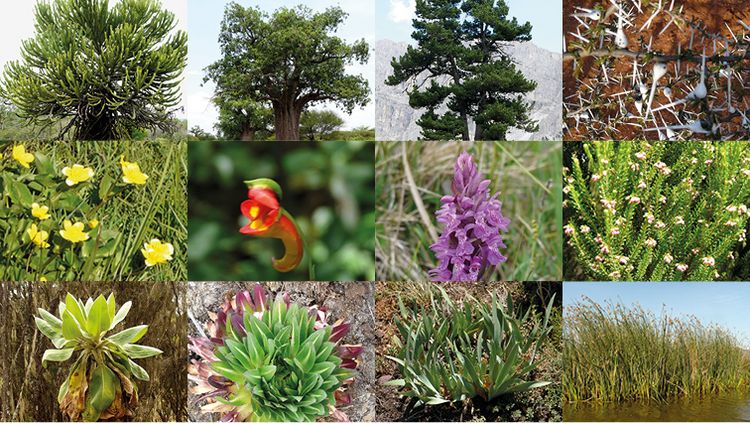

All plants on earth are to be recorded with their most important properties in the global database "Try". This is an ambitious project in which a team from Oldenburg is playing a key role. An article has already been published in "Nature", for which the database was of fundamental importance.
The claim sounds ambitious: The biological properties of as many plants on earth as possible are to be recorded in the "Try" database. The idea: global plant knowledge is collected centrally and made accessible to researchers worldwide. More than 30 scientific teams are working to achieve this goal - including a group of Oldenburg scientists led by biologist Prof Dr Michael Kleyer.
Kleyer heads the Landscape Ecology working group at the university and had already set up the predecessor database "LEDA" in 2003 - an EU project that now accounts for a significant proportion of Try's data. The first successes are already visible: the renowned scientific journal "Nature" has now published research results that would not have been possible without the Try data.
A look into the universe of plants
In the international study, in which Kleyer acted as co-author, the researchers mapped out the universe of plants. They scrutinised the six essential characteristics of plants: size, leaf size, leaf nitrogen content, seed weight and the physical and chemical properties of the stem and leaves. These characteristics are crucial for the survival of the plant because they characterise growth, stress tolerance and reproduction. Biologists call them "traits".
The scientists used the try database to analyse which trait combinations occur particularly frequently, which are less common and which do not occur at all. They discovered that there are surprisingly few combinations. Apparently, certain combinations have proven themselves in evolution, while others have been ruled out as non-viable. "A tiny plant cannot produce coconut-sized seeds, it just doesn't work biologically," says Kleyer, explaining the phenomenon using a simple example.
The combination of the individual traits is a very delicate, precisely balanced design - a design that the researchers can now draw a fairly accurate picture of thanks to the try database. "Until now, we have only been able to carry out small-scale studies in ecology due to the complex interactions. This study shows that global statements become possible when scientists around the world pool their data and analyse it together," summarises Kleyer.
Basis for more accurate climate models
Although the database is still under construction, more than 1,500 scientific projects from various disciplines already rely on it. The data helps, for example, to create more accurate climate models. Until now, these models have been based on very rough categories, only recording whether the plant is a shrub, a tree or a herbaceous plant. The Try data provides more detailed information about the individual plants and their characteristics - this makes the climate calculations much more accurate. They show, for example, how high the evaporation rate of a plant species is and how much carbon it can store - both crucial parameters for the global climate.
But it is also about very practical issues: in Lower Saxony, more wet meadows and moors are to be created again as part of the renaturalisation process. For this to work, the scientists must first clarify which plants are actually suitable for these habitats and whether they can manage to get there - even though the surrounding agricultural landscape is completely unsuitable for wetland plants. To do this, they need special characteristics that the database can provide information on.