
Hydrogen fuel cells have great potential, but their breakthrough is still a long time coming. Since July, junior professor Mehtap Özaslan has headed a BMBF junior research group that aims to give the low-emission technology a boost with new impetus.
They have been hailed time and again in the past, but the breakthrough has yet to materialise: fuel cells are too expensive, immature and unreliable - at least that is the criticism. "One of the major obstacles to widespread market launch is the high cost of materials due to the use of pure platinum as a catalyst," explains chemist Prof Dr Mehtap Özaslan. Large quantities of the expensive and very rare precious metal are still required for the electrodes of the fuel cells on which the electrochemical conversion processes take place. Without the catalysing effect of platinum, it is currently not possible to achieve the necessary performance in the fuel cell. "However, the sustainable use of expensive materials such as platinum is necessary to enable fuel cells to be utilised economically in the long term," explains Özaslan.
New impetus is therefore needed, and this is exactly what the junior professor wants to provide with her junior research group "Efficient and robust electrocatalysts for low-temperature polymer electrolyte membrane fuel cells". An unwieldy title that conceals a key technology for the reorganisation of energy systems: Hydrogen-powered fuel cells are regarded as a clean alternative to conventional combustion engines because they only produce water in addition to electrical energy. They operate silently, are more efficient than combustion engines and supply electricity instead of motion, making them suitable for a wide range of applications. The spectrum ranges from on-board power supply on ships to combined heat and power systems in private homes and vehicle propulsion. This resource-saving energy supply has long since become a "top priority": The Federal Cabinet recently approved the government's Hydrogen and Fuel Cell Technology Programme 2016 to 2026.
The junior research group is focusing on both the precious metal platinum and the carrier material, which together form the catalyst: "We are looking at the catalyst as a whole for both half cells in the fuel cell - that's what sets our group apart from many others," says the chemist. Her improvements should help to extend the service life of the fuel cell and make it more affordable. The fuel cell becomes cheaper if less platinum is used. As catalysis only takes place on the platinum surface, platinum can be saved by adding less noble metals such as cobalt and nickel. By using these so-called alloy nanoparticles, the researchers also improve the performance of the electrodes: "This allows us to drastically reduce the amount of platinum, but achieve the same and even higher performance figures as with pure platinum," explains Özaslan.
The junior professor and her team "design" the optimum nanoparticle, so to speak. "But every nanoparticle also needs a good anchor point on the carrier material," explains the researcher. Carbon as a carrier material is not only favourable, but also very conductive. On the other hand, it corrodes quickly under the operating conditions of a fuel cell - resulting in a loss of the carbon framework. This results in higher particle removal, which reduces the efficiency and service life of the catalysts. The researchers must therefore modify the carbon so that it becomes more stable. This is achieved, for example, by incorporating foreign atoms such as nitrogen into the carbon structure. "The key lies in the interaction between particles and carbon," explains Özaslan.
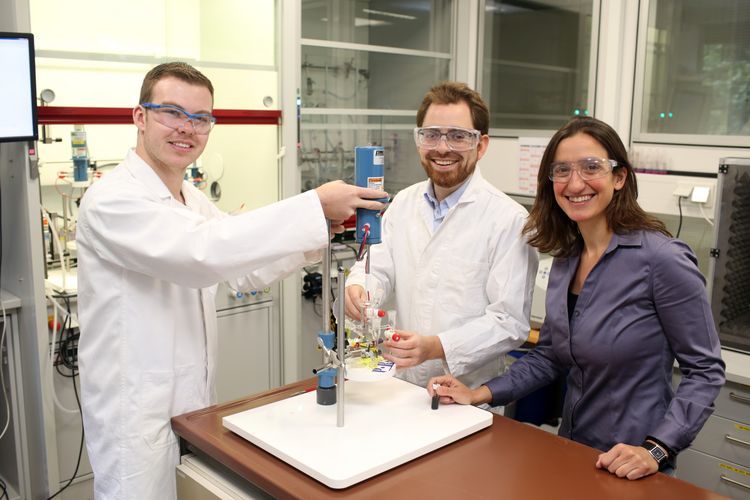
In the coming months, the scientists will initially analyse the two half-cell reactions of the fuel cell separately. "This will give us an overview of the behaviour of the materials we have developed," says the junior professor. Only then will she, her three doctoral candidates and a postdoc move from the laboratory scale to the real fuel cell. A correspondingly large test station, which Özaslan expects in April 2017, is part of the 2 million euro project approved by the Federal Ministry of Education and Research on 1 July. The scientist is convinced that the results of her junior research group will help fuel cell technology achieve a breakthrough.