

Developing new technologies to research biodiversity - that was the aim of XPRIZE Rainforest, a global competition involving more than 300 teams. Three doctoral students from the university also took part in the final.
The task that the "Brazilian Team" had to solve from 17 to 22 July was challenging: the group of more than one hundred researchers from eight countries had exactly 24 hours to explore the diversity of animals and plants in a remote, hundred-hectare section of the Amazon rainforest in the final of the XPRIZE Rainforest. The crux of the matter: no one was allowed to set foot in the area, which is the size of around 140 football pitches. And then there were only 48 hours to process and interpret the samples and data collected by drones and robots and record the findings in a report.
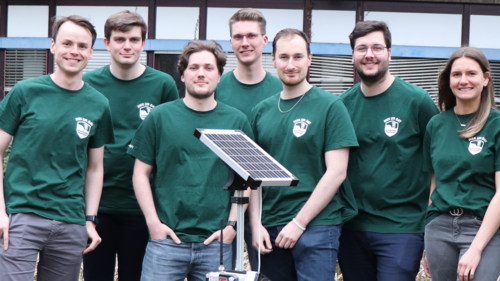
For Hannes Kath, a doctoral candidate in Prof Dr Daniel Sonntag's Applied Artificial Intelligence working group at the Institute of Computing Science, these 72 hours were "very special" - even though he spent them at home in Oldenburg. The computing scientist was part of a four-person Oldenburg group from the university and the German Centre for Artificial Intelligence (DFKI) that had developed an AI system for analysing audio data from the rainforest as part of the Brazilian team. During the final, the four were in constant contact with the other team members, who were spread across eight countries and three continents. "There were a few minor problems, but overall everything worked well," says Kath. In addition to his supervisor Dr Thiago Gouvêa from DFKI, doctoral students Ilira Troshani and Rida Saghir, also from Daniel Sonntag's group, were involved in the project.
XPRIZE Rainforest is a competition organised by the non-profit XPRIZE Foundation, which was established in 1995. The aim was to develop innovative technologies that could be used to record and monitor tropical biodiversity as quickly and effectively as possible. A total of around 300 teams took part in the competition, which ran for five years. Six teams reached the finals, which are currently underway, and will compete there one after the other. "The winners will be announced in November at the G20 summit in Rio de Janeiro," says Kath. First place is endowed with 5 million dollars.
Permanent concert in the jungle
Among the technologies used by the Brazilian team, acoustic monitoring was an important component. "This method is limited to animals that make noises, but there are quite a few," says Hannes Kath. There is a constant concert going on in the jungle: numerous birds chirping, crickets chirping, frogs croaking, other animals clicking, clacking, barking or making booming noises like a didgeridoo. For the Oldenburg acoustics team, the sound spectacle provided a comprehensive source of data to track down insects, birds, bats and amphibians in particular.
Their method was based on analysing three-second audio snippets recorded by drones or robots in the rainforest. In order to prepare the extensive data from the animal concert in such a way that their AI model could do something with it, the researchers had to go to some lengths in advance. Software first converted the recordings into images in which the sounds are represented as patterns of purple, pink and orange dots, dashes and lines. "You can see how high the energy of the sound signal is in a certain frequency range," explains the Computing Science expert. Experts can assign sounds to specific animal species based on the patterns.
"However, as we recorded the entire soundscape, the result was initially similar to the famous cocktail party effect - you hear everything mixed up," says Kath. The four Oldenburg researchers therefore split the sound snippets into eight different "channels" in order to separate the vocalisations of different animal groups. To ensure that their AI model was able to recognise cicadas or birds, for example, the team trained it with data from a sound archive. As a result, they obtained probability values for recognising a particular species in a recording.
The AI system is constantly learning
There is therefore one limitation to this method: "You can only find species that also occur in the training data," says Kath, who is also working on developing machine learning methods for the acoustic monitoring of biodiversity in his doctoral thesis. The Oldenburg team therefore utilised additional methods. Among other things, the researchers developed a method to find those among the thousands of sound snippets on which previously unidentified animal species could be heard. These recordings were then presented to experts from the entire team for "annotation". These were specialists in specific animal groups, including citizen scientists, who listened to the sound samples and then ticked which genus or species it might be. "Our AI system is constantly learning from this feedback," explains Thiago Gouvêa, who heads the Computational Sustainability and Technology working group at the Oldenburg branch of DFKI.
How many species the team was able to identify during the 72-hour final is still a secret. Kath only reveals this much: "We discovered several previously unknown cicada species." At the end of the 48-hour evaluation phase, the entire team submitted a 200-page report in which the most important result, an overview of the biodiversity in the test area, as well as the methods used are explained.
Now Kath and his team colleagues have to keep their fingers crossed - and continue working on the software, which will be freely available after the end of the competition. Any winnings will be donated, says Simone Dena from the Brazilian University of Campinas, head of the bioacoustics group, on behalf of the entire Brazilian team: "We have agreed to use the prize money for research into biodiversity in tropical forests, particularly in the Amazon, and in the Atlantic."