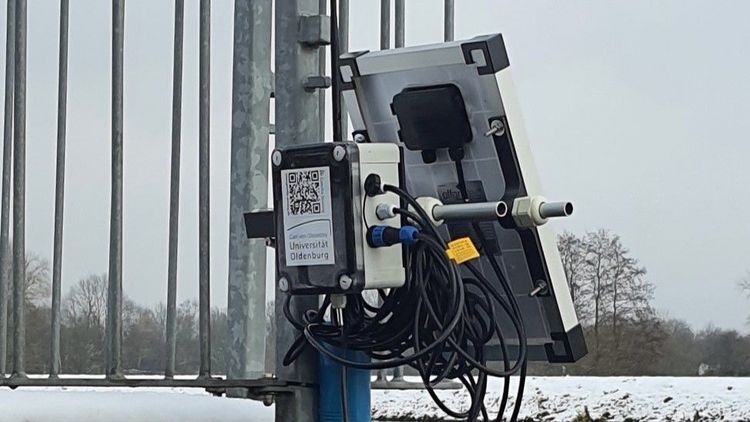


Master's students specialising in Computing Science and Business Informatics have developed a portable measuring station that can be used to detect floods at an early stage, among other things. The Oldenburg fire brigade, the Oldenburg technical relief organisation and nature conservation associations have shown interest.
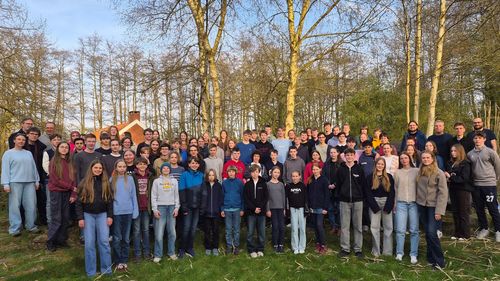
They call themselves the "Guardians of the River" in German. The name says it all: ten students of Computing Science and Business Informatics have been working on a water monitoring project over the past year, developing a measuring station in the process. "Our motivation for the project was the reports about the Christmas floods of 2023/2024. We asked ourselves what we could do as computer scientists to support rescue services and nature conservation organisations, for example," recalls Paula Wegerich, who is studying Computing Science in her third Master's semester and recently presented the project in a final presentation.
The team's measuring station, the "GBox", can use sensors to measure the water level, soil moisture, temperature and oxygen content of bodies of water and their surroundings. "By measuring water levels, for example, floods can be recognised at an early stage and measuring soil moisture can provide information about the soaking of dykes," explains Steffen Janßen, who presented the topic together with Paula Wegerich. "In the event of critical measured values, you can be notified by email so that action can be taken quickly," he continues. The data is transmitted via LoRa, a wireless network that also works over long distances. This means that the GBox can also be used without a mobile phone or internet connection.
Further advantages: The measuring stations are cost-effective, quick to set up and can therefore be used flexibly in crisis situations. "Inside there is a circuit board for signal transmission, a microcontroller as the brain of the box and a module for communication. There are also built-in lithium-ion batteries, which we charge using an externally mounted solar panel. Various sensors can also be attached to the outside as required," says Master's student Steffen Janßen.
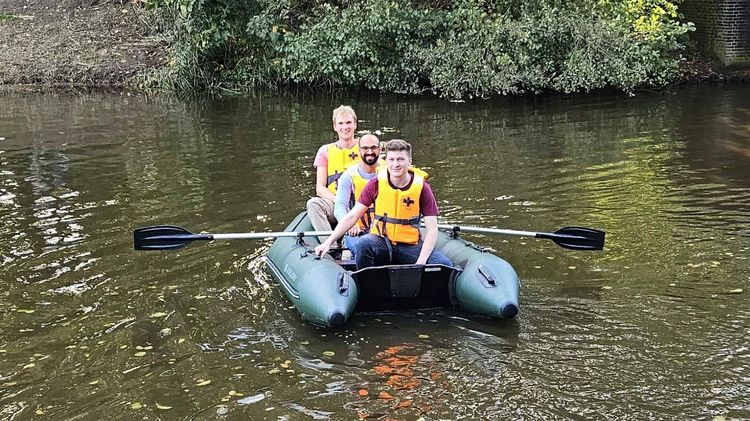
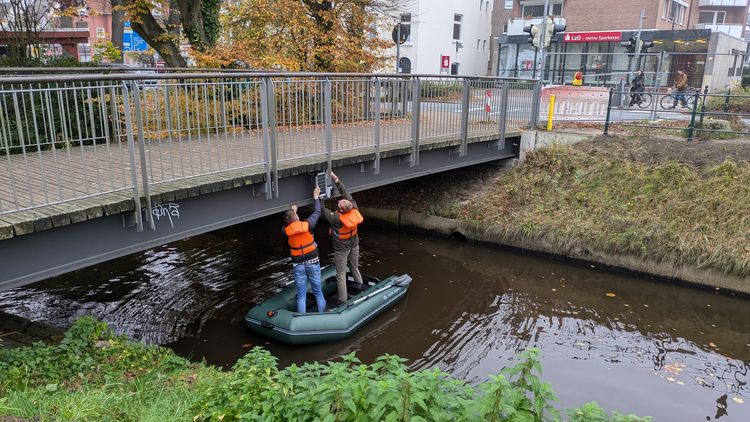
The students tested their measuring stations at various locations along the Hunte and Haaren rivers in the Oldenburg city area, for example at the Hunte barrage or at the former Cäcilienbrücke bridge.
Both the city of Oldenburg and the Lower Saxony Water Management, Coastal Defence and Nature Conservation Agency (NLWKN), the Oldenburg fire brigade and the Oldenburg Technical Relief Agency (THW) supported the students with questions during the project phase. They were also interested in the wide range of possible applications, for example in flood protection.
The "Guardians of the River" project came to an end with the presentation. In addition to developing the GBox, the students' tasks also included procuring funding and liaising with external experts. "In the beginning, coordinating the project wasn't so easy because we first had to get to know each other," reports Guardian and computer science student Mathis Kölker. "But then we quickly grew into a great group."
The next group of students is already in the starting blocks to drive the project forward under the leadership of Prof Dr Andreas Winter and Prof Dr Oliver Theel from the Department of Computing Science. In future, they will be focussing more intensively on the topic of dyke protection. To this end, they will attach the sensors to the so-called seepage lines of the dyke. The seepage line is a natural boundary inside the dyke that runs from the water side to the land side. Among other things, it depends on the water level and rises during floods. A rise in water levels can lead to undermining, which has a negative impact on the stability of the dyke.