
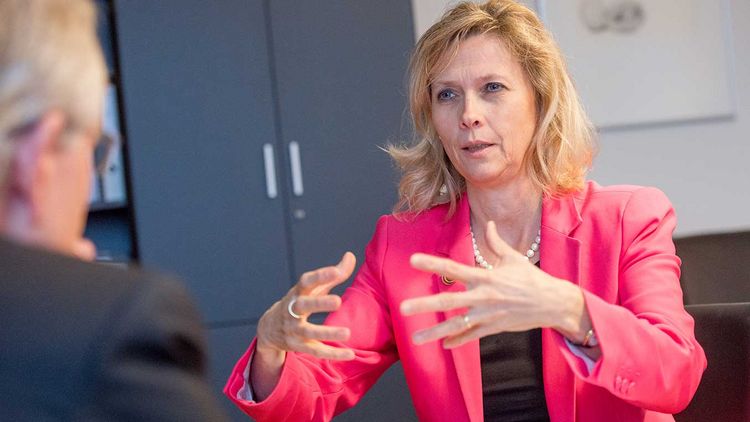


40 years of the University of Oldenburg: At the start of the anniversary celebrations, President Babette Simon talks about challenges and prospects, about "sustainable society" as a topic, the support of the region - and about what is typical of the University of Oldenburg.
QUESTION: Ms Simon, the university's anniversary year began on 4 December with a celebratory kick-off in the lecture hall centre. Numerous events will follow until the end of next year. 40 years of the University of Oldenburg: What does that mean to you?
SIMON: Well, first of all, I am very much looking forward to the numerous events with which we are inviting all interested parties to celebrate this birthday with us - and by that I mean the entire university with all its members and affiliates. We want to look at the university together, at its development, its topics, its priorities, its ideas and visions - and at its people. Because this university lives from its people - the academics, the technical and administrative staff and, above all, its students.
QUESTION: 40 years of the university's existence - is that also an occasion to look back and remember the founding moments? During the years of its foundation from 1971 to 1973 and also in the first years of its existence, the Reform University project was repeatedly on the brink of financial collapse.
SIMON: It is certainly part of an anniversary celebration to look back - but we also want to look to the present and, above all, to the future. There are many inseparable connections and transitions between them. In the broadest sense, the main motive for founding the university lay in structural policy considerations, namely to do something for the region. The fact that the University of Oldenburg would develop so successfully was certainly not foreseeable at the time, and this is due in particular to the efforts made by the university itself and the particularly fortunate alliance with the region. The founding generation contributed so much vigour, commitment and passion that these attributes have become constitutive elements of the university and are still lived in everyday life today. The University of Oldenburg is strongly characterised by the totality of all the people working at it. I think that this is a decisive prerequisite for its successful development.
QUESTION: What are the profile-defining elements that make the university distinctive on its 40th birthday?
SIMON: Carl von Ossietzky University is undoubtedly one of the most successful German reform universities and has developed very dynamically into a research university in just 40 years. Since it was founded in 1973, it has demonstrated the courage to break new ground in teaching and research - based on the idea that people should take centre stage. As a young university, it is open to new approaches and provides sufficient freedom for lateral thinking, personal development and creativity, which has an extremely positive impact on a wide range of areas of the university. It also enjoys crossing borders, including geographical ones, and is thus actively involved in shaping the European Higher Education Area. We have taken many very big steps in cooperation with the Schools and university institutions. Today, the University of Oldenburg stands for an innovative teaching and learning culture, for lifelong learning as a consistent principle, for openness towards new social groups who see education and advanced scientific training as the key to advancement, for the targeted and structured promotion of young academics, for a far-sighted appointment policy and profile-defining research focuses, as well as for intensive knowledge transfer to the region and beyond.
Our contribution to the development of a sustainable society is central. The university gained important insights in this area very early on, for example in energy and environmental research - even at a time when photovoltaic systems and offshore wind turbines were still distant visions of the future. "Sustainable society": Marine research and marine biodiversity research, teacher training with teaching and learning research as well as the humanities, social sciences and cultural studies, which have developed very dynamically in recent years, also contribute to this. When we look at Carl von Ossietzky or the philosopher Karl Jaspers here, it is also against the background of seeking answers to existential questions: Who is man, where is he heading and: Where is society heading?
QUESTION: What challenges will the university face in the coming years?
SIMON: Over the next ten years, it will be important for the University of Oldenburg to face up to the increased challenges arising from three unstoppable changes: demographic developments and regional asymmetry and thus the development of student numbers, the differentiation processes in the academic system and the associated competition for funding and bright minds, and the ongoing globalisation of education and research. The University therefore continues to focus on setting a consistent, distinctive profile and priorities and on intensifying co-operations and partnerships. It also sees itself as an important partner in the North-West science region - and provides strong impetus for strengthening regional development.
As important as success in the Excellence Initiative is, it is also important to recognise the very good individual research and its strengths and to promote promising potential. We must also be aware of the challenge of meeting the tension between broad-based education and excellent research areas by offering high-quality programmes in both areas. The development of the university is assessed very positively outside the university, and its perception and attractiveness, including that of our partners, has increased significantly. Overall, the prospects for the University of Oldenburg are very good.
QUESTION: You have been President of the University since the beginning of 2010. What developments over the past few years are you particularly proud of?
SIMON: The University of Oldenburg is the way it is today thanks to the achievements of everyone who works at it. There are many events that have been important for the future viability of the university, not all of which I can list. For example, I would like to highlight the success of the Excellence Initiative with the Hearing4all cluster of excellence or the successful launch of the European Medical School and University Medicine Oldenburg. The first-time approval of a humanities research training group "Practices of Subjectivisation" or this year's opening of the Karl Jaspers House were also important for development. The success in the "Advancement through Education" competition or in the "Quality Pact for Teaching" with the topic "Research-based Learning" were both recognition and an incentive. Everywhere at the university you can sense a great deal of expertise, creativity, commitment and friendliness. The university can be particularly proud of this.
QUESTION: Where do you see the university in ten years' time?
SIMON: The University of Oldenburg has successfully met the challenges mentioned above. It presents itself as an international campus in the north-west, multilingual and open. Our internationalisation strategy is important here. The university will be much more involved in national and international networks than it is today; it will bring the world to Oldenburg and Oldenburg to the world. This means that we will offer more international degree programmes - we are already working with European and African partners on the European Master's degree programme in Migration and Intercultural Relations, for example - and we will have more international students. The teaching profile and culture will become more international and we will expand and intensify our strategic partnerships to strengthen international high-level research in certain areas: regionally, nationally and internationally. I am thinking of partnerships with other universities or colleges as well as those with non-university institutions.
I am also convinced that our university will continue to grow. At the same time, our student body will become significantly more heterogeneous and our programmes will be adapted accordingly. Further flexibilisation of forms of teaching and learning will become indispensable, and the importance of lifelong learning will continue to increase. The German Council of Science and Humanities has recommended the further development of University Medicine Oldenburg, and the Lower Saxony state parliament has voted in favour of this. The university is an important driving force and location factor, with original ideas and sustainable co-operations in the region and far beyond.
QUESTION: What would you not want to do without on the university campus?
SIMON: Above all, it is the diversity of the people who study, teach and research here, people from different cultures with different lifestyles, who speak different languages and yet exchange ideas and understand and learn from each other: that fascinates me and makes me happy time and time again. Everyone who works here benefits from this diversity, it enriches us. This openness is typical of Carl von Ossietzky University. Just like the incredible number of bicycles, which I wouldn't want to do without - for me, they symbolise getting around through personal commitment.
QUESTION: Which event are you particularly looking forward to as part of the 40th anniversary celebrations?
SIMON: I can't single out just one, because we have put together a very colourful and rich programme together with all the Schools and institutions. In doing so, we hope to give back to the people of the region a little of the support and encouragement we receive every day as a university. By this I don't just mean financial help with the realisation of projects. For me, it is always impressive to see how firmly the University of Oldenburg is anchored in society today and how much support we receive from the region. It is not for nothing that we, as a research university, have a university society with almost 1,000 members. This is unprecedented and of inestimable value to us. As we round off the coming year and look back, we will hopefully realise that not only have there been many highlights, but that we have all moved even closer together and are ideally positioned for the future.