

In 1976, the state government adopted a drastic austerity programme. This threatened the very existence of the fledgling University of Oldenburg. How could they make their voices heard? Around 1,100 members of the university community protested by cycling all the way to Hanover.
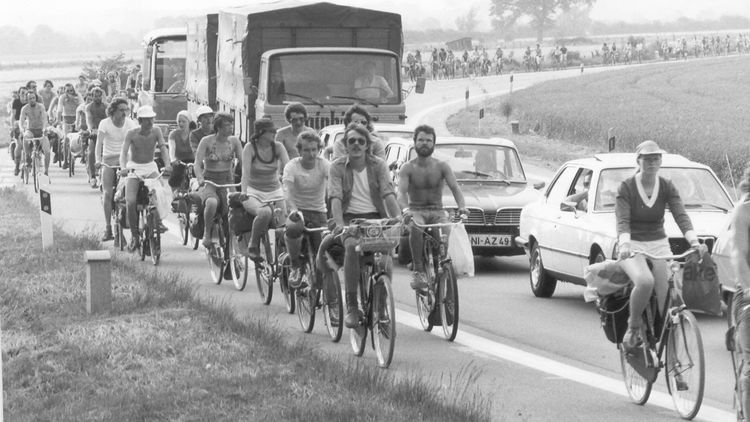
“Like a medieval military column,” as the Süddeutsche Zeitung put it at the time, the cycle protest wound its way through north-west Germany on 14 June 1976. “At the front was the ‘media bus’, which loudly announced the cause of the protest in the villages and towns; behind it, depending on road conditions, was a procession up to eight kilometres long, led by the vice-chancellor.”
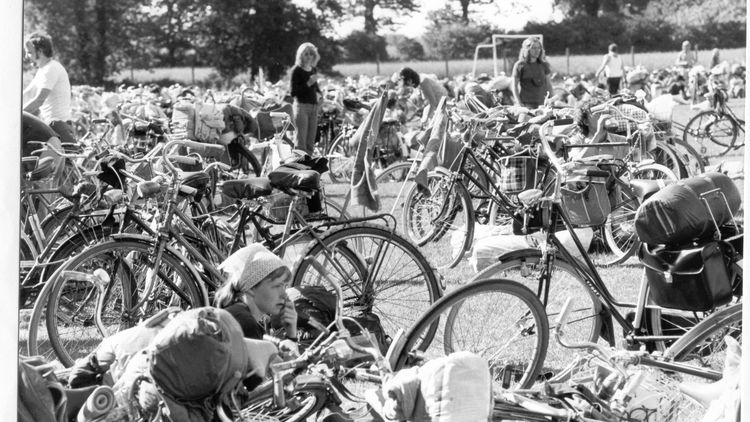
Around 1,100 students, lecturers and university staff cycled from Oldenburg via Wildeshausen, Sulingen, Nienburg an der Weser and Wunstorf to Hanover. They are on the road for four days. They spend the nights in tents at campsites, have mobile toilet facilities, take-away meals from the canteen and even a mobile cinema for social evenings and information events. By the end, they have covered around 170 kilometres.
This isn’t just about having fun. The ‘Heerwurm’ aims to protest against the politically mandated austerity measures – and to do so in the most memorable way possible. At stake is the very survival of the young university, which was only founded in 1973. As they cycle in convoy, the cyclists hand out leaflets, make announcements over loudspeakers, set up information stands in public spaces and organise discussion groups with people living in the communities along the route.
‘This university is no longer a university’
When, at the end of April 1976, the CDU state government drastically cut funding for the expansion of higher education in Lower Saxony – from around 1.6 billion Deutschmarks to 550 million Deutschmarks – Oldenburg braced itself for the worst. Students feared a decline in the quality of education. Instead of the 15,000 student places originally planned, the figure was to be capped at 5,700. Numerous teaching staff posts were cut. Buildings cannot be constructed as planned: the university library, the canteen, the sports facilities, and a campus for the natural sciences, which are only just emerging. “This university is no longer a university,” says the then Vice-Chancellor, Prof. Dr Rainer Krüger, following the announcement of the austerity plan.
Yet at that time, the young University of Oldenburg was actually planning to drive forward its expansion in a targeted manner. Under Krüger’s leadership, the university aimed to establish further academic disciplines alongside teacher training, particularly in the natural sciences. With a strong focus on research, the long-term aim was to help the north-west region overcome its structural weaknesses. In an expert report covering the period up to 1985, academics specialising in economics and spatial planning originally predicted that the expansion would create around 3,000 new jobs. In addition, the university is expected to generate contracts worth 40 million Deutschmarks for the regional economy, along with additional revenue of 140 million Deutschmarks for the retail, skilled trades and service sectors.
Students and lecturers join forces to protest
There is therefore a great deal at stake. In May 1976, students – known as the independent project initiative PIN – shook off their initial state of shock and set themselves the goal of building up pressure in order to persuade the state government to reconsider its position after all. This led to the formation of an action committee, attended not only by the university management and members of all status groups but also by representatives of the Staff Council.
“Back then, everyone agreed that state politicians in Hanover wouldn’t be impressed by a traditional demonstration involving travel by train or car,” says Dr Gunnar Zimmermann, now head of the University of Oldenburg’s archives. For a lecture on the bicycle protest, he has pored over records, eyewitness accounts and documents from that time. “The coalition wanted to find a format that would also be covered by the mass media and thus could not be overlooked by the general public.” Around 700 students finally decided at a general assembly at the end of May: this time, the protest would take place by bike.
Clear organisation instead of chaos
Organising the event within two weeks was a “Herculean task”. “The planning stood out as remarkably goal-oriented, rational and inventive,” emphasises Zimmermann. For example, the organisers promptly purchased over 100 four-person tents. Overnight stays at stage destinations in schools, churches and sports halls can only be arranged in some places; large tents are out of stock due to the shooting festival season. Funds are raised, for example through donations from teaching staff and a grant from the city. To avoid appearing to the outside world as a chaotic bunch, all participants are given leaflets setting out strict rules of conduct that apply to everyone whilst they are in the saddle. For example, the bikes must be roadworthy; smoking is strictly forbidden due to the risk of embankment fires; and riding in a pack is not permitted.
It is noteworthy that the participants have decided not simply to cycle about and complain from their ivory tower about the hardships at the university.
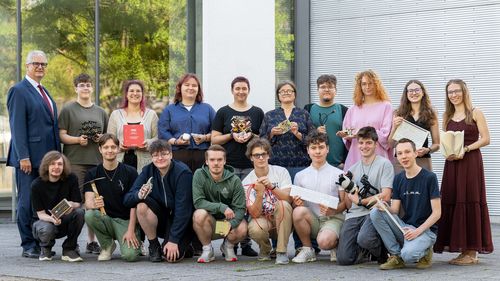
Dr Gunnar Zimmermann; Head of the University Archives
From 13 to 16 June, the approximately 1,100 cyclists will finally ride together through Lower Saxony. Following a closing rally on the Klagesmarkt in Hanover, they will return to Oldenburg on a special Deutsche Bahn train. “It is remarkable that the participants have decided not simply to cycle around and complain about the hardships at university from the safety of their ivory tower,” explains Zimmermann. Instead, on their way to Hanover, they held targeted discussions with local councillors, school pupils and the local community to exchange views on the positive effects that the continued existence and growth of a university can have on the region.
State government withdraws austerity measures
Ultimately, this exceptionally creative protest in 1976 proved successful. Later that same year, in early October, the state government withdrew large parts of the austerity measures. “The Oldenburgers’ bicycle protest certainly helped to draw the attention of many people in Lower Saxony to the problem in the first place and prompted the state government to reconsider its decision to make cuts,” says Zimmermann.
Since then, the university has established itself as a major institution in the north-west. Today, it offers a wide range of degree programmes across various disciplines – and, with three clusters of excellence, is now at the forefront of cutting-edge research at the highest national and international levels.