
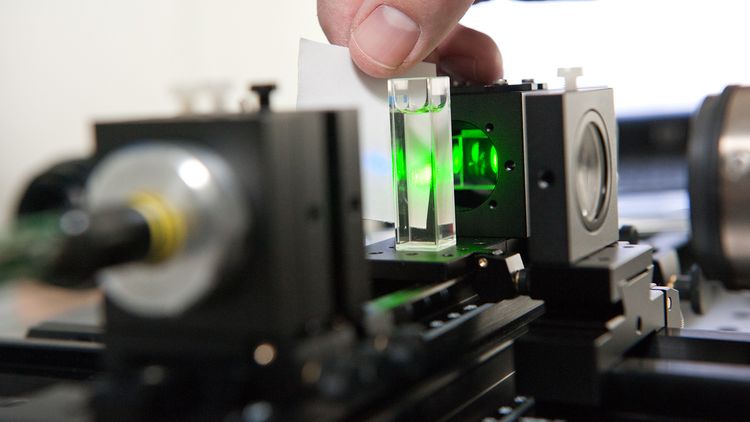

Marine researchers call the substance that gives seawater its yellowish colour "Colored Dissolved Organic Matter ". It can be used to track the path of water through the oceans. Its sky-blue fluorescence enables highly sensitive spectral fingerprints Excerpt from a research paper by Oldenburg marine scientist Prof. Dr Oliver Zielinski on marine processes and new measurement techniques for the spectral characterisation of dissolved water constituents at the Institute of Chemistry and Biology of the Marine Environment (ICBM):
"A substance that fluoresces bright blue in ultraviolet light is found everywhere in nature in the area of the earth's crust. So far it has been detected in the atmosphere, in all water occurrences in nature: in fog, snow, rain, hoarfrost, glacier ice, in waves, streams, rivers, lakes and in the surface and deep water of the world's oceans." This is how a 1963 treatise by the German marine chemist Kurt Kalle on the behaviour and origin of "sky-blue fluorescence" in water and the atmosphere begins. The chemist Dienert had already described this effect for natural waters in 1909. Kalle had been investigating the distribution of the fluorescent substance in coastal waters since the late 1930s. He was also interested in a second substance that gives the water its humus-like, yellow colour: Kalle called it yellow substance. In addition to this term and the direct translation as "yellow substance", the term CDOM, the abbreviation for "Coloured Dissolved Organic Matter", is commonly used in scientific literature today. Yellow matter is the coloured, or more precisely: the part of the pool of dissolved organic matter (DOM) that absorbs in the blue. At around 700 gigatonnes in the oceans, DOM is comparable to the mass of vegetation on land. In coastal areas, CDOM is primarily discharged into the oceans via rivers and submarine sources. In open oceans, the yellow substances are mainly formed as decomposition products of algal blooms. The CDOM content makes it possible to trace the path of the water over hundreds of kilometres through the oceans, for example from the German Bight to the Skagerrak. Nevertheless, this organic matter is still largely unexplored. Scientists from the Max Planck Research Group Marine Geochemistry at the university are in the process of deciphering its chemical composition using complex laboratory methods. The coloured dissolved organic matter CDOM has its origin in the metabolic and decomposition products of plants and animals. CDOM is - apart from the absorption properties of pure water - the most important factor for the distribution of light in the sea. It absorbs ultraviolet radiation and thus protects marine organisms from negative effects. Its absorption bands in the blue-green spectral range overlap with those of phytoplankton, influencing the physiology and primary production of algae. In addition, CDOM binds trace metals, serves as food for microorganisms and is directly linked to the entire pool of organic matter. The Institute of Chemistry and Biology of the Marine Environment (ICBM) investigates the processes that lead to the formation, degradation and distribution of dissolved organic matter on a broad interdisciplinary basis. The scientists rely on state-of-the-art laboratory methods and measurement techniques that can be used in situ - in this case in water - at high resolution and over long periods of time. Yellow matter as an optically active component of organic matter is particularly suitable for this method, as the absorption of blue and ultraviolet light can be converted into sensitive and reliable measurement technology. The Marine Sensor Systems working group at the ICBM has been developing new sensor principles since May 2011 and is working on optimising existing approaches.
You can find out more about this topic in the article by Prof Dr Oliver Zielinski, which will be published in full in the EINBLICKE research magazine in May.
More on the topic
The full article in the Insights issue Marine Sensor Systems
Contact
Prof Dr Oliver Zielinski
Institute of Chemistry and Biology of the Marine Environment
Tel: 0441-798/5342