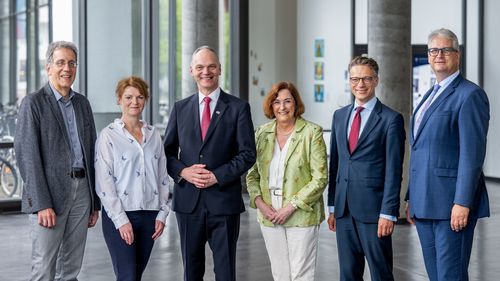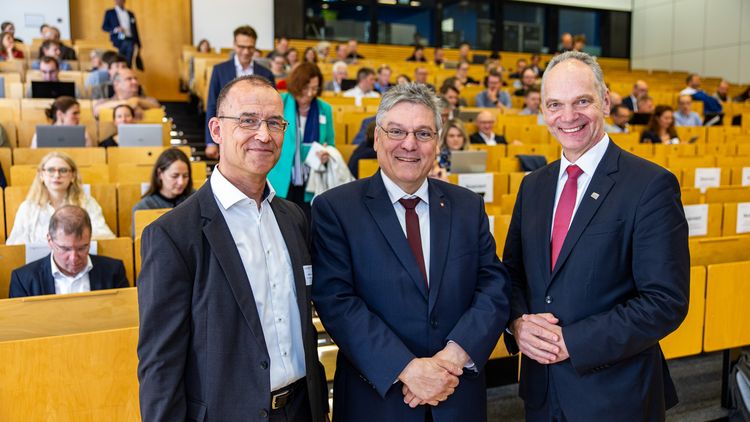
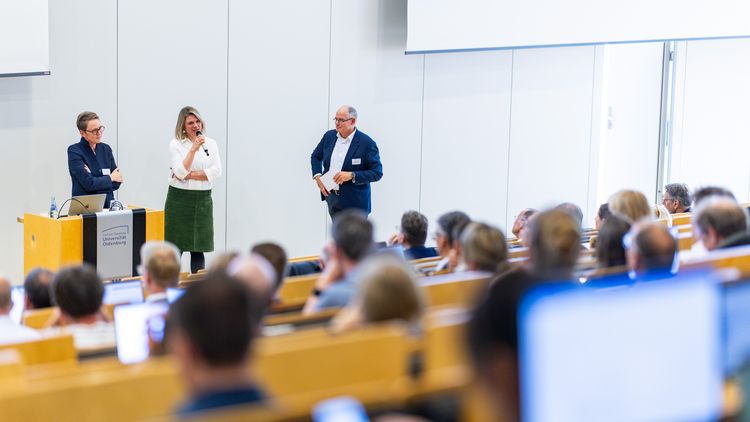
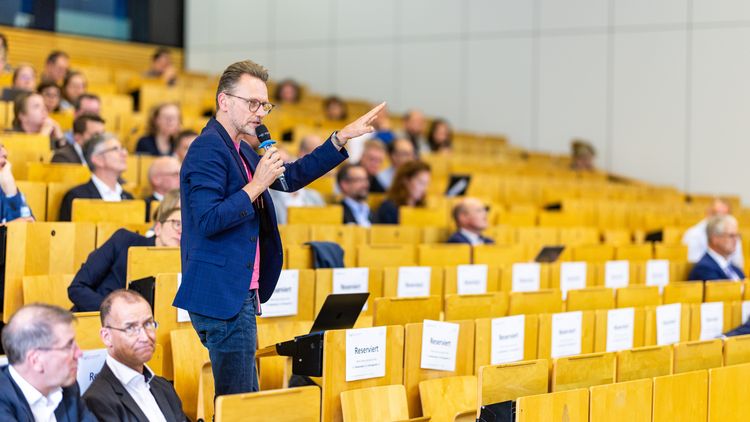


The digitalisation of higher education institutions in Lower Saxony is in full swing, driven by the “Hochschule.digital Niedersachsen” initiative. Around 160 participants recently gathered at the University of Oldenburg for the sixth HdN Summit.
“Digitalisation is fundamentally transforming universities – we can only achieve this far-reaching change by working together.” With these words, President Prof. Dr Ralph Bruder welcomed around 160 experts from all universities in Lower Saxony. As participants in the ‘Hochschule.digital Niedersachsen’ (HdN) digitalisation initiative, they recently gathered for the 6th HdN Summit at the University of Oldenburg. The fact that all the state’s higher education institutions view the digital transformation as a shared task is not to be taken for granted and is encouraging, Bruder continued – “because the issue of digitalisation is so important”.
Under the umbrella of HdN, which has been in existence since 2021, the 20 state universities in Lower Saxony are working together to shape digitalisation in the four areas of study and teaching, research, administration and IT infrastructure. By 2028, the State of Lower Saxony and the Volkswagen Foundation will provide 150 million euros for this purpose from the ‘zukunft.niedersachsen’ programme.
This year’s event offered a varied programme – ranging from the presentation of new initiatives and concrete practical examples, through insights into the current status of individual projects, to strategic issues. Heike Andermann, Head of Oldenburg University Library, presented the results of the pilot project ‘NiedersachsenPUBLISHING’, in which all 23 academic libraries in the state were involved. The team developed a plan for a shared, non-commercial infrastructure on which researchers will be able to publish their academic work in future. Other new projects focus on research information systems, improved support for researchers in high-performance computing, and sustainable energy use in Data Centres.
How projects become lasting solutions
A key focus of the event was the question of how the results of the various projects can be consolidated and implemented sustainably once the project phase has ended. It is clear that the expansion of digital infrastructure entails ongoing costs, explains Jörg Stahlmann, Vice-President for Administration and Finance at the University of Oldenburg: “The state has pledged support for the way forward. However, we are aware that digitalisation can only succeed if the universities themselves take responsibility and embed successful solutions permanently within their structures.”
To be able to respond flexibly to future requirements, it is important to capitalise on synergies, Stahlmann continued. This applies both between the various HdN projects at the university and across organisations. “Only in this way can lessons learnt from individual projects have an impact elsewhere, which is of fundamental importance,” he explained.
Another key focus of the summit was how to reconcile the local needs of individual universities with the central outcomes of cross-university co-operation. Participants exchanged views on this in discussions and workshops. Among them were State Secretary Prof. Dr Joachim Schachtner from the Lower Saxony Ministry of Science, the President of the Volkswagen Foundation, Dr Georg Schütte, and numerous members of the universities’ executive boards.
“Insights into the approaches taken by other universities – for example, with regard to internal governance – can provide valuable food for thought for one’s own university,” emphasised Stahlmann, under whose leadership the current digitalisation projects within the administration of the University of Oldenburg are being carried out. In his view, collaboration between universities will be all the more successful the more the respective strengths, expertise, identity and autonomy of the individual institutions are preserved – in other words, if, despite the competition that still exists, they manage to cooperate closely on shared concerns.