

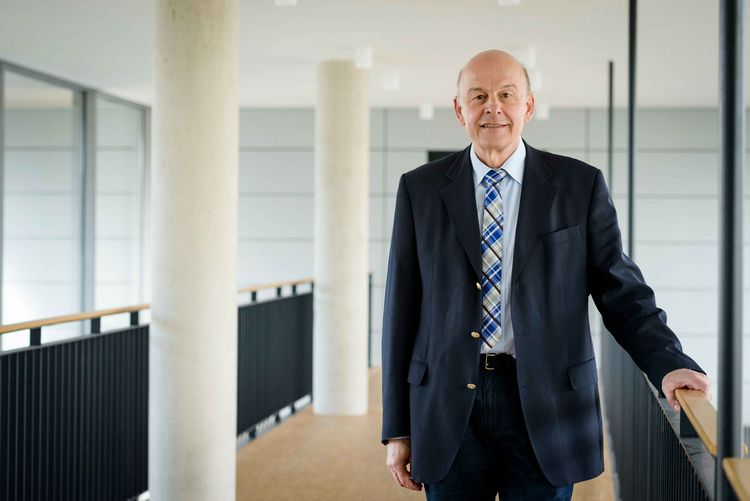


What is the aim of health services research? Vice Dean Hans-Jürgen Appelrath talks in an interview about the establishment of the new focus area at the School of Medicine - and about how scientists are trying to analyse healthcare services in our healthcare system.
QUESTION: Mr Appelrath, health services research examines the overall system of health and medical care. How is it possible to maintain an overview of such a large subject - especially as patient care takes place in separate sectors, for example outpatient, inpatient or rehabilitative care?
APPELRATH: By looking at the overall system in an intersectoral and integrated way, by being genuinely transdisciplinary and by bringing in the perspectives of different subjects with their respective repertoires of methods. It is about analysing everyday healthcare - and then improving it. That's why healthcare research looks at the need for care, existing and possibly new care structures and processes, the care services provided and, hopefully, the resulting gains in health and quality of life.
QUESTION: However, it is not possible without real data from the healthcare system. What about the patient's right to informational self-determination?
APPELRATH: Of course, informational self-determination must be safeguarded. For example, encryption methods are used for personal data in order to be able to access as many data records as possible that are necessary to answer the questions I mentioned at the beginning. With this integrated view, it is not possible to know who the individual patients are. And it doesn't have to: it's not about looking at individual medical care, but about looking at the overall "medical care" system with meaningful data from all so-called service providers, payers and other system players. And, as I said, not as an end in itself, but in order to provide better care for patients in future after intelligent data analysis.
QUESTION: This patient-orientation is something that is also and especially important at the School V - School of Medicine and Health Sciences. The focus on healthcare research is currently being established there. Why do you think this focus is important for the University of Oldenburg?
APPELRATH: For the School, we have of course initially focussed on our excellent science-oriented medicine in physics, psychology and other subjects - in addition to the clinical research in the regional hospitals, which is essential for human medicine and with which we work closely. However, it is also important for us to network research and teaching more closely across subjects and cross-schools. Without a link between the more basic science-orientated medicine and the more patient-orientated clinical research, this is difficult. Health services research can build bridges here, especially as there was already a body of preliminary work, particularly on the topic of "Data management and analysis in the healthcare system". We then developed the "Health Services Research" concept from this in 2008 and 2009. This convinced the German Council of Science and Humanities and all the committees that have dealt with the European Medical School to date.
QUESTION: The realisation of the concept is progressing: Antje Timmer has now been appointed to the professorship for "Epidemiology and Biometry" in the Department of Health Services Research at the School of Medicine. What profile will the Department have?
APPELRATH: We are very pleased that Ms Timmer has been a competent addition since 1 March, complementing Andreas Hein's existing professorship in "Medical Technology". The further structure follows the profile development documented in the comprehensive "Position Paper on Health Services Research" and agreed by all committees by initially adding three further important professorships: "General Medicine" with an emphasis on health services research, "Health Services Research" with a different emphasis depending on the appointment and "Medical Computing Science" with a desired stronger orientation towards clinical research. Depending on the appointment, we will then advertise the two further full professorships and two additional junior professorships. The individual professorships will be methodologically bundled at the three central levels of "Healthcare Epidemiology", "Quality of Care" and "Data Integration and Analysis".
QUESTION: Can you build on existing structures when setting up the Oldenburg health services research programme?
APPELRATH: Fortunately, yes. For health services research, it is initially about an intensive exchange with existing clinical and non-clinical professorships within the School of Medicine and Health Sciences. However, broad cooperation with existing institutions at the University outside the School is also important. These include the Centre for Hearing Research, the Institute of Special Needs Education and Rehabilitation, the Department of Computing Science and the large Health Division of the OFFIS computer science institute.
QUESTION: How important is cooperation with the university's partners in establishing healthcare research - for example with the Oldenburg hospitals and the University of Groningen?
APPELRATH: Healthcare research is very cooperative per se and inevitably based on networking. We will be working with the Oldenburg hospitals and other hospitals in future, particularly on clinical studies and clinical epidemiology. So far, we have identified the fields of clinical and epidemiological oncology, care and rehabilitation of neurological diseases, palliative medicine, cardiology, geriatrics and rehabilitation of hearing impairments, without excluding others. Bi-national comparisons of healthcare systems are possible with Groningen, as well as co-operation on primary surveys such as the large Groningen "LifeLines" project or infection protection.
QUESTION: Which areas of cooperation still need to be developed?
APPELRATH: Health services research is always dependent on practical questions and a meaningful database. It is therefore imperative to step up activities with the existing centres and clinics in Oldenburg - i.e. Klinikum, Pius-Hospital, Evangelisches Krankenhaus, Karl-Jaspers-Klinik - as well as with the private practice sector, the Association of Statutory Health Insurance Physicians and other healthcare providers. Co-operation with cost bearers such as health insurance companies or pension insurance is also important and has already begun. In addition, we see opportunities for cooperation in methodological research, naturally with suitable professorships at the University of Groningen as well as neighbouring institutes in Bremen such as the Leibniz Institute for Prevention Research and Epidemiology (BIPS) and the Centre for Social Policy (ZeS). Finally, there are good links with established registries such as the Epidemiological Cancer Registry of Lower Saxony, which is based in Oldenburg.
QUESTION: The organisers of the last German Health Services Research Congress in Berlin concluded that the benchmark is not the quantity of services provided, "but the quality of care experienced by the patient." In your view, why is it that patients often experience care very differently from the providers themselves?
APPELRATH: Studies have long shown that this is sometimes due to the quality of care perceived directly and in real time. In addition to direct diagnostic, therapeutic and nursing aspects, it also has psychological, social and other dimensions. However, the quality of care and support is much more frequently criticised for the gaps in the intersectoral transitions between outpatient, inpatient, home and nursing care. Despite the generally good intentions of the individual service providers, there are often disruptions here with a loss of quality, which of course have to do with legal framework conditions and economic interests.
QUESTION: What steps are necessary to ensure that the findings and results of healthcare research directly benefit patients?
APPELRATH: Teachers at the School of Medicine must manage to bring together the two worlds, which are largely separate in terms of content and methodology, for the students: Here, the world of classical, sectoral and specialised human medicine with immediate, directly patient-related care. On the other hand, the world of analysing the entire healthcare system from the perspective of population-based healthcare research. These different perspectives are converging under the concept of evidence-based, guideline-orientated medicine. This is because general healthcare research findings from databases and other sources of information must also be incorporated into individual diagnostic or therapeutic decisions.
QUESTION: What are the next steps at the Department of Health Services Research?
APPELRATH: We are planning to fill five of the seven full professorships by the end of the year - including accommodating their working groups in a shared building. Hopefully, all stakeholders will then have gained momentum for themselves, among themselves and with external partners. This is also important, as the evaluation of the School by the German Council of Science and Humanities in 2019, with reports submitted by us in good time, is getting closer every day. And we all know that: Outstanding publications, successfully acquired projects with convincing results and an attractive teaching programme take time.