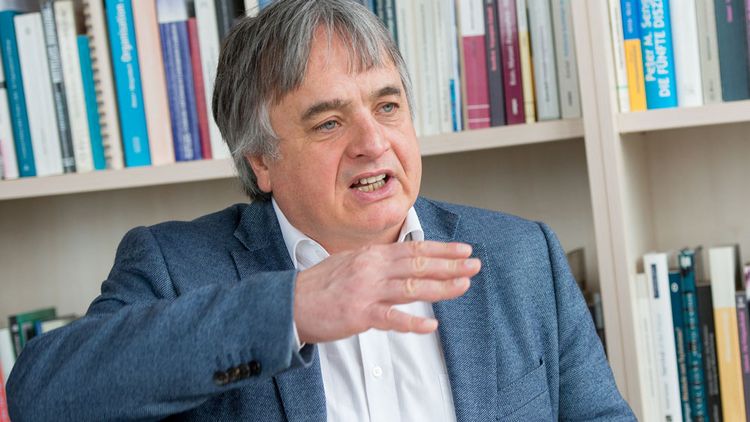

Analysing how European societies are growing together - or not: this is the centre of the research group coordinated by Oldenburg sociologist Martin Heidenreich, which the German Research Foundation continues to fund. An interview.
QUESTION: Mr Heidenreich, the transnationalisation of social fields and spaces is at the centre of your group's research. What is behind this?
HEIDENREICH: The fact that people no longer just live in a national context, but increasingly live and die, love and travel, study and work across borders. There are hardly any activities that are still limited to the national space. And we are investigating how society is changing as a result of this expansion of social fields and spaces.
QUESTION: What exactly are social fields, what are social spaces - what is the difference?
HEIDENREICH: This distinction was proposed by the French sociologist Pierre Bourdieu. Fields are social entities, such as the university system or asylum administration, which are characterised by a specific topic, specific actors and contested rules and positions. Ultimately, social space is nothing more than an expression of the society in which you live, in which you exchange ideas, spend your leisure time and experience yourself as equal or unequal.
QUESTION: You say that people live and love and work and die on a European level - and coin the term horizontal Europeanisation to describe this. How is this tangible for each individual?
HEIDENREICH: This term sets us apart from political science research on Europeanisation. This focuses on the interaction between the political institutions of the European Union and national politics and administration. As sociologists, we try to include other aspects of transnational socialisation, such as the increasingly cross-border definition of inequalities, of interpretations of history, of everyday practices, of negotiation relationships between employers and employees and of professional expertise.
QUESTION: Can you give an example?
HEIDENREICH: The project of the common economic and monetary union, the introduction of the euro, was first and foremost a political decision, anchored in the Maastricht Treaty of 1992. But of course it has a massive impact on the way people live. We can see this in Southern Europe right now: unemployment has increased dramatically, especially among young people, and incomes have fallen by 25 per cent in Greece, for example. Such effects on people's living environments, on migration and mobility processes in Europe and on the willingness to show cross-border solidarity and redistribution are our main focus. We call this increasing cross-border interdependence of living environments horizontal Europeanisation.
QUESTION: And how do you recognise this process?
HEIDENREICH: In lectures, I always ask: How many of you have studied abroad? In Master's courses, that's around 20 or 30 per cent of students. Other examples are, of course, shopping or holidays in other countries: If you go to Groningen to buy tulips, for example, or if you spend your holiday in Mallorca or Madeira. This process also affects research. Through the EU and especially the European Research Council (ERC), scientific reputation is defined to a large extent in transnational, cross-border areas.
QUESTION: There are various sub-projects in your research group. Have there been any key findings from the projects so far that have surprised you?
HEIDENREICH: One key finding is the emergence of a new periphery. Europe was never uniform in social terms. But the differences, especially between the northern and western European centre and the southern European periphery, have recently increased considerably. The introduction of the euro in 1999 initially accelerated the process of economic and social harmonisation. Since 2008, however, the differences between the centre and the periphery have increased again significantly, while the previously peripheral Central and Eastern European countries are rapidly catching up. Adjusted for purchasing power, household income in the Czech Republic is already higher than in Portugal. In Poland, it is higher than in Greece. The Baltic countries were in a deep crisis, but have quickly caught up again, while Greece is in free fall.
QUESTION: Are you observing a double split?
HEIDENREICH: Exactly. We call this double dualisation because social inequalities are increasing not only between central and peripheral countries, but also within individual countries. In other words, the divisions between higher and lower-skilled employment groups, between single parents and other family forms, between permanent and temporary employees are increasing significantly in terms of income, unemployment and health risks, for example.
QUESTION: In the next three years of DFG funding, you now want to place the crisis and conflictual nature of European integration more at the centre as a cross-cutting topic. What do you want to investigate?
HEIDENREICH: Every sub-project in our research group deals with crisis-related developments. For example, the asylum administration system deals with the controversial, costly and conflict-laden management of Europe's external borders. And in the area of the science and higher education system, we need to analyse ERC funding, which is breaking up national science systems. My colleagues in Bamberg want to analyse the awarding of ERC grants on the basis of successful and failed applicants - and find out whether there are systematic barriers for southern European scientists, for example.
QUESTION: Can your research also provide indications of how to counteract a further division between Europeanisation winners and losers and between central and peripheral states in Europe?
HEIDENREICH: A central cause of the current crisis is the inconsistency between European monetary policy and national budgetary policies. Even before the monetary union, economists pointed out that it could hardly function without a common budgetary policy and thus ultimately a political union. In any case, after the abolition of flexible exchange rates, other equalisation mechanisms are needed, such as a Europe-wide coordinated wage policy, which is at the centre of our Linz partners' sub-project. Another possibility would be a common unemployment insurance scheme. The Commission has in fact proposed that a certain proportion of national unemployment insurance schemes be financed at European level. Economically, of course, it makes sense to cushion economic cycles in this way.
QUESTION: Would a Europeanisation of unemployment insurance, for example, be suitable - or do you have other indications from your research as to what could counteract the division? This can't be desirable.
HEIDENREICH: The division is dramatic. The foundations of European integration are currently eroding: citizens' trust in the EU institutions is collapsing, life satisfaction is declining, while unemployment and inequality are jeopardising social peace. Relations between people in Europe are at an all-time low: in surveys, EU citizens rate Germany as the most trustworthy, but also the most arrogant and least compassionate country. As scientists, we naturally find it difficult to formulate political recommendations. However, it is impressive how much courage and foresight previous generations and politicians showed when they decided in favour of the customs union, the single market or later a common currency. I believe that another risky leap is necessary.
QUESTION: What kind of leap could that be?
HEIDENREICH: Ultimately, it's about a political union. We could think about Eurobonds, a common European debt, which already exists in practice via the rescue funds. However, as a sociologist, it's easy for me to talk about this, as I don't have to take political responsibility for it. All I can say is that there is a massive gap between systemic and social integration. And the deficits in social integration, which are documented in the increase in poverty, unemployment and exclusion, jeopardise the integration of European societies and the EU as a whole. The European project can also fail.
Sociologist Prof Dr Martin Heidenreich holds the Jean Monnet Chair of European Studies in the Social Sciences. Colleagues from Bamberg, Berlin, Bremen, Leipzig, Linz, Nuremberg and Siegen are involved in the research group he coordinates, which has been funded by the German Research Foundation (DFG) since 2011.