Contact

Press & Communication

+49 (0) 441 798-5446

More on the topic

INSIGHTS 63

Information on the Wadden Sea World Heritage Summer School 2018
Contact

Prof Dr Oliver Zielinski

Institute of Chemistry and Biology of the Marine Environment (ICBM)

+49 (0)441/798-3518

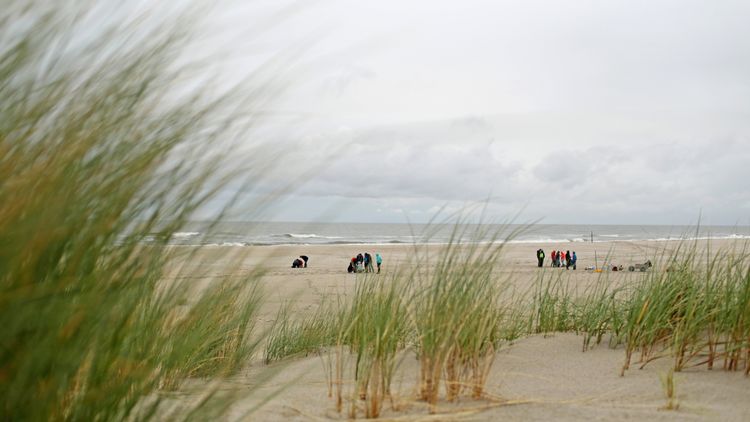
  • On the north beach of Spiekeroog, students led by marine physicist Prof Dr Oliver Zielinski are taking samples of pore water found in the fine cavities in the ground. Along two transects - on lines perpendicular from the high tide line to the dunes - they set 13 measuring points at intervals of five and ten metres. Photos: University of Oldenburg.

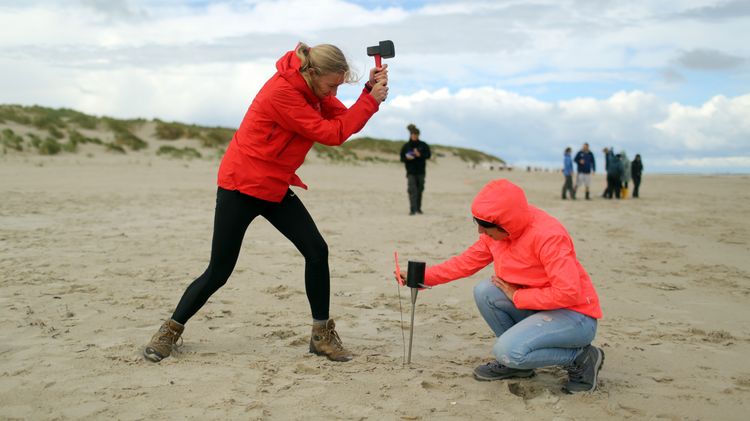
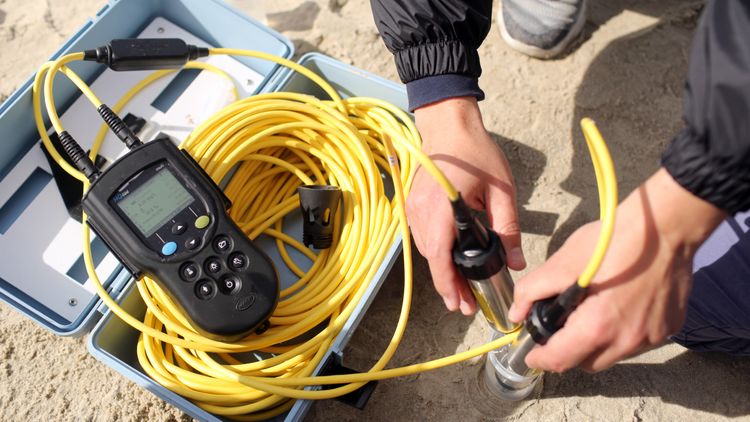
  • In order to access the water, so-called pore water lances are sunk into the ground - at a depth of one and two metres per measuring point. There are slits at the lower end of the lance through which the water can flow in.

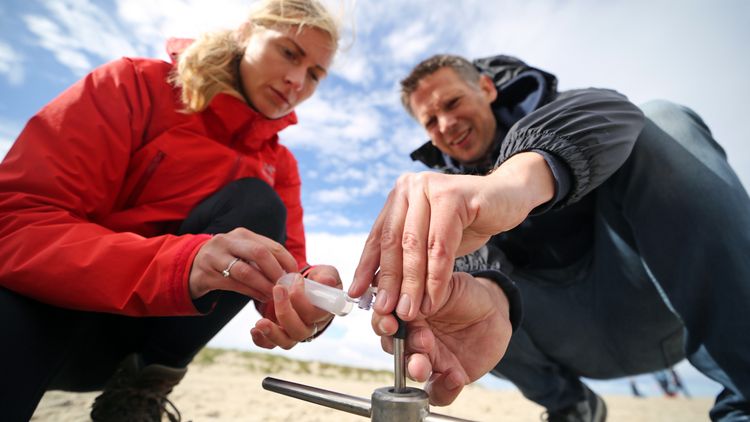
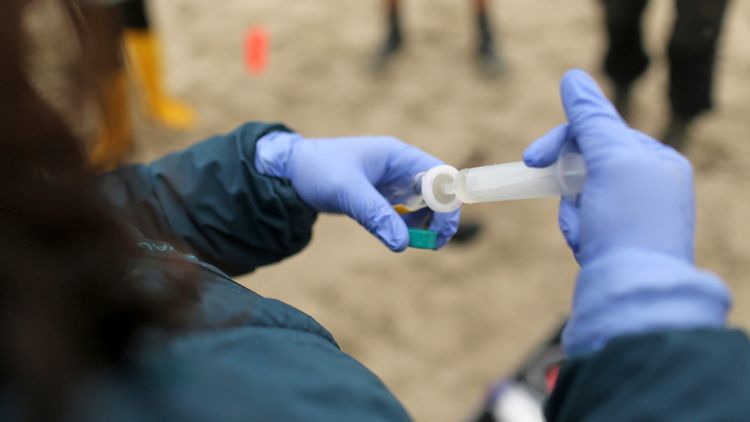
  • A syringe is used to create a vacuum, which causes the water in the lance to rise and collect in the piston.

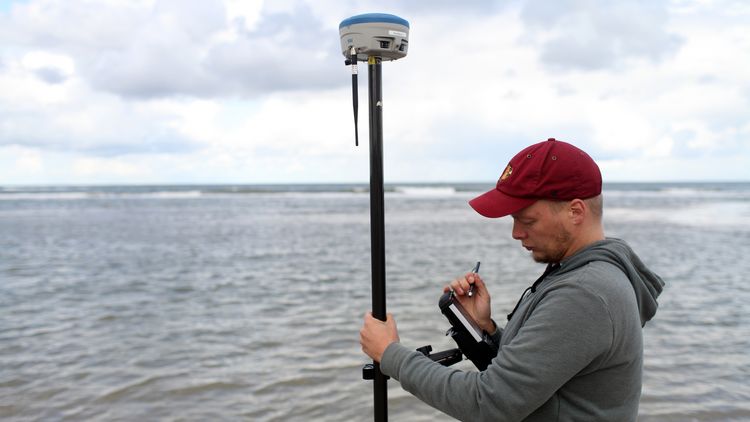
  • In order to be able to assign the measurements precisely later, the points are measured to within a few centimetres using GPS.

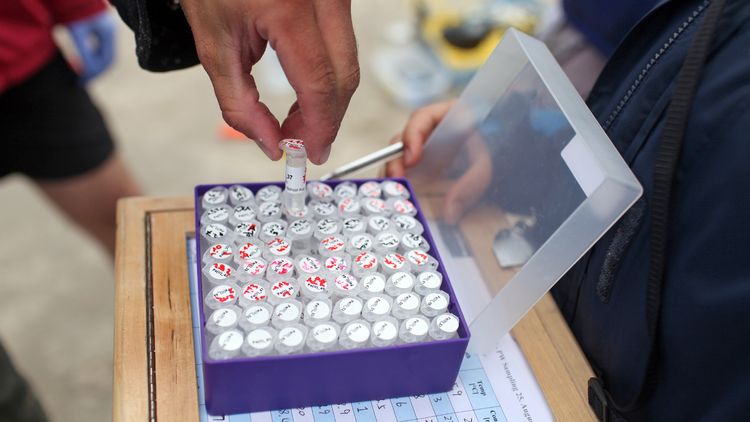
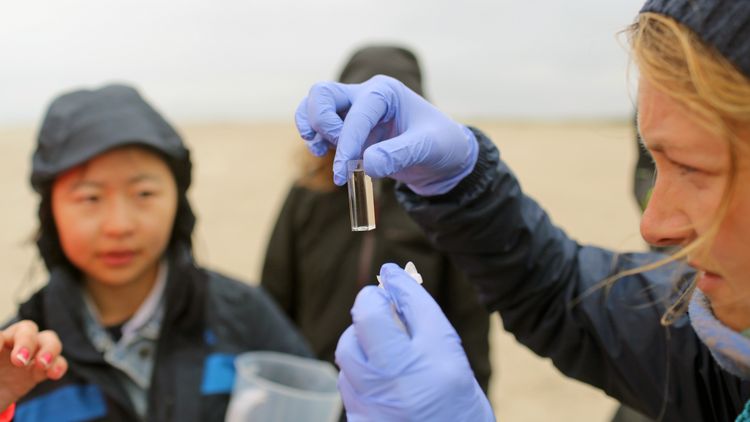
  • Samples of the pore water are filled at each measuring point for later laboratory analyses. A filter retains all particles larger than 0.2 micrometres. This means that only the dissolved organic matter (DOM) remains in the water.

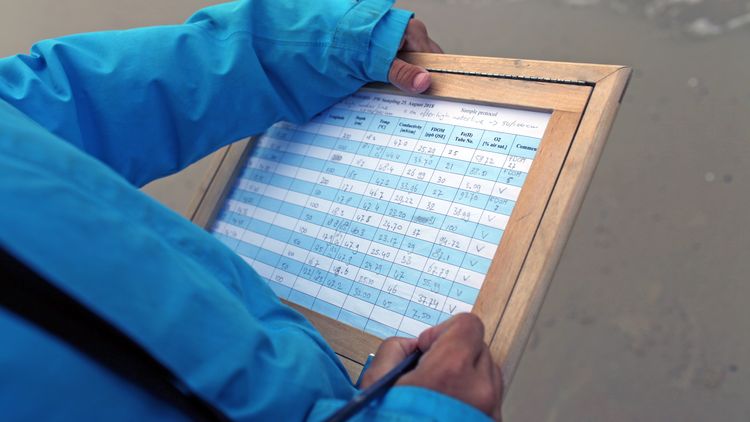
  • On site, the students measure the temperature, conductivity, oxygen and iron content as well as the amount of DOM.

  • While they closely observe every movement during the first measuring points and familiarise themselves with the methods, later on everyone concentrates on a specific work step.

  • Oliver Zielinski explains that familiarising yourself as a team and developing a routine is the be-all and end-all of measurement campaigns.

  • Patience and care are also important in order to achieve good, clean results in the field: To measure the DOM using UV light, for example, the container must be free of fingerprints, dust and water.

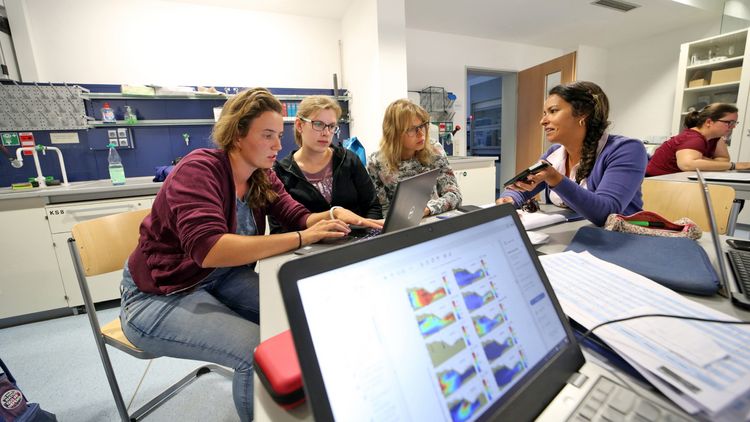
  • At the end of the project, the students prepare a presentation. Some of the group analyse the data statistically, while others prepare the methodological basis. The participants' summary: the exchange with other young scientists from different disciplines is particularly valuable.

Learning to research

What exchange processes take place between groundwater and seawater on the beach? This question was addressed by 14 international Master's and doctoral students during a summer school on the topic of the Wadden Sea World Heritage Site.

What exchange processes take place between groundwater and seawater on the beach? This was the question addressed by 14 international Master's and doctoral students during a summer school on the topic of the Wadden Sea World Heritage Site, jointly organised by the Institute of Biology and Chemistry of the Marine Environment (ICBM), the Alfred Wegener Institute, Helmholtz Centre for Polar and Marine Research (AWI) in Bremerhaven and the Netherlands Institute of Oceanography (NIOZ) on Texel. Among other things, the students learnt about pore water analysis, a method for researching the biogeochemistry of sediments. A review in pictures for the new research magazine INSIGHTS.

This might also be of interest to you:

A smartphone displays the home page of the ‘Wohnen Oldenburg’ portal
Target group: students Campus Life

New portal helps students find accommodation

Limited funds, plenty of competition, tight deadlines and no experience with tenancy agreements: once they’ve been admitted to a degree course, many…

more: New portal helps students find accommodation
Vocational training Campus Life People

University welcomes 17 new apprentices

This week, 17 young people have started their apprenticeships at the university. The range of apprenticeship roles is wide – spanning everything from…

more: University welcomes 17 new apprentices
The reddish, glowing sun is obscured by the moon in its upper quarter.
Astronomy Campus Life

Partial solar eclipse and shooting stars over Oldenburg

Solar eclipse over Europe: On Wednesday 12 August, this event will also be visible in Oldenburg in the evening. The University, together with its…

more: Partial solar eclipse and shooting stars over Oldenburg
(Changed: 18 Aug 2026)  Kurz-URL:Shortlink: https://uol.de/p82n3004en
Zum Seitananfang scrollen Scroll to the top of the page

This page contains automatically translated content.