

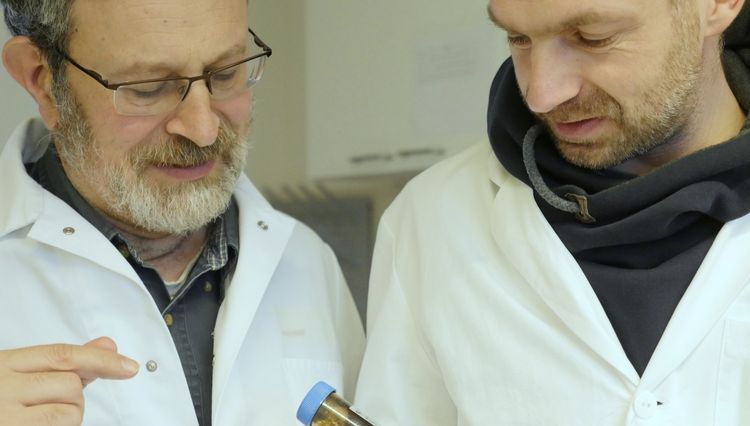


For the first time, researchers from Oldenburg, together with colleagues from Braunschweig and Chapel Hill (USA), have been able to scientifically describe a bacterium isolated from oil-contaminated samples from the Deepwater Horizon accident in 2010. It belongs to the Roseobacter group and is therefore one of the most important groups of marine bacteria.
In the March issue of the International Journal of Systematic and Evolutionary Microbiology, the team led by Dr Helge-Ansgar Giebel from the Institute of Chemistry and Biology of the Marine Environment (ICBM) at the University of Oldenburg and first author Franziska Klotz show that the organism now found belongs to a new genus. One of its outstanding characteristics: The ability to break down special aromatic compounds. The question of which microorganisms break down oil and what specific role they play in this is particularly important for dealing with oil spills. According to the scientists, this is the only way to create supportive conditions or even to use large quantities of oil-degrading organisms in a targeted manner.
A completely new genus
The newly described bacterium was given the scientific name Tritonibacter horizontis by environmental scientist Giebel. The genus name alludes to Triton, a sea god in Greek mythology. The species name horizontis establishes the link to the origin of the isolate from the oil of the Deepwater Horizon accident. "We wanted to take a very close look at such an organism that survives on the oil from the Deepwater Horizon accident," says Giebel. "We soon realised that we had to assign the bacterium to a completely new genus". It combines properties of individual representatives of the Roseobacter group, while typical characteristics of the closest related genus are missing. The genetic material for the degradation of special aromatic compounds is otherwise only found in more distant genera, says Giebel. "But the new bacterium cannot produce a certain antibiotic, which closely related species do," adds the scientist.
Following the explosion and sinking of the Deepwater Horizon oil platform in the Gulf of Mexico on 20 April 2010, an estimated 800 million litres of crude oil escaped by 19 September of that year, the day the oil well was capped. The incident is considered the worst environmental disaster of its kind to date. The effort required by the emergency services after the accident was enormous. For example, large quantities of special chemicals were used to finely disperse oil plumes occurring at different depths in order to enable microorganisms to attack the oil components more quickly.
Distracted from oil extraction
"A not uncontroversial method," says co-author Prof Dr Andreas Teske, marine scientist at the University of North Carolina, currently a guest at the ICBM. He adds: "New results in the literature indicate that the chemicals used are degraded first". The bacteria are therefore "distracted" from their actual task of breaking down the oil. "They form a network of different supporting microorganisms that we are only just beginning to understand. Tritonibacter could play its part in making it easier for other bacteria to break down oil."
Environmental scientist Giebel explains: "In addition to a spectrum of sugars and amino acids, Tritonibacter also utilises various aromatic compounds, such as those found in oil, as a source of carbon and energy." With the help of other bacteria, the aromatic 4-hydroxybenzoic acid, for example, is produced from certain oil components. Through various intermediate steps, Tritonibacter ensures that various degradation products are formed - which in turn can then be utilised by other types of bacteria.
Tritonibacter is kept stable at minus 80 degrees Celsius at the ICBM for further investigations. "For the first time, we are able to provide the scientific community with a fully genome-sequenced and taxonomically described bacterium from the Deepwater Horizon oil spill."
Microbiologists, natural product chemists, geneticists and bioinformaticians have been conducting research in the "Roseobacter" Collaborative Research Centre since 2010 under the leadership of Oldenburg microbiologist and co-author Prof. Dr Meinhard Simon. The scientists are investigating the evolutionary, genetic and physiological characteristics and adaptations of bacteria in their various habitats.
"Tritonibacter horizontis gen. nov., sp. nov., a member of the Rhodobacteraceae, isolated from the Deepwater Horizon oil spill", Franziska Klotz, Thorsten Brinkhoff, Heike M. Freese, Matthias Wietz, Andreas Teske, Meinhard Simon, Helge-Ansgar Giebel, Int. J. Syst. Evol. Microbiol. 2018 Mar; 68(3):736-744. doi: 10.1099/ijsem.0.002573