

Since summer 2016, the university has had its own student body for students on the joint degree programmes. After all, studying at two universities at the same time presents its own unique challenges.
Want to study French or Spanish to become a teacher? That’s not actually possible in Oldenburg. In Bremen, however, it is. For almost 20 years, a co-operation between the two universities has enabled students to take subjects not offered by their home university at the partner university. For trainee teachers, this is a fantastic opportunity – they benefit from the courses and expertise offered by both universities. Students from Oldenburg can study Geography, French and Spanish in Bremen, whilst those from Bremen can study Slavic Studies, Material Culture: Textiles and Dutch Studies in Oldenburg.
However, this also means coordinating two timetables, factoring in travel times and keeping track of the different study and examination regulations – a real challenge, especially at the start of their studies. To make the start easier and to further improve conditions in future, students of the cooperative degree programmes founded their own student body in June 2016.
Sharing experiences
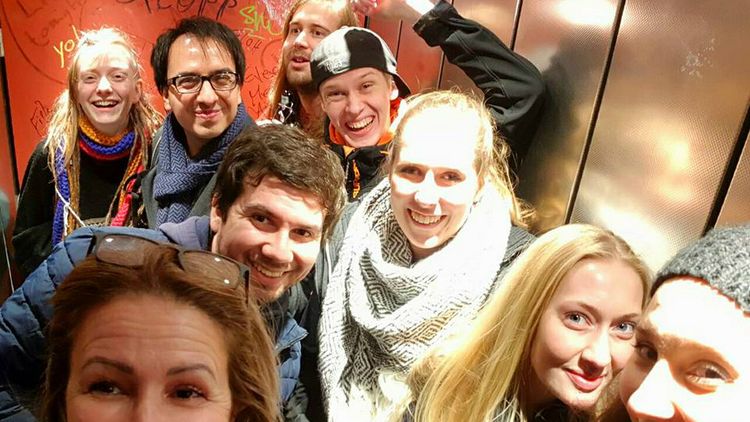
“Anyone studying a collaborative subject is automatically a member of the student body,” explains Etienne Légat. He himself is studying Art and Media as well as French to become a secondary school teacher and is one of the seven current members of the student council. All students of the collaborative degree programmes can vote for the council members at the start of each winter semester. The members represent the interests of their fellow students in bodies such as the Institute and faculty councils or the study committees for the respective subjects, and act as points of contact for any questions or problems relating to their studies.
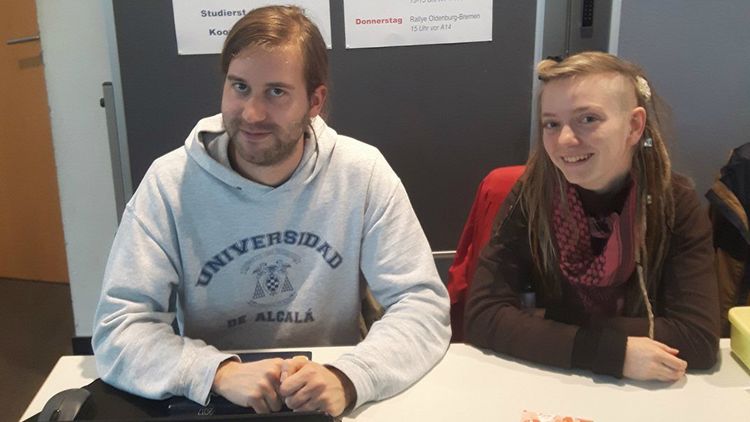
For example, it often happens that students are completely unaware that they need to travel to Bremen for certain modules, explains Student Council member Dennis Janßen, who is studying English and Spanish to become a secondary school teacher. However, such issues and other initial queries can be clarified during the orientation week. At the information fair held during the official welcome ceremony, the student body has its own stand; it is present during the introductory course for the joint degree programmes and subsequently offers its own timetable advice service. Janßen adds that the joint campus rally from Oldenburg to Bremen is also a good opportunity to chat and share experiences.
Plans for the future
Through the orientation week, the student body reaches at least the Oldenburg students. “What’s much harder for us to keep track of are the joint-degree students who come here from Bremen. That is, Dutch Studies, Slavonic Studies and Material Culture: Textiles,” says Alina Hinrichs. She is also on the Student council and is studying the subjects Music and Spanish to become a secondary school teacher. Many are completely unaware that they could also take part in the other university’s orientation week.
A total of 236 students are studying a partner subject as part of a dual-subject Bachelor’s degree or Master of Education programme at the universities of Oldenburg and Bremen. For 182 of them, Oldenburg is their home university. Before the student body was established, the degree programme committees in Bremen – the equivalent of the student body here – were the points of contact for any questions relating to the Bremen subjects. This still applies to students from Bremen: if they have any questions, they primarily turn to the relevant student bodies in Oldenburg. “In the long term, our aim is to establish a joint, cross-campus student body,” says Etienne Légat. It is also conceivable that the student body could be expanded to cover other forms of co-operation – such as the joint Bachelor’s and Master’s programme in “Comparative and European Law”.
But first, the members of the student body want to sort out a few basic matters and get them off the ground: their own room with fixed office hours for the student body, student body jumpers and an online channel through which they can reach all students on the joint programme. Above all, though, they want to raise their profile: “Many people don’t even know we exist yet,” says Dennis Janßen. That is why, in future, they will also be taking part in typical student council events – such as the canteen party or the University Night of Clubs.