
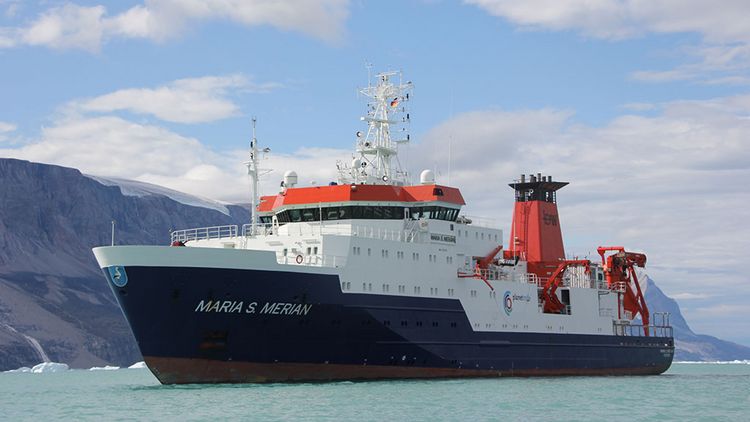


Is there a northern limit for dangerous algae? An expedition led by Oldenburg on the research vessel Maria S. Merian "MSM65" is currently investigating this key question. The scientists want to find out more about the impact of global climate change on biodiversity.
Melting glaciers accelerate the outflow of freshwater into the sea and reduce the salt content. When temperatures also rise, toxic algal blooms, which can affect the marine ecosystem, find ideal conditions. But is there actually a northern limit for dangerous algae? An expedition on the research vessel Maria S. Merian "MSM65" is currently investigating this key question. Until 19 July, scientists from Oldenburg and Bremerhaven, together with experts from North America and Chile, are exploring the coast and fjords on the west side of Greenland - a region where the effects of global warming are directly tangible. The expedition will be led by marine physicist Prof Dr Oliver Zielinski, Director of the Institute of Chemistry and Biology of the Marine Environment (ICBM) at the University of Oldenburg.
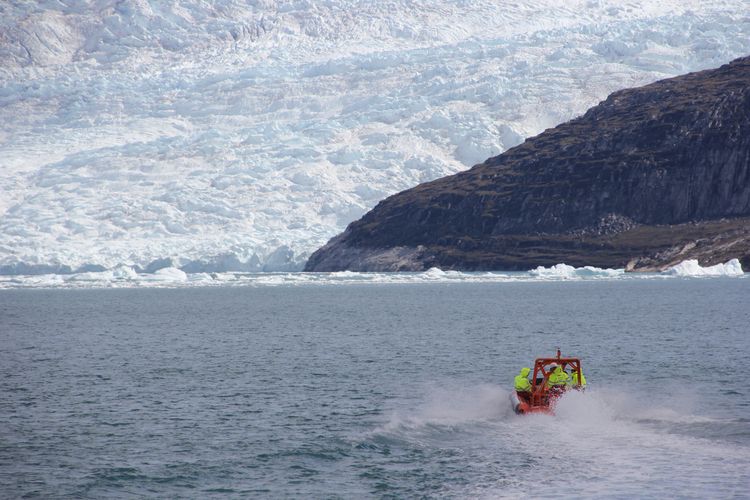
The expedition, called "GreenHAB II", started at the end of June in St. John's in Canada and, after crossing Baffin Bay, will take the scientists northwards from Nuuk in Greenland through fjords and along the West Greenland coast up to 75 degrees north latitude. Along the route, the scientists will repeatedly take samples, both in the upper water layers and from the sea floor - always with the aim of better understanding the formation and spread of toxic algal blooms and their toxic composition, and thus also the influence of global climate change on microbial biodiversity. Among other things, modern bio-optical measurement methods are used, which can detect marine substances and organisms directly and with high resolution using spectral properties.
Scientists from various marine research institutes will pool their expertise on board. From Germany, these include the ICBM at the University of Oldenburg, the Alfred Wegener Institute in Bremerhaven, Helmholtz Centre for Polar and Marine Research (AWI) and the Institute of Environmental Physics (IUP) at the University of Bremen. Other researchers come from the USA (Woods Hole Oceanographic Institution), Chile and Canada.
Many of the 22 scientists on board already know each other from an earlier expedition off Greenland and Iceland, which took place in the summer of 2012 under the leadership of Prof Dr Allan Cembella (AWI). "Based on these results, we developed the hypothesis that toxic microalgae, which frequently form blooms in temperate latitudes, are also present in low concentrations in polar regions and can occur there en masse under favourable environmental conditions. We now want to test this hypothesis together," says Oliver Zielinski. The scientists also expect the project to provide new insights into the interactions of physical and bio-optical conditions that favour the overwintering and development of toxic algae species - and thus an answer to the question of whether there is a northern limit for dangerous algae.