

Many sports activities for children and adolescents were cancelled during the COVID-19 pandemic. This had a noticeable impact on their development, which went beyond sports skills and motor performance. Sports scientist Katharina Pöppel wants to help children discover the joy of movement and physical activity with an innovative exercise concept.
One of the first protective measures during the COVID-19 crisis was to close playgrounds and sports facilities over a lengthy period, which meant that young people could no longer engage in their typical sport activities. According to recent studies – such as the studies of the Karlsruhe Institute of Technology’s Motoric Modul – the closure resulted in delays in physical competence and sports skills. Oldenburg sports scientist Dr. Katharina Pöppel is also exploring this topic. She conducts research in the Sports and Education group at the Institute of Sports Science and is looking for solutions within the framework of sports education to encourage young people to lead an active life at an early age and in a motivated manner. Specifically, Pöppel addresses the question of how learning processes can be optimized to promote young people's physical and health-related competence, and how the associated learning processes can be optimized.
Even before the pandemic, studies had shown that only around 25 percent of children in Germany engaged in the minimum of 60 minutes of moderate to intense physical activity per day recommended by the World Health Organization. During the pandemic, the European average dropped by another twelve minutes, and there has been little sign of a reversal ever since. "This is a worrying trend because physical activity in childhood has a decisive impact on motor skills development later on," says Pöppel. "Anyone who does too little exercise as a child will probably attach less importance to sport as an adult and struggle with the health consequences."
Holistic concept of "physical literacy" as a basis
Working together on a study with Dr Johannes Carl from the Friedrich-Alexander-Universität Erlangen-Nürnberg, research associate Louisa Schmittwilken, and Anne Williges of the Bremen-based foundation Aktion Hilfe für Kinder, which sponsored the project, Pöppel developed an innovative exercise programme called TRYZE.active that provides tips and support measures designed to encourage physical activity in a child-friendly way. The programme is based on the idea of "physical literacy", a holistic concept that has been more widely used in English-speaking countries until now. The four dimensions of physical literacy are physical and motor skills, cognitive aspects such as knowledge and understanding of the health benefits of an active lifestyle, psychological aspects such as motivation to be active, and social aspects such as respectful behaviour in team sports. "We do not aim for a performance ethos; this is different from achieving previously defined performance goals in school sports or in sport clubs. What we want is to encourage children to participate in informal, professionally guided sports activities which are fun and offer a positive approach to sport and exercise."
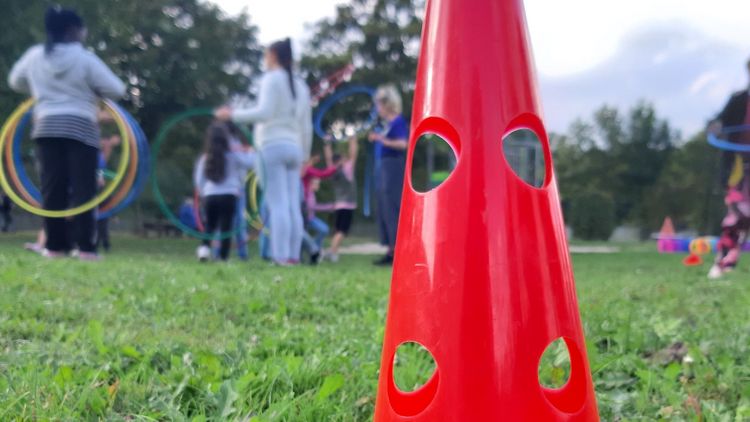
The TRYZE.active programme consists of various individual and team sport activities which were initially tested and evaluated in two pilot phases with children at primary schools in Bremen, in a voluntary full-day format. "We chose the school context for our study because it allowed us to reach out to children with different societal backgrounds. At the same time, it was a voluntary offering, meaning there were no constraints like mandatory participation, performance tests, or grades like in physical education (PE) classes," Pöppel explains. The dimensions of physical literacy were consistently implemented – for example, by involving the children in the choice of exercises included in parkours or ball games. "In alignment with the psychological aspects of physical literacy, this increased their motivation to engage in sport, also because they generally have little say in regular PE lessons," she says, adding: "The boys and girls also measured their pulse rates before and after an endurance exercise and then compared the results. What sounds trivial has a big impact. The takeaway for the children was: it's not just about your performance – exercise has its own intricate value and helps you to grow!"
The participating children give positive feedback on the programme
The team then used its observations from the pilot phases to improve the programme, documented the tested exercises in a handbook and carried out further field tests in a third phase. Subsequent group interviews with children who participated revealed that the exercise programme had a positive impact overall: 57.5 percent of the participants said they had enjoyed doing exercise with the other children in the TRYZE.active programme – significantly more than the 32.5 percent who said they enjoyed PE lessons, which were also included in the survey. No less than 77.5 percent said they had also learned a lot about their bodies during the exercises (compared to 20 percent in PE lessons). And around two-thirds of the children said they looked forward to each session – whereas less than a third said this about PE lessons at their school. Summing up, Pöppel says: "These responses show that the programme we developed offers advantages over standard PE lessons, particularly in terms of the cognitive and psychological aspects. These results speak for themselves. The approach we have chosen is very good for encouraging children to enjoy sports in their free time again."
The Aktion Hilfe für Kinder foundation is continuing the TRYZE.active programme and currently offers it as an afternoon activity at schools in Bremen. The TRYZE.active handbook is available in a digital version. Anyone interested can send a request to the Aktion Hilfe für Kinder foundation. The foundation has also developed the TRYZE.mobil, a minibus which visits playgrounds located in neighbourhoods where socioeconomically less well-off families live. There are times when the TRYZE.mobil exercise programme alone attracts more than 2,200 children per week.