
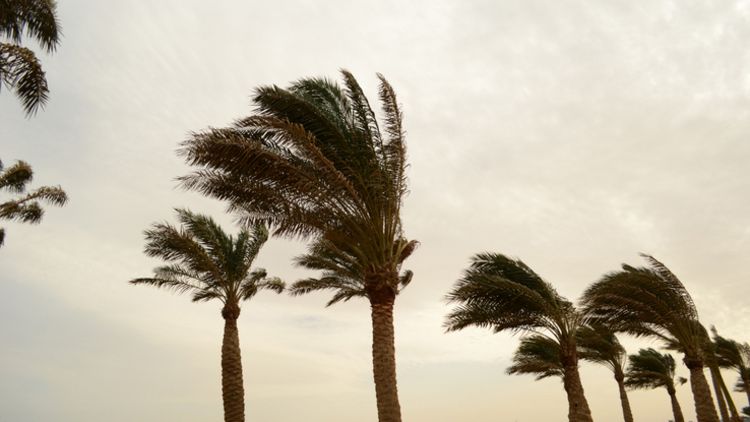

Hurricanes and their consequences are currently omnipresent in the news. Historian Annika Raapke shows how differently people have dealt with hurricanes in different eras. A guest article.
"Trees have been uprooted, roofs torn off... it's a sad repetition of the tragic scenes that unfolded before our eyes last year." A quote whose choice of words coincides with a large number of current hurricane reports. And yet this is not a quote from last week. It comes from an issue of the local gazette of the Caribbean island of Martinique from 19 October 1780 and describes the so-called "Great Hurricane", which is still considered one of the most severe hurricanes ever. Around 11 October 1780, it hit Barbados in the south-east of the Caribbean and then, over the course of a week, it ate its way north-west to what is now the Dominican Republic. Historians estimate that at least 22,000 people lost their lives.
Extreme wind events are an integral part of the meteorological cycle in the Caribbean. The indigenous peoples of the island Caribs and Taino, as well as the K'iche' Maya on the now Central American mainland areas of the Caribbean region, knew how to interpret the storms in a meaningful way as part of their way of life. The word "hurricane" also comes from their languages.
For the K'Iche' Maya, Hurakán, the "heart of the sky", was the god of wind, storm and fire and one of the powerful "creator deities". Among the Taino, however, the huracán was not a deity himself, but may have been a term for the storm that the female spirit Guabancex sent when he was angry. In illustrations, Guabancex appeared as a personified hurricane: her head was in the centre of the storm, her arms symbolised the raging winds. The Caribs saw the hurricane as the wrath of the god Maboya, who had to be appeased with prayers.
For the indigenous peoples of the Caribbean, storms were understandable divine statements about their way of life. They were carried out as punitive and regulatory measures. The destruction they brought was seen as a painful but necessary eradication of the existing world in favour of new creation. Historian Matthew Mulcahy reports that some Caribs interpreted the increasing hurricanes at the beginning of the 17th century as punishment for engaging in too much contact with Europeans.
In the 17th century, Europeans gradually began to occupy the Caribbean islands. Step by step, they wrested their territories from the Taino and island Caribs, killing or expelling them, until finally, in the 18th century, only small groups of them remained on very few islands. The Europeans established productive plantation complexes in the plundered areas. An immense number of brutally oppressed slaves, who were brought to the Caribbean by the Europeans from various African countries, were forced to cultivate coffee, indigo, cocoa and, above all, sugar through arduous physical labour.
In this world, which the historian Sidney W. Mintz has described as a practically industrial complex, there was no meaningful place for the hurricanes. In 18th century Europe, natural disasters were very often read as punishments from God. However, in the European-Christian conception, divine punishments occurred spontaneously, as immediate reactions to human misdemeanours. The regularity of the Caribbean hurricanes could not be reconciled with this. And although most Europeans in the Caribbean continued to regard hurricanes as part of divine creation, or even directly as acts of God, their meaning and significance often remained unclear and had to be intensively debated.
The explanations of the Caribbean peoples, however, were dismissed as pagan superstition, and their expertise in dealing with hurricanes, for example in the construction of buildings, was also neglected. Wealthy Europeans repeatedly insisted on building European-style houses that were completely unsuitable to withstand a tropical cyclone - and could easily become death traps in the event of a storm. Thousands of "souls lie buried under the rubble" wrote a French woman from Guadeloupe in a letter to her sister in France after the "Great Hurricane". Time and again, the islands, which were now colonies, were turned into deserts of destruction in this way and had to be rebuilt at great expense over a period of years.
The colonisation of the Caribbean meant a massive transformation of the entire region - its people and cultures, its landscapes, and even its storms. The understanding of what a hurricane is defines how one encounters it. The Taino and Island Caribs feared the storms. But they also knew how to interpret them. The destruction, although painful, had a purpose. They did not contradict the social order, but were part of it. Life was organised in such a way that it could easily be blown away by the storm, but could also be quickly rebuilt.
The European colonists, on the other hand, remained unfamiliar with the storms despite all their observation and confrontation. Their attempts to explain them remained contradictory, and their preparations inefficient and often illogical. And so storms like the "Great Hurricane" of 1780 became mere "natural disasters" for most inhabitants of the Caribbean colonies, events of ultimately senseless destruction.