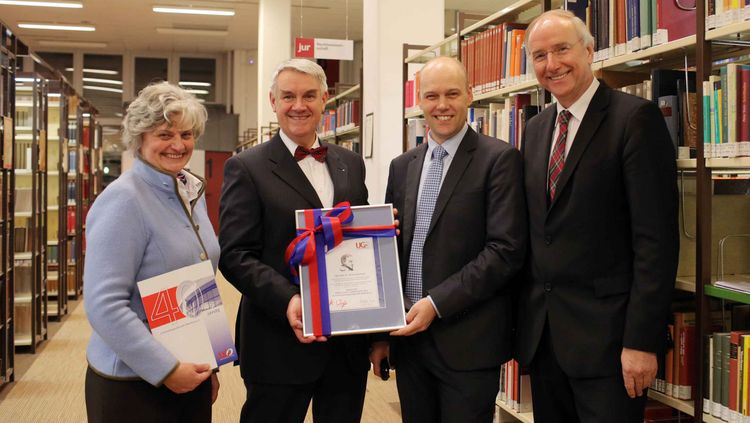

On 19 November, Oldenburg researcher Prof. Dr Henrik Mouritsen, who is known worldwide for his research on migratory birds, received the 5,000 euro prize for excellent research from the Oldenburg University Society (UGO).
In his laudatory speech, the Secretary General of the Volkswagen Foundation, Dr Wilhelm Krull, described Mouritsen as an "outstanding researcher who has made a name for himself internationally with both creativity and precision". The Volkswagen Foundation is proud to support Mouritsen and to help keep him in Lower Saxony.
With his ground-breaking research in the field of neurosensor technology and migratory bird navigation, Mouritsen has done much to strengthen the reputation of the University of Oldenburg beyond national borders, said UGO Chair Michael Wefers. Overall, the university is on a very good path and can look back with pride on its 40-year history.
University President Prof Dr Katharina Al-Shamery congratulated the University Society on its decision. She had made an "excellent choice among many possible ones" and had once again shown that she had a particularly important function as a partner and supporter of the university in the region. Her support is part of the success of the University of Oldenburg.
The 43-year-old Mouritsen has been researching and teaching at the University of Oldenburg since 2002, where he also completed his habilitation in 2005. He turned down calls to Manchester, Kiel and Bayreuth in favour of Oldenburg. In 2007, he was awarded a 1.5 million euro Lichtenberg professorship by the VW Foundation, which had previously supported him as a junior research group leader. In 2011, he received the Eric Kandel Young Neuroscientists Prize, named after the American Nobel Prize winner. In 2013, a graduate school entitled "Molecular basis of sensory biology" was established at the University of Oldenburg, which he and biochemist Prof Dr Karl Wilhelm Koch designed and which was funded by the DFG with 2.2 million euros.
As head of the "Neurosensorics/Animal Navigation" working group, Mouritsen was able to prove that birds can perceive the earth's magnetic field for orientation in two different ways. They perceive the compass direction of the magnetic field via light-sensitive molecules in the eye and the visual system. In addition, they have another magnetic sensor that is connected to the brain stem via the trigeminal nerve. His proof, recently published in "Nature", that robins can no longer orientate themselves as soon as they are exposed to electromagnetic interference, caused a sensation not only in scientific circles, but also in the media worldwide.
In his presentation at the award ceremony, Mouritsen emphasised that his research into the navigation of birds provides strong evidence that their magnetic compass is based on interactions between the magnetic field and electron spins. This would mean that the magnetic compass is fundamentally based on quantum mechanical principles. If this is finally confirmed, it would be the first biological process ever for which classical physics would fail as an explanatory model. The consequences would be huge, as many biological processes would have to be looked at in a completely new way. The reason: it would then be clear that interactions that are over a million times weaker than previously assumed could influence biological processes. Quantum biology would then finally be born, said Mouritsen.


