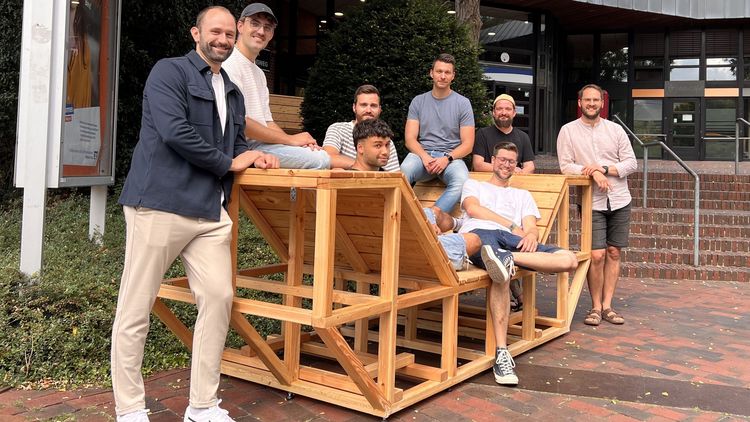
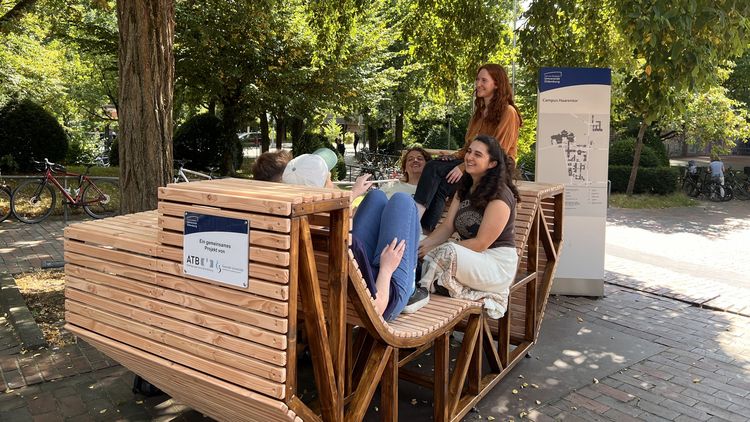


Unusual seating has recently appeared on the Haarentor campus. Whether sitting or lying down, this is a place to relax, study and chat. Students from the Technical Education (ATB) working group have been working on the three benches for weeks.
They’re a real eye-catcher: just seconds after they were installed, the first students were already climbing onto the seats and lounging areas of the large benches. Each of the three modern-looking wooden benches can seat up to eight people. They have been on display on the forecourt of the canteen at the Haarentor campus since mid-August.
For the project’s initiators, it is about more than just functional seating. “Thanks to their open design, the benches encourage encounters and interaction,” says Tim Wohlann, who coordinates Student Health Management (SGM) at the University of Oldenburg. “They are ideal for studying, as well as for conversations and relaxing breaks.” The furniture is weatherproof and can be used all year round. “The benches visibly enhance the quality of life on the campus,” emphasises Wohlann. The area in front of the canteen, in particular, is a popular meeting place.
Students have built the furniture
The wooden benches were created as part of a teaching module, initiated by the SGM and the Technical Education Working Group (ATB). “The project aims to encourage the trainee teachers to provide similar practical experiences in their own lessons later on,” report research assistants Lennart Rohlfs and Marius Rothe, who supervised the ten-strong group in the ATB’s premises. The building management team supported the project with 2,000 euros. Inspiration came from Bielefeld University. There, they had already had positive experiences with similar seating, says Wohlann.
Ten students were responsible for the project over the course of the summer semester. They produced drawings of the seating, sourced materials – and finally sawed, hammered, sanded and oiled the pieces in the workshop. “Sanding the individual slats was the hardest part for me,” recalls student Can Kaptan, for example. For over a month, his project group met several times a week for up to seven hours at a time to get on with the work.
“We went through every stage, from the initial idea to its realisation,” recalls student Nils Carell. Now, for example, he realises how important it is to make the right selection of wood and dimensions, and to finish the surfaces of the furniture properly. Following this initial success, the team is already considering offering further projects in the coming semesters.