

Gaining an insight into academic work, getting to know the university and finding clarity about study and career choices: Enno Gronewold started his Voluntary Academic Year with these goals in mind. After seven months, he takes stock.
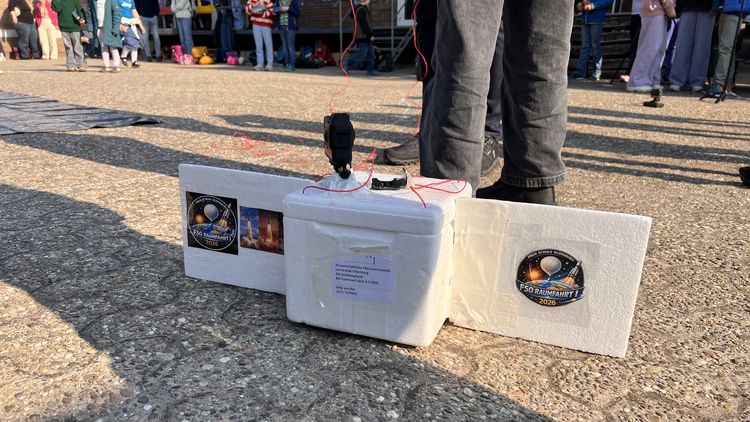
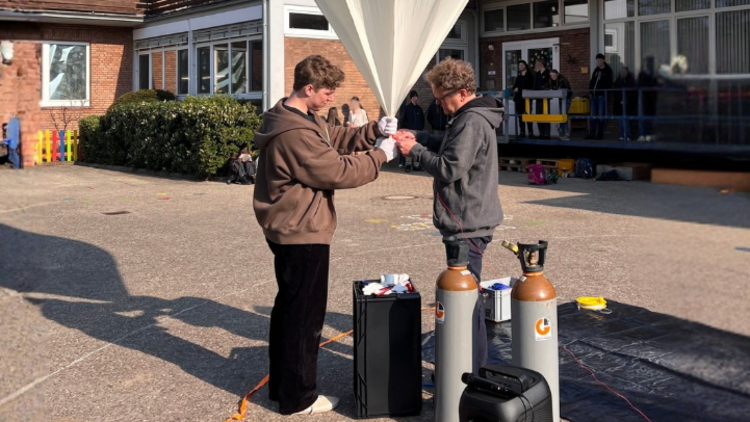
Enno Gronewold walks briskly across the schoolyard. He is looking for new adhesive tape with which he can attach cameras to a white polystyrene box. They have to be windproof. This is the only way to guarantee impressive shots. "You can never stick enough," Björn Poppe, Professor and Head of the Department of Medical Radiation Physics and Space Environment, calls out to him from a few metres away. Gronewold is already holding the adhesive tape and the box in his hand. "Here, hold this," he says to a child. The boy, who then helps to attach the cameras, understands immediately. They have been preparing together for weeks for what they are about to do. They want to send a weather balloon to the edge of space.
At the beginning of his Voluntary Year of Science (FWJ) at the University of Oldenburg, Gronewold had not expected to accompany such an exciting schoolyard experiment. "This is one of the highlights that I will remember for many years to come," says the 20-year-old.
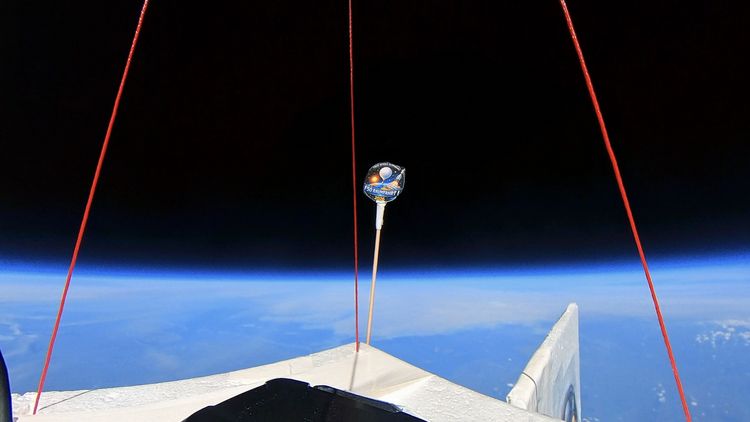
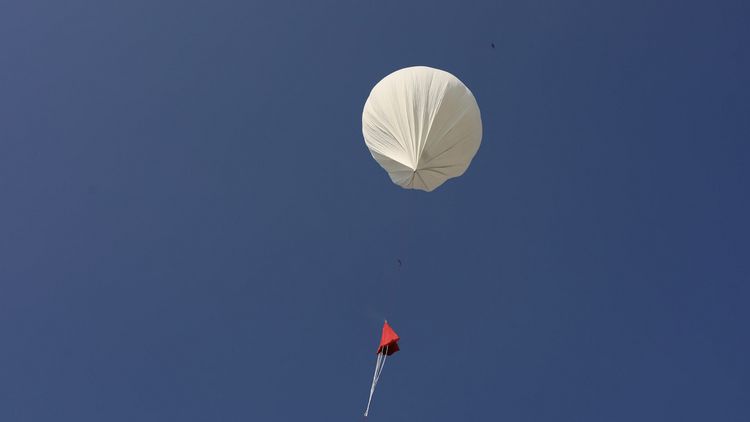
The day is perfect for it: mild temperatures and a cloudless sky offer the best conditions. All the other preparations are also running like clockwork - in the truest sense of the word. A white balloon resembling a bed sheet is filled with helium. Strings and adhesive tape prevent the filling from escaping. A red parachute will later ensure a soft landing. The white polystyrene box, which turns out to be a probe, contains three cameras, a mobile phone and a GPS system. In addition to the children involved, there are also lots of onlookers around the balloon. They stream out of the classrooms to experience the balloon flight up close with their teachers. Gronewold and Poppe are slightly tense. After all, they don't want anyone to be disappointed today.
Now it's getting loud: first the countdown, then shouts of joy. The balloon has taken off successfully. It finally flies 36 kilometres into the air before bursting and landing in a treetop near Achim. In addition to landscape shots, photos and videos were also taken from the edge of space, as the balloon actually reached the stratosphere. Mission Accomplished!
For the experiment, Gronewold and Poppe ran an "Astro-AG" for primary school pupils at the Freie Schule Oldenburg for several months. The programme included learning about space, the atmosphere and the planets. "Everyone enjoyed the balloon flight today. You can get people excited about science with special formats like this," says Gronewold. Working with the children once a week was a matter close to his heart: "I had a lot of fun. I learnt how to bring research to life for young people."
A year full of insights
Private contacts drew Enno Gronewold's attention to the Voluntary Scientific Year at the university last year. "It came at the right time for me," he says. Although he was interested in physics and mathematics after leaving school, he didn't want to commit to a degree programme just yet. The FWJ offers him the opportunity to gain insights into research projects and work processes as well as to familiarise himself with study and career opportunities. Accompanying workshops and an English course round off the year. He can also attend lectures, for example in astrophysics. "Now I'm sure that I want to study physics after the FWJ," he says. "Preferably at the University of Oldenburg."
His supervisor Björn Poppe is delighted. "Enno Gronewold is the first FWJ student in our department. It's great that he enjoyed it so much with us." Gronewold: "I was able to help shape my year right from the start. I hope that future FWJ students will have similar great experiences."