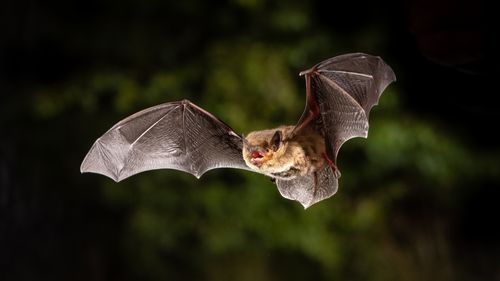


Despite their tiny brains, honeybees find their way home safely. International researchers, including biologist Jacqueline Degen, report in the journal Nature, how the insects’ navigation strategy could be applied to autonomous flying robots.
Honeybees are experts at flying long distances across the countryside on orientation flights and foraging trips, and at finding their way back to their hive – even though they have only a tiny brain. To do this, they use, amongst other things, a technique known as odometry: by observing the landscape passing by, they can estimate how far and in which direction they have flown.
An international research team has taken a closer look at this ingenious mechanism from the animal kingdom – and used it to develop a navigation strategy for man-made drones. The ‘Bee-Nav’ project involved Dutch robotics researchers from Delft University of Technology, biologists from Wageningen University, and navigation biologist Dr Jacqueline Degen from the Institute of Biology and Environmental Sciences (IBU) at the University of Oldenburg. The team recently published the corresponding study in the prestigious journal *Nature* .
Honeybees memorise distinctive landmarks
Before setting out to forage, honeybees carry out special orientation flights to familiarise themselves with their surroundings. As early as 2015, navigation biologist Dr Jacqueline Degen had conducted a detailed study into how the insects structure these flights and explore different parts of the landscape. The findings were published in the journal Animal Behaviour . “We know that honeybees calculate the return journey to their hive precisely,” says Degen. “During their orientation flights, they memorise distinctive features of their surroundings, which later help them to find their way.” However, it is not yet fully understood exactly how the bees store such relevant environmental information.
Previous findings have already been successfully applied to the design of drones. In future, for example, small, autonomous flying robots could be used to monitor plants in greenhouses for pests and diseases. They should also be able to navigate independently when GPS is unavailable. Most current systems do this by creating detailed maps of the landscape. However, this requires a great deal of computing power and storage space, which makes such drones expensive and energy-intensive. Against this backdrop, the research team investigated the extent to which the mechanism used by honeybees for navigation could be applied to autonomous flying drones, with a view to making the robotic systems more cost-effective and energy-efficient.
Orientation flights like those of bees
With success: the researchers also relied on shorter orientation flights in the surrounding area for the drones. In outdoor experiments, the ‘Bee-Nav’ navigation strategy developed by the researchers enabled very small quadcopter drones to travel around 600 metres from their starting point and fly back successfully – using just 42 kilobytes of neural memory. Every test proved successful even in large indoor spaces. Only in windy outdoor conditions did the success rate drop to 70 per cent. A main reason for this was that the wind caused the drone to tilt, making its images more difficult to use for navigation.
“The experiments are very encouraging,” says Dequan Ou, the robotics researcher leading the study, in a press release from Delft University of Technology. “However, they also show that our current system needs to become more robust under real-world conditions.” Degen adds: “The study also provides new insights into how honeybees find their way back to their hive and what role odometry and visual learning play in this.” Further studies are needed to fully decipher the insects’ complex navigation system for estimating distances and directions.