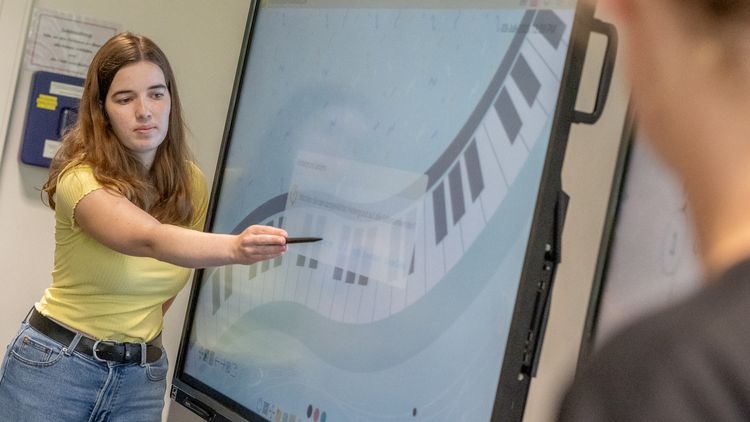


Trainee teachers spent a semester researching how interactive whiteboards can be meaningfully integrated into school lessons - and which hurdles make them difficult to use in practice.
Fetching blackboard chalk or pushing the overhead projector from the materials room into the classroom - these tasks are familiar to very few pupils today. The blackboard and projector have almost lost their supporting role as teaching aids. Instead, many classrooms now have whiteboards. The modern whiteboards promise interactive lessons. "In practice, however, they are usually used more like a projector screen," says Prof Dr Ines Oldenburg from the Institute of Educational Sciences.
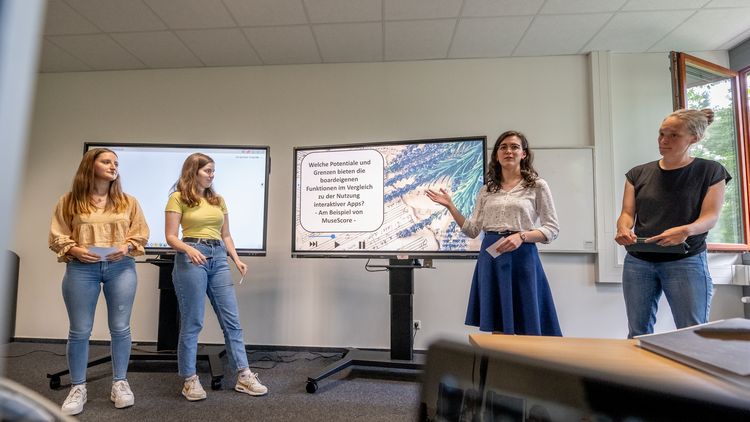
She has therefore made the devices the subject of her seminar "Evaluating digital teaching materials for inclusive settings" and, together with a total of around 50 students in the Master's degree in teaching, has researched the potential of an interactive whiteboard in the classroom - and the hurdles that sometimes prevent it from being used effectively in practice. What's special is that the students have now also presented their findings to a representative of the company whose devices they put through their paces.
Teaching concepts for different subjects and school types
The prospective teachers were very thorough. They began by designing interactive lesson content with the board and the applications available on it. They recorded the problems they encountered in the process. Because the students are studying very different subjects and types of school, they were able to provide impressions from many different perspectives at the end of the semester.
During the final presentation, one prospective physics teacher reported on her idea to prepare a student experiment on the board. "It would be cool if I had pictures of lamps, cables and a power supply unit, for example," she explained. This would allow her to visualise the experimental setup, which her students would then have to recreate in the classroom using real materials. So far, however, such a function has been missing.
There was also good feedback for the fact that different work results from the class - for example from group work - can be shown and compared simultaneously on the board. "It would be great if handwriting, which is sometimes difficult to read, could be automatically converted into typed words," suggested one student.
Not suitable for all purposes
On the other hand, a student of special education saw hardly any useful applications in her everyday life as a teacher. "In our type of school, the pupils need something they can touch. We need to appeal to as many senses as possible. When teaching with a whiteboard, concentration quickly wanes," she feared.
A group of sports students also saw the tool as more than just an advantage. "Movement time must not be reduced by standing in front of the board for too long," warned the prospective teachers. They also reported technical problems when dealing with videos recorded during lessons: "We only managed to transfer a video from the tablet to the board once without any intermediate steps or problems," criticised one student. But then it was practical to be able to make markings and notes in the video.
Prospective music teachers see potential
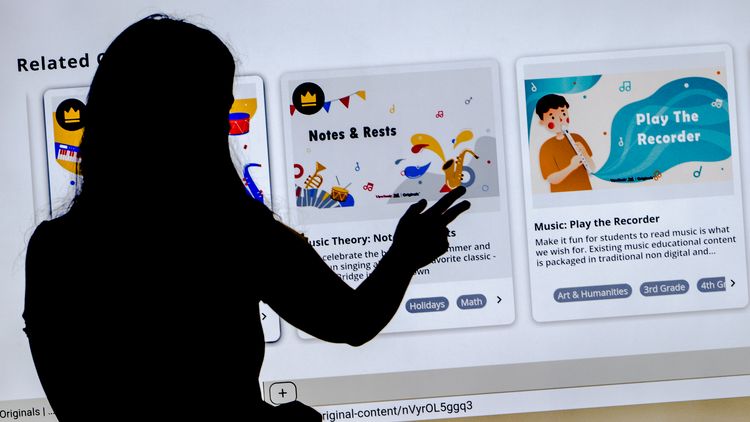
A group of female students reported that the interactive board could have an exciting effect in music lessons. The young women demonstrated that the keys of a virtual keyboard they called up actually produced sounds. In their opinion, it would be even nicer if played notes were converted directly into grades and entered into the staves.
Some points of criticism were frequently raised. For example, a mere 45-minute introduction, as is normally given to teachers at schools, is not enough to be able to use the board properly. "Some of our points of criticism may seem petty, but you have to imagine that we are standing in front of a class of eighth-graders, for example, who immediately turn up the volume if something doesn't work," said one student.
Feedback should help to improve the boards
"According to the Conference of Ministers of Education and Cultural Affairs, pupils should be made fit for the future in terms of digitalisation," says Ines Oldenburg. For her, this also includes motivating prospective teachers to use digital teaching materials and at the same time encouraging them to use them critically. "Of course, it's great that the students can use their feedback to have a concrete impact on the further development of this manufacturer's board."
The manufacturer's representative Philip Meier, who had explained the function of the board to the students at the start of the semester and now took their feedback with him, emphasised once again how valuable the re-registering students are for the manufacturer. "Developers are developers and look at a product like this with different eyes than users," he said. The view through the "professional eyes" of prospective teachers is therefore very helpful for the further development of the board.