

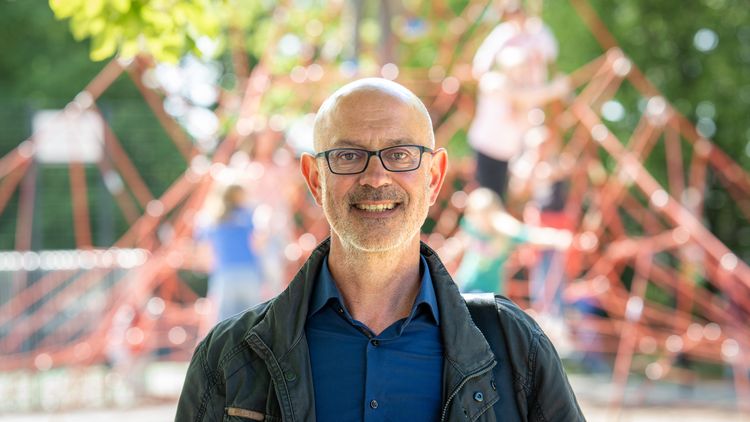


All children starting school in Germany are, from now on, entitled to all-day care at primary school. In this interview, education expert Till-Sebastian Idel discusses the educational quality, the need for professional staff and suitable premises – as well as schools' future role as the heart of their neighbourhoods or villages.
It is not only in Lower Saxony that the legal entitlement to all-day care for children in primary school is being phased in from the start of the new school year. This is an issue that affects many – and represents a major financial and organisational challenge for the federal states and local authorities. What about the quality of education?
This is indeed a tension: on the one hand, we have the federal requirement for childcare provision that meets quantitative needs, which must be fulfilled even in the face of local disparities. On the other hand, we have the demand for quality in educational work, in schools and in their cooperation with social education or child and youth welfare services. Our stance in educational science is that it is not just about childcare capacity, but – regardless of the scarcity of financial and human resources – about schools and all-day care for schoolkids aiming to be a good place for children to grow up.
How, then, can this standard of educational quality be met?
Whether the staff for all-day care are employed directly by the school itself, by a funding body or by an after-school care centre – as is traditional in many parts of eastern Germany, for example – what matters is professionalism and professional development. It is not impossible, for example, to join an all-day school without formal teaching qualifications, a degree or relevant training, and still do a good job. However, staff must not be left to their own devices. On the contrary: a key factor in the educational quality of an all-day programme is the staff’s continuing professional development.
So simply having a ‘knack’ with children is not enough as a qualification…
All-day programmes – provided they are not outsourced to an after-school care centre – are also part of the school. Without any educational background, one can easily find oneself rather ‘lost’ there, as we know from a recent research project. It is therefore essential to integrate all those involved into the teaching staff and to train them ‘on the job’. And it may well be necessary to establish a clear framework along the lines of: ‘Anyone working as a freelance staff member in the all-day programme to a certain extent must either already hold this or that certificate or obtain it in the near future.’ After all, the aim is for children to experience school days that form a coherent whole, effectively balancing lessons with the all-day programme.
Apart from qualified staff, what else is needed for the all-day programme to succeed?
The second key is development work within the schools. It must not be left to individuals to do a good job; rather, schools must each consider how they wish to further develop their school and learning culture. All-day schooling implies a broader understanding of education.
What does that mean in concrete terms?
This involves something that has long been happening at many all-day schools, namely: opening up to the wider community – the local area or neighbourhood. It means that schools see themselves even more as part of the wider community, and that civil society organisations from their local area also help shape the all-day programme. One example would be a sports club offering an after-school activity in the afternoon. By opening up to social organisations – clubs, associations, the parish or others – the school, in turn, also takes on a different significance for the neighbourhood in which it is located. A colleague of mine always refers to schools as ‘social spaces within social spaces’: a school is a social space in its own right, which must be equipped, designed and curated. And schools are part of a larger social space; they must see themselves as such and open up accordingly.
Speaking of space: what is the situation regarding the physical facilities in schools? Is there still work to be done in this area?
In many places, schools complain that investment is needed, that the physical conditions could be improved, and that there is simply a lack of space. It is questionable whether schools are adequately served by classrooms alone – however aesthetically pleasing and cosy they may be – or whether further spaces are needed where one can work with children in different ways. Youth centres and child and youth welfare facilities could serve as models here, as they often offer different learning and experiential spaces.
Many primary schools have long been offering all-day programmes and may simply have adjusted their supervision hours to the statutory entitlement that will come into force at the start of the new school year. Are there models or examples that have proven their worth?
There are plenty of examples of both structured and open, rhythmically organised all-day schooling. Networking between schools is absolutely vital here, and in many places there is a fruitful exchange of ideas. The winners of the German School Prize also provide inspiration for other schools. It is up to headteachers at the very least to take a look at different models – and then the question for the school is: which model do we choose because we believe it suits our school?
What does an all-day school mean for the children?
Research into all-day schooling over the last 20 years has yielded a clear finding: for there to be a positive impact on academic performance and social interaction, it is important that children attend all-day school regularly and over a prolonged period, and that the quality of the activities offered to the children is high. Crucial to the latter are respectful, positive educational relationships – which brings us back to educational professionalism. And when all these conditions are met, the all-day school becomes a place where children feel they belong and feel at ease. A sense of belonging, in particular, and also of well-being, is becoming an increasingly important issue in educational research – an immensely important factor in enabling children to learn and thrive at school.
A look to the future: how will and should all-day schools change?
Many schools are already very advanced and have anticipated many desirable developments: a comprehensive range of activities involving collaboration, a well-developed learning culture and a strong focus on the children. Owing to their educational tradition – the primary school as the first school and as a school for all – primary schools in particular are often already well advanced and can serve as role models for secondary schools. However, I see the major transformation that lies ahead for the system primarily in schools broadening their understanding of education even further and making fundamental solidarity – which is so important for a democratic society – a tangible experience. Ultimately, this will see them network even more closely and become the heart of their neighbourhood or village.
Interview: Deike Stolz


