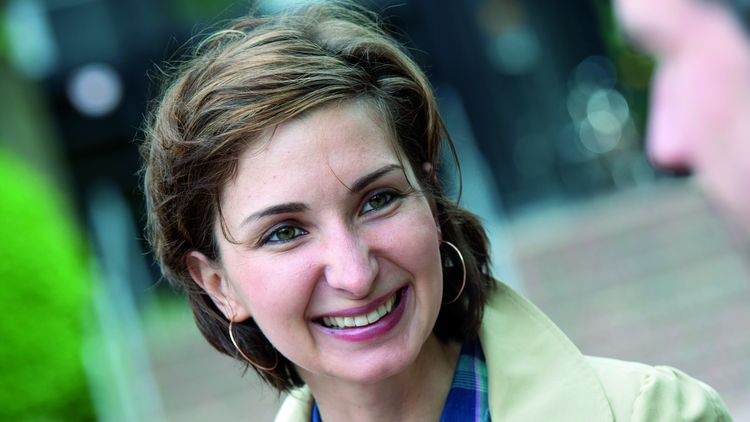

She comes from Russia and has been studying at the University of Oldenburg since 2006. In this interview, Natalia Movchan talks about the start of her studies and her first experiences in Oldenburg. And about the special recipe that helped her.
QUESTION: Natalia, you are studying economics in your 9th semester and are about to graduate. What is your Bachelor's thesis about?
MOVCHAN: The topic is "Maritime shipping in the context of the global economic crisis". Many people think that the crisis is over. The fact that this is not the case can be clearly seen in the port and container sector, for example.
QUESTION: You come from Krymsk, Russia, which is not far from the Black Sea. Is this where the origins of your Oldenburg bachelor's thesis lie?
MOVCHAN: That could be the case. I moved from Krymsk to Novocherkassk to study, a city about the same size as Oldenburg, situated on the Don, not far from Rostov. You can see that: I was always where the water was.
QUESTION: What did you study in Novocherkassk?
MOVCHAN: It's difficult to translate, something like the "complex use of water resources" - perhaps best explained with the simple German word "Wasserwirtschaft". The degree programme lasted five years.
QUESTION: What was different in Novocherkassk than in Oldenburg?
MOVCHAN: Pretty much everything. I lived in a hall of residence back then. It's not at all comparable to a German hall of residence. The living conditions there are different, simpler. You live together in a small space. If you go out there, you can call yourself "socially competent".
QUESTION: Why did you choose Oldenburg of all places?
MOVCHAN: To improve my German language skills, I used an Internet portal to establish e-mail contact with German students. That's how one or two internet friendships developed, and that's how I first came to visit Oldenburg. Later, I was invited again by the university to take the mandatory language test.
QUESTION: You travelled there in the summer of 2006.
MOVCHAN: Yes, when the World Cup put the whole of Oldenburg in a state of emergency.
QUESTION: Unfortunately, Russia wasn't there. At least Ukraine made it to the quarter-finals ...
MOVCHAN: I only followed it all from the sidelines. At first I felt very alone. It was difficult at first. My German wasn't that good yet, although I had already taken language courses in Novocherkassk.
QUESTION: How did you get through the first few months?
MOVCHAN: I realised how many Russian-speaking young people there were in Oldenburg. I didn't expect that, and that helped. I skyped a lot with my parents. And at some point I overcame the language barrier - it just happened, I can't pin it down to a specific day.
QUESTION: What was the best way to overcome the language barrier?
MOVCHAN: Asking questions, approaching people, developing courage. That's simply the best recipe. But also a difficult one.
QUESTION: Why?
MOVCHAN: We have a different culture in Russia. Approaching people directly is not so common, and as a student you tend to be shy. But in Oldenburg, the ISO really encouraged and supported me. Although there is a strong tendency at the beginning to spend most of your time in groups of Russian-speaking fellow students. There was hardly any contact with German students at the beginning - which is so important for arriving and learning the language. I think in the beginning, German fellow students didn't want to have much to do with us because we spoke a lot of Russian. I'm glad that this has changed a lot over time.
QUESTION: What was your most important experience during your studies in Oldenburg?
MOVCHAN: That was a learning success for me: when we had to write a seminar paper in a group of five people in the Communication module, then present the whole thing - and I got a grade that was in some cases even better than that of my German fellow students. That's when I realised for myself: You can do it. That was an incentive to continue.
QUESTION: What are your plans after graduation?
MOVCHAN: I would like to put the knowledge I have acquired into practice as soon as possible, preferably in a commercial area of a company, ideally in a marketing department.
QUESTION: How long do you have to find a job?
MOVCHAN: I have to find work within a year of completing my bachelor's degree. Otherwise I have to go back to Russia. But I'm very optimistic that it will work out. I have already gained very important work experience during my internship.