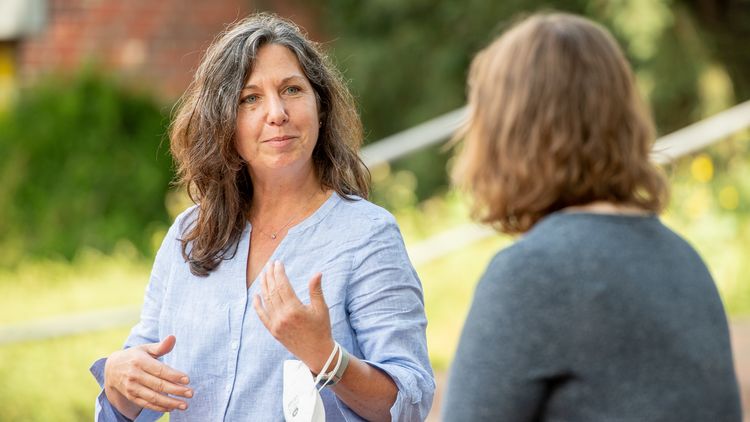

Astrid Beermann has been working as a therapist, supervisor, coach and mediator in practice and teaching for 20 years. At the university, she is the contact person for all employees, from apprentices to managers. A conversation outside.
Dr Beermann, do you like going for walks?
Yes, I've always enjoyed being out in the fresh air and being active. I also have a dog that I really enjoy walking.
You have been at the university since 2006. What brought you here?
I was a research assistant at the C3L - Center for Lifelong Learning for 14 years in the fields of psychotherapy, supervision, coaching, meditation, organisational development and counselling and also taught in this area. I moved to Oldenburg in 1999 for personal reasons and there was a very attractive job vacancy at the university that matched my qualification profile and interests very well. Before that, I had worked in a counselling centre and as a freelancer, underwent extensive further training and then also wanted to work in academia again. And even years later, I still really enjoy being here at the University of Oldenburg.
What is your current role at the university?
I've been an advisor for psychosocial counselling and conflict prevention in health management in the Department of Human Resources and Organisational Development since October 2020. Anyone interested can contact me by email or phone without obligation. Various topics can then be discussed in a confidential dialogue.
What topics are these?
It's very varied. Of course, the focus is always on the work situation. Well-being in the workplace is influenced in different ways. Mental stress, individual crises in team situations, conflicts between colleagues or difficulties in day-to-day management are just a few examples. The programme is aimed at all levels of the university. If desired, it is possible to involve colleagues or superiors in the discussions in order to resolve conflicts together. In addition to this counselling, mediation is a major area in the case of more escalated conflicts. And, of course, prevention. In a counselling session, my neutral view from the outside can be very helpful for those affected.
It certainly takes a lot of effort to seek preventative counselling ...
People often associate the perception of a problem with the fact that they are doing something wrong. Yet obstacles are normal in everyday working life: it is professional to deal with them and they support personal and organisational development. At a large institution like a university, conflicts can also be seen as helpful because they draw attention to issues. This can improve our efficiency, i.e. our work processes, but it also makes the university a humane employer. There is an offer to do something to make work feel good. Younger people in particular take a closer look and have certain expectations when it comes to work-life balance. It's different today and perhaps also healthier - developing things together and at eye level.
What do you particularly like about your work?
I like working with people. I enjoy offering advice for different issues and in particular coaching, mediation and organisational development. Accompanying people in a search and change process and seeing how they develop new things and grow in the process - that's great.
What challenges do you face?
Confidentiality and transparency are particularly important in internal counselling. Counselling is subject to confidentiality. If we expand the setting, we can only do so with the release from confidentiality. Without this consent, it only happens on an abstract level. If I see that a conspicuous number of people are coming with the same issue, then that would be important for the organisation - in order to create additional services or rethink existing ones. Another challenge is to make the programme more widely available at the university. To present it as a contemporary offer for personal and academic appointment development.
Which enquiries are the most frequent?
There are many individual topics. Counselling in the context of illness and reintegration as well as coaching in management and employee conflicts are also frequent.
Has this changed due to the pandemic?
The number of enquiries has not increased, but new topics have been added. For example, how to best organise good working relationships in the context of digital encounters and forms of collaboration. Fears of losing one's job or changes in the workplace have also become more prevalent.
What do you like to do to switch off?
I make sure to pursue other meaningful and enjoyable activities in addition to this fulfilling work. A healthy lifestyle is also important to me. In my field of work, it is a matter of course to do supervision - to reflect and develop.
If you had to choose: mountains or sea?
The sea. Especially the Mediterranean. But I have to admit that I've also had some great experiences in the mountains.
Interview: Lara Schäfer
This text first appeared in the October issue of the university newspaper UNI-INFO .