
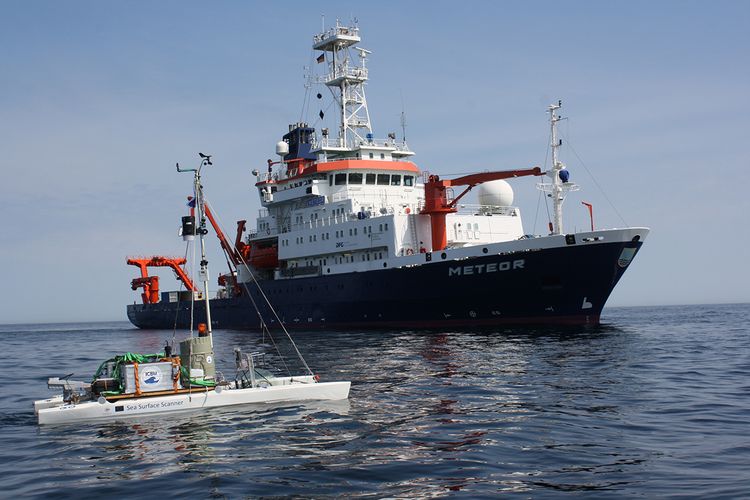

To what extent can oceans absorb climate-relevant gases and ensure that they disappear from the atmosphere? What changes occur? Oceans are largely covered with wafer-thin surface films - what happens in this thin film?
Dr Oliver Wurl, a marine scientist at the University of Oldenburg, and his research group "Ocean Surfaces" are working on these and other research questions. In order to find answers, Wurl and his colleagues from the Institute of Chemistry and Biology of the Marine Environment (ICBM) have been on board the Hamburg research vessel Meteor since 23 July.
The scientists are currently conducting research in so-called upwelling areas near the Gotland Basin in the central Baltic Sea. Before they return in mid-August, sampling in the Gulf of Finland is still on the expedition's schedule. Upwelling areas are characterised by the upwelling of cold deep water and only occur in certain weather conditions. The uppermost water layers in upwelling areas are saturated with carbon dioxide and rich in nutrients, which in turn leads to high plant biomass (primary production). Upwelling areas are therefore of particular interest to marine scientists in many respects.
Wurl's research group determines carbon dioxide exchange rates between the sea and the atmosphere using a buoy specially developed at the ICBM. The group also investigates chemical and biological parameters in the sea surface film, which has a thickness of less than one millimetre, at high resolution. Here too, the research instrument - a remote-controlled catamaran - was developed at the university. The catamaran is equipped with rotating glass discs and the principle of sampling is very simple: the surface film adheres to the glass due to its water-repellent nature.
Wurl's group also uses the samples for microbiological analyses in order to better understand the role of bacteria in gas exchange. She is also investigating oxygen development and oxygen consumption at different depths in the sea compared to the surface. "Only if we know the relationships between the gas exchange rate and the properties of the thin sea surface can we assess how climate-relevant gases are actually absorbed by the oceans and which processes play a role," emphasises Wurl.
The Meteor expedition comprises both a long-term monitoring programme on behalf of the Helsinki Commission and the Federal Maritime and Hydrographic Agency as well as a scientific programme to better understand biochemical processes in upwelling areas. In addition to the Oldenburg scientists, working groups from the Institute for Baltic Sea Research (Warnemünde) and the Leibniz Institute for Tropospheric Research e.V. (Leipzig) are also on board.