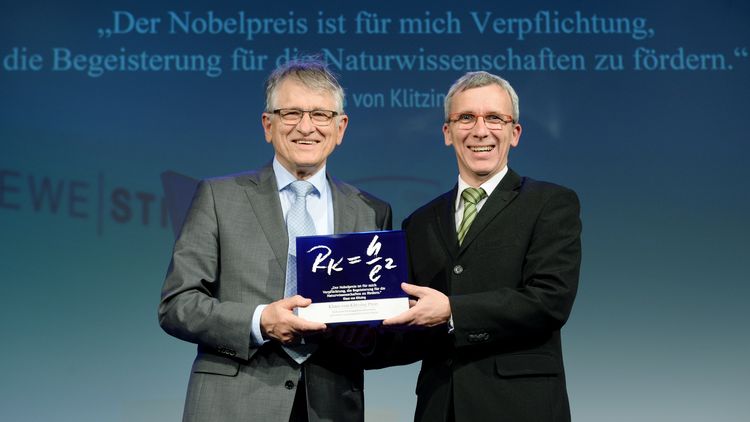

Biology and chemistry teacher Dr Steffen Möller uses practical projects to inspire his pupils at the von Bülow School in Neudietendorf, Thuringia, to protect the environment. He has now received the Klaus von Klitzing Prize 2017 for his commitment. The award, which is endowed with 15,000 euros and has been presented in co-operation between the University of Oldenburg and the EWE Foundation for thirteen years, recognises outstanding commitment in the STEM subjects - Mathematics, Computing Science, Natural Sciences and Technology.
"I am touched beyond measure" - with these words Möller expressed his gratitude for the award on the evening of the ceremony in the auditorium of the Grad-Anton-Günther School in Oldenburg. "The Klaus von Klitzing Prize is confirmation and encouragement to continue on the path we have chosen, even when we face headwinds." The path that Möller is talking about is characterised by personal conviction and passion: he founded an environmental working group, established a biodiversity day and the "green classroom" to enable lessons in the open air. The school's own vivarium enables pupils to learn how to handle exotic animals. "I want to develop an environmental awareness in as many people as possible that reaches far beyond the horizon, is based on science, is supported by personal responsibility and leads to real changes in behaviour," says Möller himself about his commitment. This is well received: in their laudatory speech, his former pupils Lara Simon and Niklas Renner were deeply impressed by their time at school. "Even in the pouring rain, we went out into the Apfelstädt and collected freshwater shrimps." The joint cycle tour, during which they visited the homes of all their classmates, also remained a great memory for the pupils.
As in previous years, namesake and Nobel Prize winner in physics Prof Dr Klaus von Klitzing presented the prize in person. "First and foremost, Steffen Möller impressed the jury with his expertise. He is a scientist with heart and soul. But it was his attitude that tipped the scales in favour of his nomination. He does not pursue his work as a profession, but as an academic appointment and endeavours to reach as many people as possible with his projects," said von Klitzing, explaining the jury's decision. Michael Heidkamp, Chairman of the Board of Management of the EWE Foundation, adds: "Steffen Möller pursues applied natural sciences and makes an extremely important contribution to a society that is fit for the future with his environmental projects. We wish there were more teachers like him." The Klitzing Prize emphasises the importance of STEM disciplines for our educational, economic and scientific system, said Heidkamp. Two thirds of the prize money provided by the EWE Foundation is used to support one school project each year. In this way, the EWE Foundation is making a sustainable and targeted commitment to science and technology education.
"As a university with a focus on the training and further education of teachers and a high demand for research-oriented learning, it is particularly important to us to honour outstanding teacher personalities and thus make them visible," commented Prof. Dr Dr Hans Michael Piper, President of the University of Oldenburg, on the selection of this year's award winner. According to Piper, Steffen Möller dedicates himself to his students, everyday teaching and school development in an enormously imaginative, technically skilled and highly problem-conscious manner. Prof. Dr Sabine Kyora, Vice President for Studies, Teaching and Gender equality, pointed out at the award ceremony that STEM subjects are still not particularly popular despite extensive support programmes. "There are still too few women studying subjects in the natural sciences."
In addition to von Klitzing, the jury includes representatives from the University of Oldenburg, the EWE Foundation, the management of the Chamber of Industry and Commerce and the headmaster of Graf-Anton-Günther-Schule, Wolfgang Schoedel, who also hosted the ceremony. This year, the jury was reinforced by a student, Noemi Wassermann, who scrutinised the applications from the perspective of the target group.
Klaus von Klitzing, who spent his early school years in Oldenburg, is, among other things, Director of the Max Planck Institute for Solid State Research in Stuttgart and a member of the International Solvay Institute. In 1985, he was awarded the Nobel Prize in Physics for discovering a new quantum effect five years earlier. This had a significant influence on the development of modern computer chips.