

The Low German Forum aims to raise the profile of the regional language within the university’s cultural life – anyone interested is invited to attend the fortnightly meetings.
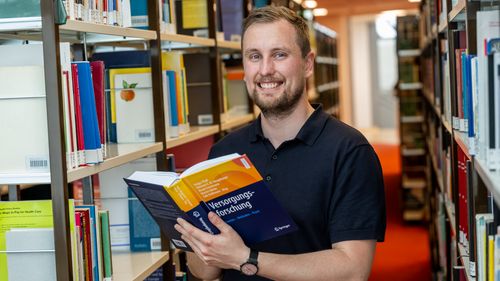
“There are great opportunities to learn Low German at the university, but it’s difficult to keep practising afterwards,” says German studies student Joschka von Lienen. Together with his fellow student Thees Becker, he therefore launched the Low German Forum –
in Low German: Nederdüütsk Forum – at the start of the last winter semester. Every two weeks, they host gatherings in room A6-0-009 – to have a natter in Platt, but also to work together to ensure that the regional language becomes more visible in the university’s cultural programme.
The forum’s guests have already enjoyed joint trips to Low German performances at the Oldenburg State Theatre and an excursion to the ‘ThinkTank Platt’ run by the Low German Secretariat in Hamburg. Relevant literature – ranging from the Low German poetry collection *Quickborn* to *Harry Potter un de Wunnersteen* – has also been discussed.
Although the meet-up is explicitly intended to be more than just a ‘Klöönkring’ – that is, a little chat – for many, speaking the language is the main reason for taking part. As soon as they cross the threshold, most participants automatically switch from High German to Low German. Yet language skills aren’t even required to take part. “We also have two or three people here who don’t actively speak Low German themselves, but simply understand the language,” says Becker.
What they all have in common is a love for the regional language, which very few of them picked up at home. Lucia Gerst, for example, grew up in Stuttgart. “When I came to Oldenburg to study, I saw that there was a Low German certificate and just decided to give it a go,” explains the German studies student. Today, as a student assistant, she is herself involved in teaching the language to students and writes her own stories in Low German. “I just think it sounds lovely,” she says.
André Graën, from near Hildesheim, is fascinated by the linguistic perspective on the Low German variant of his East Westphalian homeland – a language that is now scarcely spoken at all – so much so that, despite having successfully completed a degree in computer science, he is currently studying again: on the new Bachelor’s degree programme in Low German. “There are so many aspects that research has never addressed before, and so many linguistic treasures to discover,” he says.
Up to 13 participants are currently involved in the Low German Forum. Members of the university can join at any time. As well as joint excursions, the focus in the summer semester will be on planning their own activities. “We’d like to organise a Low German poetry slam, for example,” says von Lienen. Outside of teaching and research, there has so far been a lack of Low German influence on the campus. “We want to fill that gap,” says Thees Becker.