
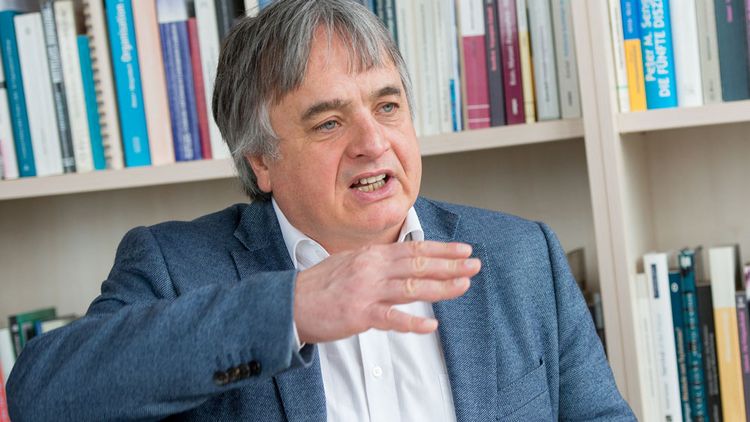


The European Union is celebrating its 60th birthday - and is in crisis. In this interview, social scientist and Europe expert Martin Heidenreich talks about the successes and failures of European integration, cross-border solidarity and social division.
QUESTION: On 25 March 60 years ago, government representatives from Italy, France, Belgium, Luxembourg, the Netherlands and the Federal Republic of Germany signed the so-called Treaty of Rome, laying the foundations for today's European Union. A reason to celebrate. What have Europeans achieved since then?
HEIDENREICH: Europe was created in the 1950s as a project to secure peace. That has been a success. That is the historical merit of European integration. Especially when you look at the conflict areas in Eastern and Southern Europe and in the Middle East. The economic development and democratisation of Southern and Central Europe and the single market are also a success of European integration. The eastward enlargement is also a success story. However, this does not yet apply to the monetary union.
QUESTION: What do these achievements mean for life in Europe?
HEIDENREICH: There is more and more cross-border interaction - especially among citizens. People study or live in other European countries, they shop there or spend their holidays there. It is true that only around 1.8 per cent of the European population live in other EU countries. But the life satisfaction of these people does not differ statistically from that of the national population - unlike that of immigrants from non-European countries. We were able to show this on the basis of Europe-wide data. This means that whether you are French and work in Germany or France makes no difference to your life satisfaction. They can work and live anywhere in the EU and find just as good working and living conditions as the native population.
QUESTION: But that only affects a relatively small proportion of the population.
HEIDENREICH: Yes, a transnational elite has emerged. Nevertheless, around half of the European population is prepared to support other eurozone countries financially if they abide by the agreed rules. Without this cross-border solidarity, the European Central Bank and the euro rescue funds would not have been able to tackle the crisis.
The euro crisis - a crystallisation point
QUESTION: Despite this solidarity, there are populist, euro-critical parties in many countries that are very popular. The UK will formally apply for Brexit in a few days' time. What are the causes?
HEIDENREICH: Much of what is expressed in the current populist movements points to the dark side of European and global economic integration. Economic openness and accelerated technological development have led to many people seeing their skills devalued and fewer opportunities for economic development. This goes hand in hand with lower life satisfaction, particularly in southern Europe, even if national populist movements are paradoxically strongest in continental and northern Europe. But many losers of opening processes are resisting further transfers. National governments have not managed to secure social cohesion. But the EU has also failed to counteract the erosion of trust.
QUESTION: Is the current crisis in the European Union mainly a consequence of the euro crisis?
HEIDENREICH: For me, the euro crisis is a central point of crystallisation - not the only one, of course, if you think of the refugee crisis, terrorist threats or wars in the neighbourhood. So far, there are no convincing solutions to the euro crisis. It has worsened life chances, particularly in southern Europe. The economic differences between northern and southern European member states had narrowed rapidly until the crisis. Since 2009, however, income inequality in the eurozone has increased again. Unemployment rates have diverged even more. In Greece and Spain, youth unemployment rates are over 50 per cent. When an entire generation in southern Europe is sidelined, this naturally has consequences for trust in national governments and the EU.
Hardly any social competences at European level
QUESTION: What does all this mean for European integration?
HEIDENREICH: Even the wealthier member states, which have not been so badly affected by the euro crisis, are spatially and socially divided. The national populist movements in Poland or Hungary, in France, the Netherlands or the UK cannot be understood without these domestic inequalities. In Germany, too, there are considerable social and regional differences in the labour market. In many EU countries, these differences are even greater. The population in regions that are left behind, as well as groups with poorer economic prospects, are naturally susceptible to populist movements. Warsaw and eastern Poland are not comparable. Or: London on the one hand and the deindustrialised regions around Birmingham and Manchester on the other - they are worlds apart.
QUESTION: The latter was also demonstrated by the Brexit vote.
HEIDENREICH: Yes. The division of national societies undermines the foundations of European integration. The EU should integrate the population better socially. In my view, it could focus on broader, cross-border social security, especially through education and qualifications, equal opportunities and the opportunity to participate in competition. And on intergovernmental transfer payments to take the losers of technisation and market liberalisation processes with them. However, the European Union has hardly any social competences. These lie at national level. There have been repeated attempts to develop a European social policy since 1985. But these approaches have been scaled back since 2010. Many people have focussed primarily on national solidarity. However, I fear that the attempt to create justice only within a nation state is increasingly reaching its limits. This is demonstrated by the increasing inequalities within countries and the conflicts that go hand in hand with this.
Five paths to a European future
QUESTION: So do we need more competences at European level to tackle the current problems rather than fewer?
HEIDENREICH: In my view, yes. Firstly, to ensure the social cohesion of the population. Secondly, a monetary union without a European fiscal policy, i.e. without the possibility of intergovernmental transfers, will hardly function in the long term. This means rescue funds, a banking union and a coordinated economic policy. These are three pillars of cross-border solidarity that have so far only been institutionalised to some extent. At a social level, for example, a Europe-wide unemployment insurance scheme could stabilise the economic development of disadvantaged countries and regions. Every monetary union needs mechanisms for interregional transfers. Unemployment insurance is one such mechanism: if a region has high unemployment, it automatically receives more money from other countries.
QUESTION: What general direction should Europe take now?
HEIDENREICH: The European Commission has now presented a paper outlining five paths to a European future: Continue as before, only a single market, a multi-speed Europe, concentration on a few topics, more joint action. The Commission has deliberately left it open as to which of these paths it favours - with the exception of the single market - because each of these paths is linked to prerequisites. Above all, the member states must agree on a path. Even though I would of course like to see the fifth option, the chances of this happening are limited.
QUESTION: So the crisis will be with us for some time yet.
HEIDENREICH: We are confronted with a divided Europeanisation. Many policy areas - monetary policy, foreign trade and the internal market - are largely Europeanised. But everything that is important for people's social integration - education, a sense of belonging and social security - is still tied to the nation state. We are facing this divide. But every crisis also harbours opportunities. Great Britain, for example, will quickly and clearly learn the disadvantages of not having free movement of people, goods, services and capital over the next few years. I therefore believe that enthusiasm for Europe will increase massively in the UK over the next few years. And I hope that Europeans will learn to appreciate the advantages of a cross-border social area bound by common rules again, after we have recently experienced the abyss of national populist policies.
Interview: Constanze Böttcher