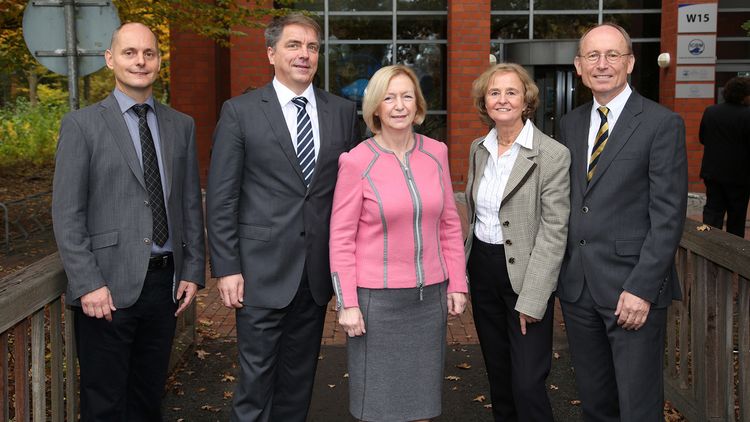

High-ranking visitor for the Institute of Chemistry and Biology of the Marine Environment (ICBM) at the University of Oldenburg: Federal Research Minister Prof Dr Johanna Wanka personally informed herself about the latest successes of marine research in Oldenburg on Tuesday. The meeting focused on the new Helmholtz Institute for Functional Marine Biodiversity, which is being established in Oldenburg together with the Alfred Wegener Institute (AWI) in Bremerhaven, as well as the future Lower Saxony Centre for Marine Sensors at the university's external site in Wilhelmshaven. "Our planet's largest habitat is under threat: overfishing, climate change and littering. The issue of microplastics alone has a serious impact on nature and humans. The sea urgently needs our help. Every year, 13 million tonnes of waste end up in the oceans. We can only solve all these problems with the support of excellent marine research, such as that conducted here in Oldenburg," said Federal Research Minister Wanka during her visit. Starting next year, experts from the university and the AWI will be working together at the Helmholtz Institute to investigate the consequences of global change for marine biodiversity and thus the function of marine ecosystems. The state of Lower Saxony plans to support the establishment of the new Helmholtz Institute with 23 million euros over the first four years; the funds will go towards a new building in Oldenburg, among other things. From 2021, the Helmholtz Association will predominantly support the Institute. "We will do everything we can to support the establishment of the Helmholtz Institute. We are currently developing a technology park in the immediate vicinity of the university, where there is a suitable site for the new institute. I reaffirm our commitment to reserve this site for the construction of the Helmholtz Institute," emphasised Oldenburg's Lord Mayor Jürgen Krogmann in his address to the Minister. University President Prof Dr Dr Hans Michael Piper was delighted: "For the University of Oldenburg, closing ranks with the city is also of great importance here. We are once again demonstrating what we can achieve together in this region," emphasised Piper, adding: "Our academics need research funding, space, the best working conditions - and a political tailwind. Today is a day on which our extremely successful marine researchers can be happy about all of this." Minister Wanka was also informed about the upcoming Lower Saxony Centre for Marine Sensors (ZfMarS). It is expected to be established at the ICBM's Wilhelmshaven site by 2020. The interdisciplinary and transfer-orientated research institution will focus on marine measurement technology as one of the key technologies of modern marine technology. Specifically, the scientists are researching possible fields of application and the reliability of the methods. The costs for the new building, which will be connected to the existing building at the ICBM site in Wilhelmshaven, amount to just under 5 million. euros. They are being co-financed with 2.5 million euros from the European Regional Development Fund (ERDF). ICBM Director Prof Dr Bernd Blasius thanked Federal Research Minister Wanka for her visit. "We feel confirmed on our path of a strongly future-orientated focus of marine sciences. The ICBM's interdisciplinary research approach has proven its worth over the past three decades since it was founded. The traditional research focus on coastal and shelf sea research is now increasingly being complemented by ocean research - as demonstrated not least by its function as the home institute of the state-of-the-art research vessel 'SONNE'." Background information Helmholtz Institute for Functional Marine Biodiversity The aim of the new Helmholtz Institute is to gain an even better understanding of what climate change and human-induced influences mean for biodiversity in the marine environment. Scientists from the university and AWI want to work together to find out what consequences this has for the function and performance of marine ecosystems - after all, they provide food and raw materials, influence air quality and the global climate and much more. The development of nature conservation and management strategies is therefore a further task. The future Helmholtz Institute will bring together existing working groups, but will also appoint new professors and set up junior research groups. Oldenburg biodiversity expert Prof Dr Helmut Hillebrand will be the institute's director. There are currently seven Helmholtz Institutes in Germany. These are branch offices of Helmholtz centres on the campus of a university. Centre for Marine Sensors (ZfMarS) The scientists at the ZfMarS focus their research on three main areas: In the "Innovation Laboratory for Reliability and Fouling Prevention", they are researching sensors that monitor offshore technologies even more reliably and efficiently. The "Innovation Lab for Oil, Water, Ice" aims to make sea transport more environmentally friendly by developing new measurement methods. Another aim is to be able to explore, extract and store energy resources even under adverse conditions without jeopardising the environment. The "Innovation Laboratory for Marine Surfaces" focuses on testing and measuring methods for processes on the water surface that are related to environmental pollution and climate change. The new centre covers the entire research field of water-sensor interactions - from the marine environment and inland waters to processes in ships or aquaculture facilities. Within the ZfMarS, the ICBM works closely with the Jade University of Applied Sciences and regional industry.
More on the topic
Helmholtz Institute for Functional Marine Biodiversity
Centre for Marine Sensors (ZfMarS)
Contact
Institute of Chemistry and Biology of the Marine Environment