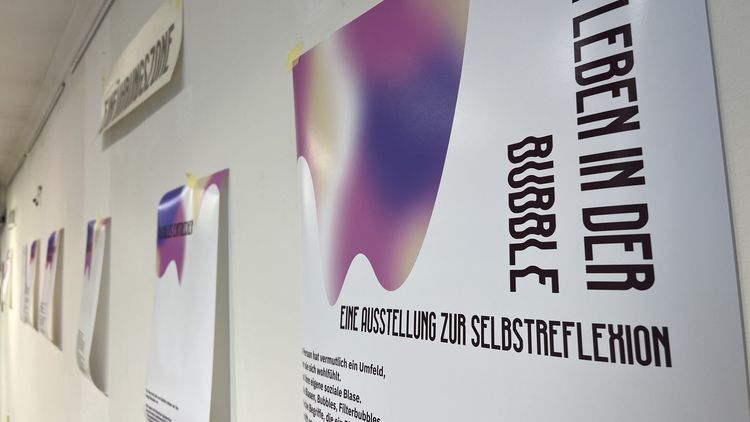
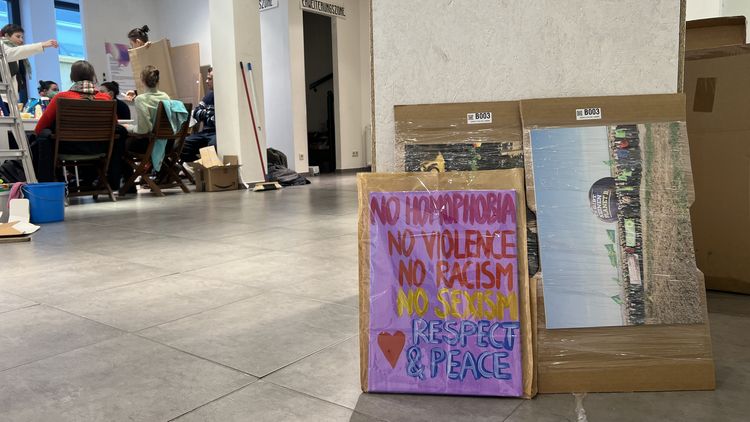


Everyone is part of some kind of social bubble - or perhaps even several. An interactive student exhibition in Oldenburg city centre sheds light on the phenomenon of the "bubble".
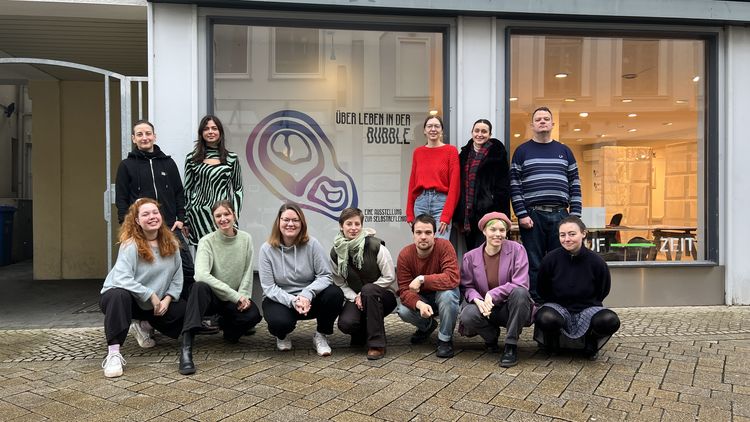
What do a reusable coffee mug, a video game and a towel from the open-air festival in Wacken have in common? "These objects represent social bubbles in which the people we interviewed locate themselves - in this case, for example, environmental protection, gaming and heavy metal," reports Franziska de Vries, a student on the "Museum and Exhibition" Master's programme. The "bubble" phenomenon is at the centre of the biggest project of her studies: her own exhibition, which she is currently working on together with 14 fellow students. From 13 to 25 March, the show entitled "About Life in the Bubble. An exhibition of self-reflection" can be seen in Oldenburg city centre at Haarenstraße 39.
The student team leaves open what exactly is meant by the term "bubbles" - for example, it could be real groups in which people feel comfortable, but also filter bubbles and echo chambers on the internet. "We have no power to define the term and don't want to convey any truth," explains Eyke Foraita, who is responsible for public relations together with Franziska and Denise Neumann.
Encouraging self-reflection
The team is much more interested in encouraging visitors to actively reflect on themselves: What are the advantages and disadvantages of social bubbles? Which bubble do I feel I belong to? How do I get out of a filter bubble? The students have come up with some ideas to get visitors to the exhibition thinking: Visitors can fill out questionnaires, distribute sticky notes, create collages and bring along objects that they associate with a bubble.
"The idea is for the whole thing to moderate itself and for something new and inspiring to emerge at the end," explains Eyke. The concept behind this is what is known as aesthetic research - a method of creatively engaging with questions, objects or feelings and thereby gaining new perspectives on a topic. In addition to the interactive exhibits, Haarenstraße also features classic text panels, objects, videos and multimedia installations. Visitors can approach the "bubble" theme in different ways in a total of five areas.
Preparing the show was an intensive, busy time for the 15 students. "You learn an incredible amount because you do everything yourself," says Franziska. In teams of two or three, they took care of financing, PR, the supporting programme or organising the vernissage - and at the same time, in other constellations, the content concept. "It demanded a lot from us because our normal studies continued at the same time and many of us also had to work," reports Denise. Dr Jutta Moster-Hoos, Director of the Horst Janssen Museum, supervised the team.
The effort was worth it: in addition to the exhibition, the students put together a varied accompanying programme. In addition to the vernissage, this includes a workshop, a film evening and an online lecture. The exhibition is sponsored by the Landessparkasse zu Oldenburg, the Universitätsgesellschaft Oldenburg e. V. and the Institute of Art and Visual Culture. The creative interim use was organised by the agency Raum auf Zeit.