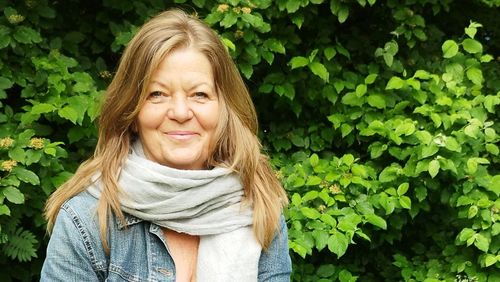


Johanna Raphaela Wahl is the first in her family to study at university and is now doing a doctorate. The new mentoring programme Perspectives is helping her to advance her academic career.
Johanna Wahl can well imagine staying in academia and making a career for herself there. Research, doctorate, postdoc –then who knows, perhaps one day she might even land a professorship in an exciting field of research. “But for a long time, I was unsure about how to take the first steps in the academic world,” she says. “I had no academic role models whom I could ask for advice.”
Wahl is a first-generation academic – the first in her family to have completed a university degree. By the time she made up her mind to pursue an academic career she had already earned a master’s degree in cultural studies at the Humboldt University in Berlin four years earlier. Now 35, Wahl worked as a consultant for the German UNESCO Commission both during and after her studies. “But at some point, I realised I wanted to do a PhD as well.”
Promoting equal opportunities at university
Wahl is now a research associate at the University of Oldenburg’s Institute of Educational Sciences and doing her PhD in social sciences as part of the “Generations in Protest” project funded by the German Research Foundation (DFG) under the supervision of PD Dr. Martina Schiebel. She is making good progress, too. “Nevertheless, I still get the feeling I have to make more of an effort than most to understand university processes,” Wahl explains. “So when I found out that the University of Oldenburg had a new mentoring programme aimed specifically at first-generation academics in the early stages of their careers, I applied immediately."
The programme is called “Perspectives: Pathways to Academia”. Launched in September 2025, it runs for a year and is aimed at advanced doctoral students and recently graduated postdocs. It was introduced by the University of Oldenburg as an additional component for promoting equal opportunities – and there appears to be a real need for such initiatives. Statistics show that social background still plays a key role in Germany in determining an individual’s educational success: only 27 percent of primary school pupils from non-academic households go on to study at university, compared to 79 percent of children of academics. And only two out of 100 children of non-academics go on to earn a doctorate, compared to an average of six out of 100 children of academics. (Source: Hochschulbildungsreport 2022).
Advancing the careers of children from working-class backgrounds
The mentees have already taken the first steps in their doctoral studies, but they still need support and advice. Eight women and two men are participating in this first round. “The new programme supports the specific needs of first-generation academics throughout their early careers to help them consolidate their academic careers,” emphasises Prof. Dr. Katharina Al-Shamery, Vice President for Academic Career Paths, Equal Opportunities and International Affairs and patron of the Perspectives programme.
For participants, the first step is to find a suitable mentor in the academic world with whom they can discuss issues such as decision-making, career orientation, financing and research projects. “The one-to-one mentoring relationship is at the heart of the programme, because mentees benefit enormously from being able to seek personal and confidential advice from an experienced professor or leading personality from outside academia,” emphasises Dr Sandra Wienand, Officer for Academic Career Paths. “Workshops, discussion evenings and targeted coaching for mentees complement the programme.”
Building up a network
Coming into contact with like-minded people who have not been shaped by an academic environment is an especially valuable experience, says Wahl, who has already attended the first meetings. She notes that there are many parallels between children from working class backgrounds, and many hurdles on the academic path that they can reflect on together. “Most of us are a little older, our path to a doctorate was not direct, we worked alongside our studies and obtained our higher education entrance qualification through adult education.”
Wahl has already found a suitable mentor in Professor. Dr. Alice Mattoni, who researches social movements and digitality at the University of Bologna in Italy. In other words, an academic from abroad who works in a field similar to Wahl’s. “In sociology, we often confine ourselves to Germany as a research area,” explains the doctoral candidate. “I would like to use Perspectives to learn more about protest research at an international level and at the same time exchange ideas on content-related issues and career paths with my mentor.” Being the first in her family to earn a doctorate is already a big step. And when she’s finished with that? Wahl doesn’t want to commit to a specific path yet. She’s working towards keeping all doors open – including the door that leads to the goal of becoming a professor.