

Unusual inventions have almost become a tradition in the ‘Physical Measurement Techniques’ lecture. With outlandish devices and absurd ideas, students demonstrate that they have understood how sensors work and what they are capable of.
The seminar room is full, warm – and suddenly dead quiet. Around 50 students are eagerly waiting for a small red light to come on and for their fellow student Lukas to press a button in a flash. When his outstanding reaction time flashes up on a digital display, applause breaks out. The reaction game ‘Senso’ has managed, using seemingly the simplest of means, to captivate the students. As everyone here knows, building this small electronic device was not actually that simple. What looks like a game to outsiders is the final assessment for the ‘Physical Measurement Techniques’ lecture.
For a whole semester, students of Physics and Medical Physics have been working on the devices, which they are now presenting for the first time to their fellow students and their lecturer, Prof. Dr Bernd T. Meyer. On the tables here are small plastic dinosaurs, there are chocolate sweets; one student has brought along a large birdhouse, and two students are even carrying a potted pineapple plant into the seminar room. All these items are part of inventions that only reveal their common features at second glance: Sensors are built into all the designs, capable of measuring various physical quantities such as temperature, charge, force, sound or brightness. Furthermore, they all use electronic components and software from a specific supplier that specialises in making it easier to get started with electrical engineering and programming.
“What the students ultimately build is largely up to them. The aim is for them to learn how sensors work and what can be done with the data they measure,” says Meyer. He makes no secret of the fact that, personally, he particularly enjoys those inventions that incorporate a good dose of humour, quirkiness or even apparent pointlessness. “Nerd stuff” is expressly allowed, and the end-of-semester presentation is therefore – despite the marking involved – always quite entertaining.
For example, this term Felix and Paula invented what is perhaps the world’s most annoying alarm clock and gave it the extremely apt name ‘Morning Misery Machine’. Once activated, thanks to its built-in MP3 player and small speaker, it blares out – at the set alarm time – predominantly high-energy tracks such as AC/DC’s ‘Highway to Hell’. There’s no snooze button. Anyone wanting to switch the alarm off must remember the order in which the LEDs light up on a display and then enter this pattern themselves by pressing the buttons. At the final level of difficulty, you even have to put four notes from an A major scale in the correct order. “It’s really annoying,” say Felix and Paula, beaming.
The allergy assistant “Apollo Uno”, created by Paul and Tim, could put its users’ nerves under similar strain. Not only does it know the current allergy forecast, but it also reacts to people sneezing by shouting “Watch out, pollen in the air!” at the person sneezing – as if they hadn’t already realised that themselves. “It may well be that the person has forgotten their predicament, in which case there’s a considerable risk that they’ll open the window for what they think is fresh air,” the students argue with a wink in their project description. After all, if the sneeze is ‘wet’ – as measured by a dedicated sensor – ‘Apollo Uno’ unlocks access to a box of tissues.
This semester, Arne and Leonie have solved a problem from their childhood: the major flaw in so-called ‘mood rings’. These were supposedly able to reliably indicate the wearer’s current state of mind by changing colour accordingly. However, there was one thing they couldn’t do: improve the supposedly bad mood. Now the ‘Moodinator’ can do just that: like the earlier mood rings, it infers a person’s mood from their body temperature, displays the result via a coloured light and, if necessary, dispenses a chocolate sweet to cheer them up.
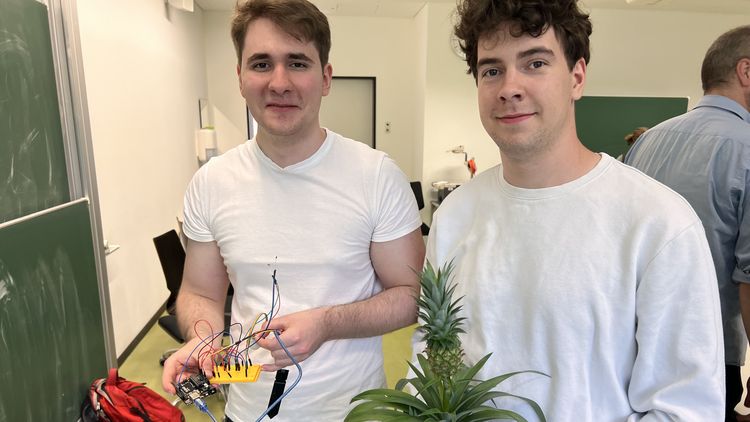
Leon and Louis have even taught their pineapple plant to speak using measurement technology – and had to watch the cartoon series ‘SpongeBob SquarePants’ for hours on end to do so. After all, what voice could possibly have more expertise than that of a yellow sponge in trousers who lives in a pineapple himself? Thanks to soil moisture, light, temperature and motion sensors, ‘The Dramatic Pineapple’ now knows what it’s missing and can call out to its passing owner with a fitting SpongeBob quote. Handy.
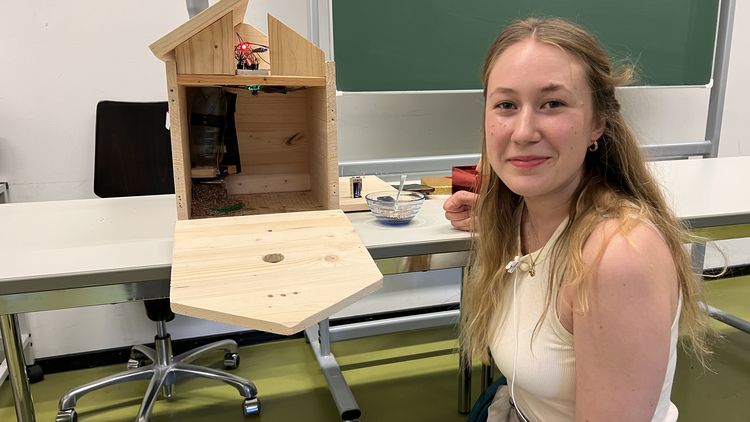
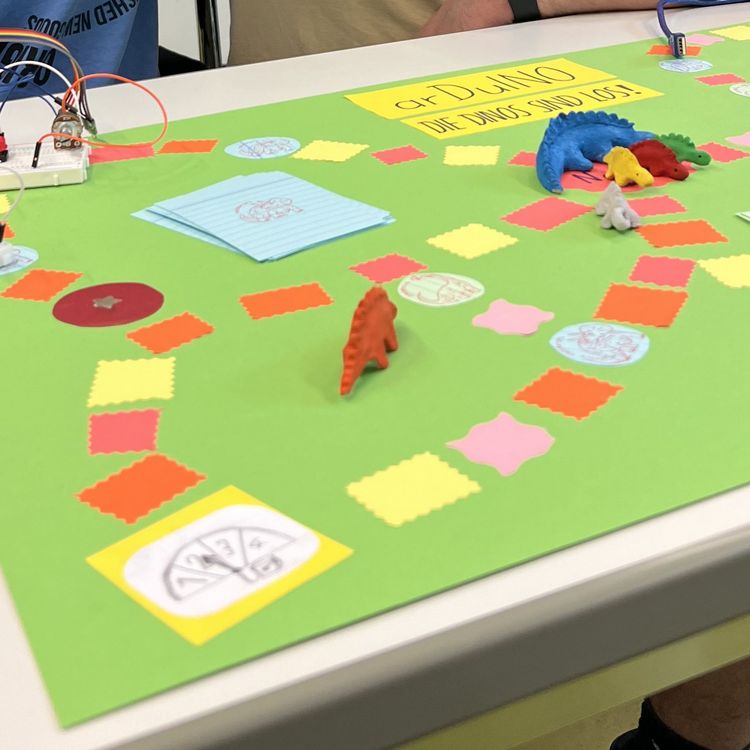
A dinosaur board game with an electronic dice and electronic mini-games, a bird feeder that automatically dispenses the right amount of food when a bird flies in, or a ‘Useless Box’ whose sole purpose is to switch itself off in as many different ways as possible once switched on – this year’s student inventions are certainly very creative. However, in their presentations, they also explain just how tricky even such ‘fun projects’ can be. Too few slots on the hardware board, inconsistent measurement results, underpowered motors or extremely complicated programming for a touchscreen posed challenges for the students.
Meyer is clearly pleased with his students’ achievements. “Tomorrow I’m sure my mouth will be sore from all the grinning,” he says, bringing the course to a close. The next crazy inventions are sure to be just around the corner. The next ‘Physical Measurement Technology’ lecture will take place in the summer semester of 2024.